


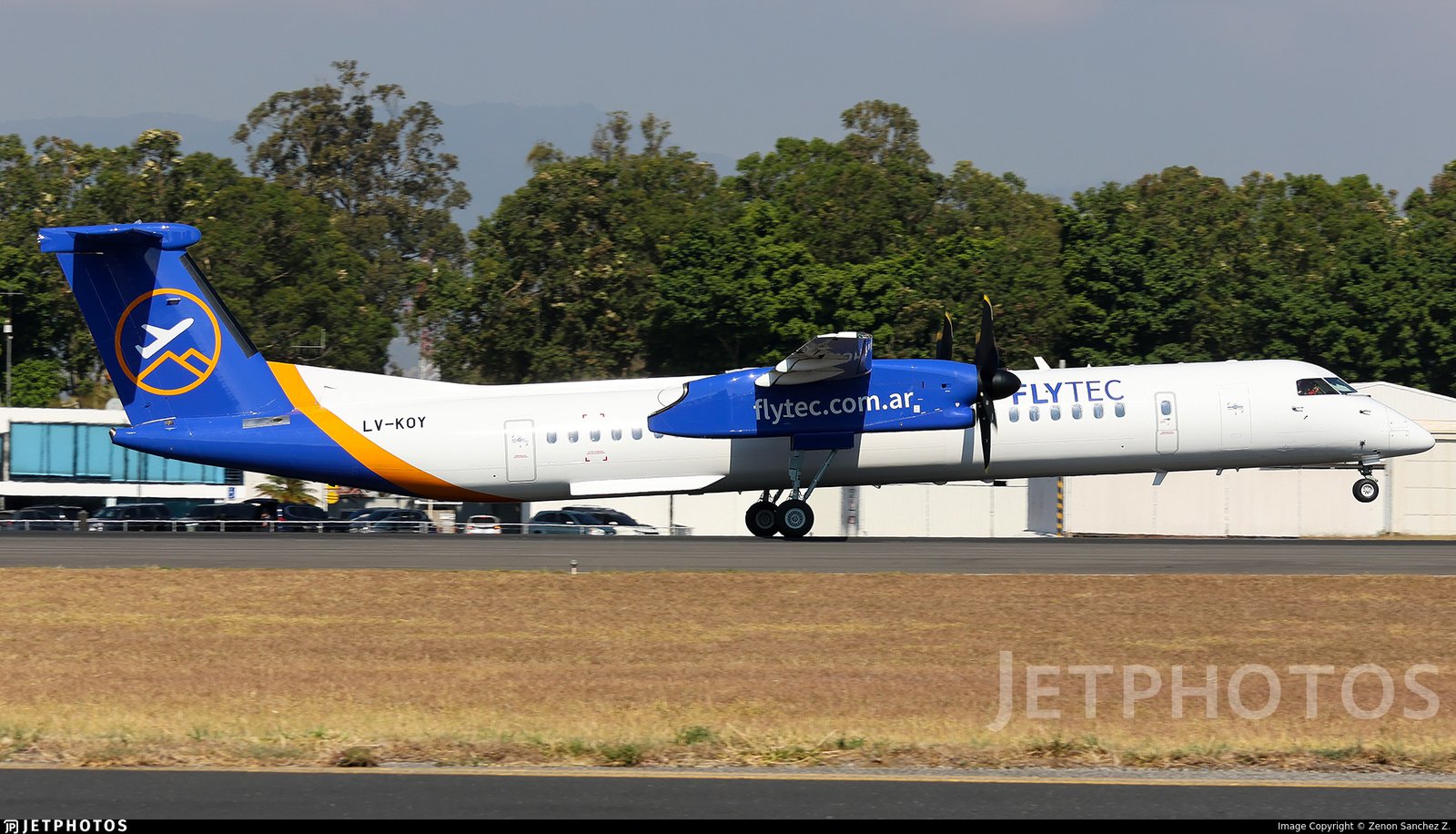
A historic milestone for South America took place in March 2026 with the introduction of the first Dash 8-Q400 to an Argentine airline, which completed a long delivery flight that began some 25,000 kilometers away in late January.
Following the success of the DHC-2 Beaver and the DHC-6 Twin Otter, de Havilland Canada started developing a new passenger aircraft in the 1970s, designed for the 50-seat market. It was named the DHC-7, later popularly known as the Dash 7, and made its maiden flight on March 27th, 1975, entering commercial service on February 3rd, 1978.
The higher operating costs of the DHC-7 for airlines led de Havilland to deliver fewer aircraft than expected, prompting the company to respond quickly by launching a new turboprop by mid-1980: the Dash 8.

At that time, the aircraft known as the DHC-8 was designed to meet short-field performance requirements and was a modified version of the Dash 7, featuring more powerful engines. The Dash 8-100 conducted its first test flight on June 20th, 1983, with the first delivery taking place in 1984 to NorOntario, a Canadian airline that operated between 1974 and 1996.
De Havilland Canada was acquired by Boeing in 1986, which boosted the development of the Dash 8 with the aim of competing against Airbus in Canada. Air Canada was about to place a major order, and Airbus and Boeing were competing to see who would get it.

In the end, Air Canada decided to order more than 30 brand-new Airbus A320-200s, marking a defeat for Boeing in its competition with Airbus. Following this, Boeing, along with other adjustments, opted to sell the assets it had acquired from de Havilland six years earlier, being purchased by Bombardier in 1992.
By the 1990s, the turboprop aircraft market had grown significantly, capturing the interest of airlines worldwide, as these aircraft have lower operating costs than jets, are capable of serving routes with lower passenger demand and can operate on shorter runways. Towards the end of the decade, Bombardier Dash had four variants of the Dash 8 in production, ranging from the -100 to the -400.

The most successful version of the Bombardier Dash 8 is the Dash 8-Q400, with more than 600 aircraft produced since 1999, though only about 590 have been delivered. In second place is the -100 version, with nearly 300, followed by the -300 with 267 and the -200 with 105 aircraft delivered.
In 2019, Longview Aviation Capital acquired the entire Dash 8 program and the de Havilland Canada brand from Bombardier for a total of $300 million. Longview Aviation Capital decided to revive the de Havilland brand, restoring the name “de Havilland Canada Dash.”

On December 23rd, 2005, the Bombardier DHC-8-402 Dash 8-Q400 with serial number 4118 performed its first test flight. As with most Dash 8 aircraft, the airplane was manufactured at Toronto Downsview, an airport that the company used for the production of its Dash program.
Due to the COVID-19 pandemic, De Havilland halted production of the Dash 8 in 2021 amid low demand for orders from airlines. In addition, the lease agreement for the Downsview facility expired in 2023, forcing De Havilland to seek a new facility to continue production.
De Havilland Canada expects to open new facilities shortly.

Returning to the Dash 8 with serial number 4118, the aircraft was delivered to Flybe in April 2006, having departed for Europe brand-new from the factory in March of that year. Flybe was one of the leading operators of the Dash 8 in Europe, with around 90 aircraft in service, including the Dash 8-Q200, Dash 8-Q300, and Dash 8-Q400 variants.
Flybe had 79 Dash 8-Q400s in its fleet, receiving the registration G-JECM the protagonist of this story. The airline ceased operations due to its delicate economic situation in March 2020, returning all its operational aircraft at that time to their respective lessors.
This Dash 8, which was nearly 15 years old in 2020, was parked in Southampton until mid-2020, when it was ferried to Maastricht, remaining there for the next five years.

Under registration number N4118M, the aircraft took off from Aachen Airport in the Dutch city on August 21st, 2025 heading to Malta on a ferry flight, where works began to join Flytec, an Argentine airline that operates charter flights for the mining industry.
The Dash 8 arrived still sporting Flybe’s livery, which it retained until November 2025, when it was repainted with Flytec’s livery. On January 30th, 2026, it operated a test flight prior to its delivery to Argentina, and on January 31st, 2026, it departed from Malta for Canada.

On that same day, the aircraft arrived at Reykjavik Airport (RKV) following a stopover in Copenhagen. The day after, it left for Goose Bay, finally landing in Muskoka on February 1st at 13:47 local time.
Muskoka Airport is home to a maintenance and freighter conversion facility for the Dash 8-Q400, and Flytec’s Dash 8 was sent there for maintenance. After the work was completed, it took off from Muskoka on February 19th, bound for Calgary, where another facility for Dash 8-Q400 aircraft is located.

Prior to its ferry flight between Muskoka and Calgary, the Dash was assigned a Canadian registration number, which it retained for approximately two weeks. As C-FKUZ, it landed in Calgary on February 19th at 16:01 local time after a flight of 4 hours and 37 minutes.
Finally, on March 11th, it resumed its delivery flight to Flytec, after being on hold for almost 40 days due to maintenance work in Canada.

At 09:06 local time, it left the Canadian city for Midland, a U.S. city located in Texas, about 530 kilometers from the state capital. Following a one-hour stopover, the journey continued to Guatemala City, completing the first day of the delivery flight.
The crew completed the longest leg of the trip on March 12th, covering the route Guatemala City-Guayaquil-Lima, flying nearly 3,700 kilometers over more than six hours. On March 13th, they flew the Lima-Arica-Buenos Aires route, although the Argentine capital was not their final destination.

Flytec, the Argentine airline that introduced the country’s first Dash 8-Q400, is based at Martín Miguel de Güemes International Airport in Salta, an Argentine city located about 1,300 kilometers from Buenos Aires and nearly 350 kilometers from Bolivia.
The airline specializes in operations in Argentina’s mountainous region, all of which are centered on flights to/from Salta, providing charter services specifically for transporting mining personnel. Flytec operates on runways located at altitudes above 10,000 feet, some of which are paved and others unpaved.

Its fleet consists of three Beechcraft B200s and three Beechcraft B1900Ds, with the addition of a De Havilland Canada Dash 8-Q400, registration LV-KOY. Furthermore, according to its website, the company is in the process of incorporating its first helicopter, an Airbus H125.

On March 14th at 15:23 local time, the Dash 8-Q400 departed from Ezeiza Airport in Buenos Aires bound for Salta, where it landed at 17:50 local time. Upon arrival, it was welcomed with a water salute alongside airline employees.
As for its maiden flight in Argentina, it took place on March 20th, operating between Salta and an unpaved runway located in the Puna region, in the Andes Mountains. These flights cover approximately 190 kilometers, which the Dash completes in 30 minutes. The unpaved runway where it lands and takes off has thresholds 14 and 32 and is about 3,000 meters long.

Cover photo: © Zenon Sanchez Z. – JetPhotos (Guatemala City, Guatemala)
