


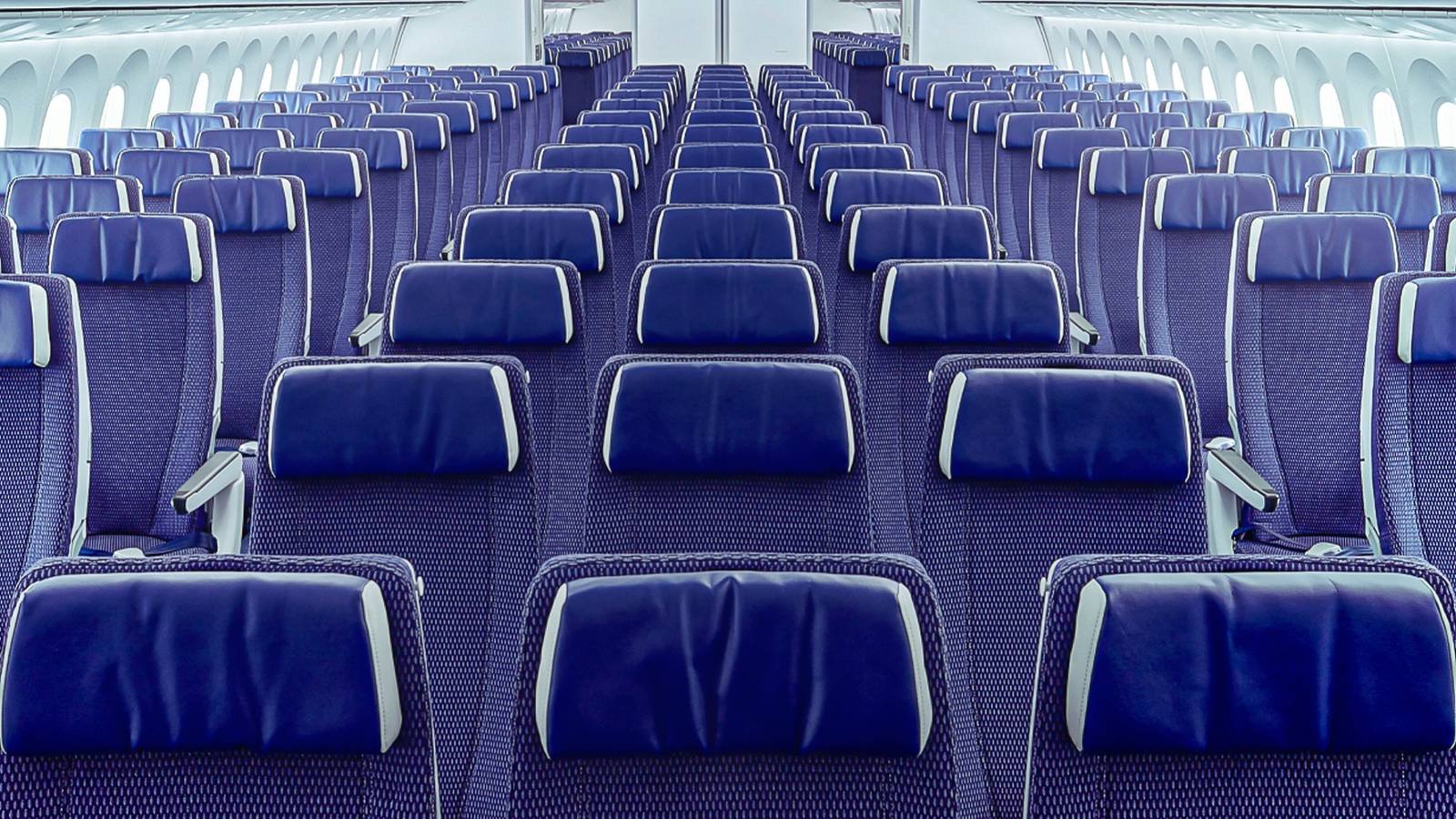
Seat pitch is something that should be simple and relatively standard. Two words and one measurement; yet, the difference between 30 inches (76.2 cm) and 35 inches (88.9 cm) is the difference between arriving and surviving. Today, the average economy class cabin offers you 30 to 31 of those inches. Down from 35 inches in the 1970s, time has brought with it a slow erosion, a quiet surrender to the balance sheet. But not everyone has surrendered to this fate.
What follows is not a ranking of premium economy cabins or extra-legroom tiers where space feels almost unlimited. Instead, this list focuses exclusively on standard economy, the seat of the people. While the US market continues to densify, it is the East Asian carriers who have become the true benchmark for spatial generosity. Six airlines and six decisions to protect the geometry of the cabin, all offering something unique to today’s airline market.
Emirates Airlines
32-34 inches
From the gold-plated luxury of the UAE’s global leader, you can expect to find 32 to 34 inches (83.8 to 86.4 cm) of pitch. On paper,  Emirates‘ economy sits comfortably among the world’s most generous cabins. In practice, that generosity is specific; it lives most consistently on the Boeing 777 fleet, and this is not a cabin-wide promise. It is a fleet-specific detail that most passengers never think to check before they book.
The conflict within these seats is real, almost too obvious. While the knees have room, the shoulders do not. Emirates configures its 777 in a ten-abreast, three-four-three layout, one of the densest configurations on a widebody aircraft, and it feels dense onboard. The result is a seat width of approximately 17.2 inches (43.7 cm), meaning there is a generous pitch but compressed width. Ultimately, space is given with one hand, and taken with the other.
The newer Airbus A380 and Airbus A350 fleets, which are the aircraft Emirates markets most heavily, offer a similar pitch, but the older 777 still holds its weight and is being enhanced further with retrofits. The older 777 is, quietly, holding a world-class economy product to the surprise of many; a hidden comfort pick hiding in plain sight.
Oman Air
34 inches

Not too far away from Emirates’ Dubai hub, you can find 34 inches (86.4 cm) of pitch on a widebody fleet. That is the number  Oman Air quietly offers on select Boeing 787 configurations on long-haul routes, a figure that places a boutique Gulf carrier in the same conversation as some of the world’s finest. Nobody tends to talk about Oman Air in the context of economy comfort, and that is precisely what makes it special.
The discrepancy within the wider fleet, however, is stark. Step onto a narrowbody Boeing 737 and that generosity disappears, and 30 to 31 inches (76.2 to 78.7 cm) becomes the reality on shorter regional sectors. Oman Air is a widebody story exclusively for this exceptional amount of space. Book the 787 on the Muscat to  London route, and the experience is fundamentally different to what the airline’s modest reputation might suggest.
This, summed up concisely, is stealth comfort. No marketing campaign and no premium tier rebrand; just 34 inches (86.4 cm) of standard economy pitch on a Dreamliner, connecting the Middle East to Europe at a price point that rarely commands a second look, until you sit down and find you are pleasantly surprised by the surrounding space.

It Took Oman Air 3 Years To Join The oneworld Alliance: Here’s Why
Most airlines take around a year to join an alliance.
Korean Air
33-34 inches

33 to 34 inches (83.8 to 86.4 cm) of pitch and 18.1 inches (46 cm) of width is what Korean Air‘s Boeing 777-300ER economy cabin delivers in a three-three-three configuration that the rest of the industry has largely abandoned. Where rivals densified, Korean Air held its ground, and the product is measurably better for it. While the brand may have been modernized and refreshed, the core product itself has stayed true to tradition.
The story behind that decision is remarkable. Korean Air attempted to follow the industry and reconfigure its 777 fleet to a ten-abreast layout. The South Korean government intervened and blocked the wider rollout, ruling it would breach commitments made as part of the airline’s merger with Asiana Airlines. One aircraft was already retrofitted before the halt, and the rest of the fleet kept its nine-abreast geometry, not by choice, but by mandate.
Configuration | Seating Layout | Seat Pitch | Seat Width | Passenger Experience |
Nine-Abreast (Current) | 3-3-3 | 33–34 inches | 18.1 inches | Superior hip room; maintains a wider aisle and greater lateral clearance. |
Ten-Abreast (Industry Standard) | 3-4-3 | 30–31 inches | 17.0–17.2 inches | High-density layout; reduced shoulder room and narrower aisles to accommodate the extra seat. |
The result is an 18.1-inch (46 cm) seat that is physically impossible to replicate on a densified 777. Ten-abreast configurations generally compress width to approximately 17.2 inches (43.7 cm), and that missing inch matters more than it sounds. It is the difference between a long-haul flight and an endurance test, which in reality no one truly wants to pay money for.
All Nippon Airways
34 inches

With 34 inches (86.4 cm) of pitch across the widebody fleet, that alone places All Nippon Airways (ANA) among the world’s most generous economy cabins, but in 2026, the airline is going even further. New 787-9s are set to enter service with the Recaro R3 economy seat, a product that does not just maintain that pitch, but also makes every millimeter of it feel larger. ANA’s approach is to focus on the physical seat itself first before thinking about seat pitch.
The engineering detail is what separates this from a simple seat swap. The space around the knees on the R3 has been redesigned to provide an additional one inch of knee space, and the recline is increased by two inches, one and a half times that of the outgoing seats. That recline figure reaches six inches (15 cm). In an industry where four inches is standard, seven is a statement. The literature pocket has been moved to the top of the seatback, returning knee space that was previously lost to storage.
What ANA is doing here is the precise opposite of the American slimline movement, where US carriers strip padding to create the illusion of space. Instead, ANA is engineering real space, perceived and actual. While 16 further Dreamliners await retrofitting from 2027, there are already aircraft setting the new standard. In short, ANA is doing far more than recognizing what passengers want; they are delivering on that in real time with a clear plan.
Japan Airlines
33-34 inches

Boasting 33 to 34 inches (83.8 to 86.4 cm) of pitch combined with a seat width of 18.9 inches (48 cm), those two numbers together tell the Japan Airlines (JAL) story better than anything else. While most competitors offer just 17 inches (43 cm) of seat width on the 787, JAL’s Sky Wider cabin delivers nearly two additional inches of space, and it does so without charging a premium tier surcharge.
JAL is the only global 787 operator still maintaining an eight-abreast, two-four-two configuration in economy. Every other Dreamliner operator moved to nine-abreast to get those extra paying passengers. JAL has persistently framed this decision as providing new spacious economy on international routes, and in 2026, that philosophy is being doubled down on with a sweeping 787-9 cabin modernization program unveiled at the Singapore Airshow. The eight-abreast is being preserved and refreshed, and there are no signs of it being left out any time soon.
The Sky Wider seat is an engineering rejection of the Boeing-suggested nine-abreast layout, a deliberate choice to sacrifice one seat per row in exchange for a far more unique and different product. Skytrax’s 2025 awards singled JAL out for having the world’s best economy class seat, and that is not an accident. It is the result of a decision made years ago and defended every year since. If anything, it’s the mass movement away from this configuration that has given JAL the upper hand.

The Airlines With The World’s Widest Economy Seats In 2026
Beyond some Asian airlines, the best way to get extra space between other economy class passengers is to focus on the aircraft type.
Air Premia
35 inches

After looking at the previous airlines and the strides they are making for seat pitch offerings, 35 inches (88.9 cm) of pitch is something truly eye-catching. For South Korea’s Air Premia, that number is not a marketing claim; it is literally built into the branding, with the Economy 35 cabin name reflecting the exact seat pitch in inches. No other airline in the world has made a specific pitch measurement the centerpiece of its product identity, and this hybrid carrier has built an entire commercial proposition around longitudinal space.
There is a real caveat that is worth understanding before you book. The 787-9 is configured in a nine-abreast, three-three-three layout with approximately 253 economy seats, giving standard width and extraordinary length. A tall passenger gains everything in front of them and surrenders nothing behind. The shoulder room, however, is identical to any other nine-abreast Dreamliner. This is a product engineered for the long-legged traveler who knows exactly what they are optimizing for. Air Premia’s decision to remove seats and increase pitch is a rare example of an airline choosing passenger comfort over revenue potential per flight.
The 35-inch figure currently applies to specific aircraft within the fleet. Air Premia plans to standardize a minimum of 33 inches (83.8 cm) across all nine 787-9s by the end of 2026, a fleet-wide commitment to space that no US carrier comes close to matching. Three aircraft already deliver the full 35 inches, and the rest are being reconfigured. While the rest of the industry compresses, Air Premia moves in its own path and expands.
