


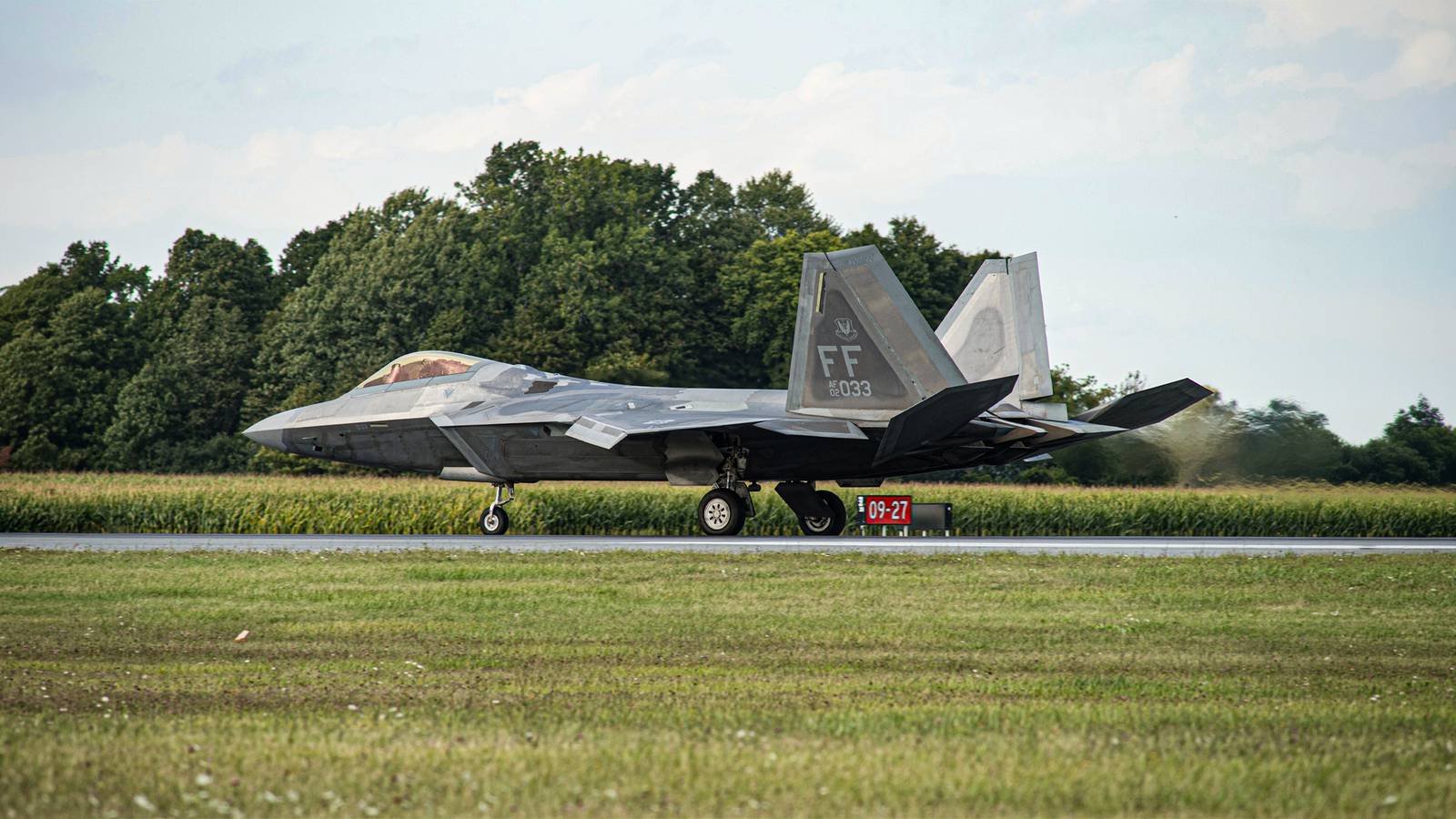
Does the Lockheed Martin F-22 Raptor still outperform modern fighter jets? Short answer: No, the newer Lockheed Martin F-35 Lightning II outclasses it. The longer answer is that it depends on what capabilities are being emphasized. The Raptor was built as a dedicated air dominance fighter and is considered the world’s leading fighter jet in the air-to-air dominance role. Meanwhile, the F-35 is generally regarded as coming second in that role and a more advanced multirole fighter overall.
The F-35 was designed as a strike fighter to carry out air penetration missions and destroy enemy air defense. It outclasses the F-22 in all-important sensor fusion and networking, as well as benefiting from more modern radar-absorbent materials (aka stealth paint). That said, there are a number of areas where the F-22 excels, thanks to its niche air dominance role. While the F-35 may win as a flying supercomputer, the F-22 wins in more classic fighter jet metrics.
7
Air Dominance
Only 187 examples were procured
As stated, the F-22 is optimized for air dominance, unlike the F-35, which is built from the ground up as a true multi-role fighter. To be fair, the F-22 is a multirole fighter and is able to carry out ground strikes, but it remains highly specialized. This specialization was also something of its downfall. Due to specialization and expense, it was only procured in low numbers (187 vs 750 originally planned) and never exported. The lack of exports is due to both few air forces interested in it (perhaps just Japan, Australia, and Israel) and, more importantly, the US imposing an export ban on it.
The F-22’s primary job is to sweep enemy fighters, deny airspace, and escort high-value assets like tankers and AWACS. For the Raptor, everything else is secondary. To this end, its frontal stealth is prioritized, its internal weapons bay is tailored for air-to-air missiles like AIM-120 AMRAAMs and AIM-9 Sidewinders, it has high thrust-to-weight ratios, supercruise, and large control surfaces.
Its sensors and information are built around finding enemy aircraft, whereas the F-35 is optimized for battlefield awareness across domains. It is designed for persistence in contested airspace and more. This all makes the F-22 something of a very expensive one-trick pony that is also rivaled in that particular trick.
6
Lowest Radar Cross-Section
Reported RCS of 0.0001 m2

The F-35 Lightning II has an extremely low radar cross-section, but the F-22 is considered even lower. These RCS returns are classified and vary depending on where the aircraft is being observed. The figures given by Globalsecurity.org are estimates (real values are classified), and the values are only for frontal returns.
According to Globalsecurity.org, the F-22 Raptor still has the lowest RCS of 0.0001 m2 while the F-35 has a frontal RCS of 0.005 m2. These are both far lower than any other fighter jet in service, including Russia’s semi-stealthy Su-57. Like the F-35, the F-22 carries its munitions internally, and both have stealth-optimized engines. The Russian Su-57 is still powered by old, non-stealthy engines.
The closest international competitor to the F-22 is generally considered the J-20 Mighty Dragon. However, the J-20 does not appear to be optimized to take on the F-22 directly; instead, it appears to be designed with the low-observability and range needed to hit the F-22’s enablers, like tanker aircraft.

The Striking Differences Between The F-22 Raptor & F-35 Lightning II
F-22 vs F-35: 2 fifth-generation fighters with unique strengths: speed and air dominance vs multirole flexibility. Discover what truly sets them apart
5
The F-22’s Supercruise
Sustain Mach 1.5 without afterburners

One of the most notable aspects of the F-22 Raptor in terms of flying performance is that it can supercruise. It can sustain supersonic speeds of over Mach 1.5, without the use of afterburners. This allows the Raptor to expand its combat radius and overall time in the air and shorten its transit times. Supercruise also reduces the Raptor’s infrared signature.
While Russia loves to demonstrate the acrobatic performance of the Su-57, that aircraft has not demonstrated the ability to sustain supercruise. The Chinese J-20 has also not demonstrated its ability to supercruise. As stated, the Su-57 is not yet equipped with its intended optimized engines AL-51F1, which remain in testing.
Most J-20s are also powered by the suboptimal WS-10 engines, with China only recently able to integrate the modern optimized WS-15 engines into the aircraft. The F-35 is designed for a different mission set. Whereas the F-22 has a top speed of around Mach 2.2, the F-35 maxes out at around Mach 1.6. The F-35 emphasizes stealth and penetration over speed.
4
First-Look, First-Shot, First-Kill Advantage
108:0 initial reported victory ratio in 2006 (not representative for 2026)

While it is unclear how the F-22’s first-look, first-shot, first-kill advantage compares with the F-35, it is considered superior to all other foreign fighter jets flying today. The F-22 has advantages like a lower RCS, allowing it to get closer without being detected compared with the F-35, although the F-35 is more heavily networked, allowing it to leverage ground-based, air-based, and space-based systems to a greater extent.
All in all, the F-22 has the ability to see and engage almost any other fighter jet in the world before that hapless aircraft even knew there was a fight to be had. The F-22 is so advanced that the rare occasions that it loses in exercises against 4th-generation fighter jets (e.g., Eurofighters) are reported as news. That’s an example of the exception proving the rule.
When the F-22 first entered service in the 2000s, it had absurdly high kill ratios from Red Flag exercises at around 144:0 or 106:0 in Northern Edge in 2006. Other reports in 2017 say the F-22 achieved around 41:1 victory ratios when paired with F-15s. Some analysts argue that the F-22’s real-world performance would be much lower, although the ratio would still be in its favor. The F-22’s advantages have eroded over time, which is why the US Air Force is rushing to develop the successor F-47.
3
Stealth Tanks
2x 600-gallon stealth tanks

The F-22 Raptor was first observed flying with stealth drop tanks in 2024, and this makes it the first 5th-generation fighter jet to be able to extend its range with stealth drop tanks. The F-22 can carry regular, unstealthy tanks externally, although this undermines its stealth. As threats have increased, like the J-20 being able to hit KC-46 tankers, the need for the F-22 to have a longer range has grown.
As of 2026, there doesn’t appear to be any evidence that stealth drop tanks have been developed for the Russian Su-57 or the Chinese J-20, although the J-20 is thought to have a long range due to its large fuel capacity. There are unconfirmed reports that Israel developed stealth drop tanks for its F-35Is. If true, then they are likely the only other stealth tanks in service.
The War Zone reported on the upgraded F-22 in 2026, saying, “The new faceted, low-drag tanks, like the older ones, can be jettisoned from the jet to restore the full scope of its performance and further reduce its radar cross-section. However, Lockheed Martin says it expects the F-22 to go into direct combat, at least in some scenarios, with the tanks fitted.”

Which Country Has The Most Powerful 5th-Generation Fighter Jets In The World?
The United States has the world’s most advanced fighter jets, with China also rapidly developing its own advanced fifth-generation fighters.
2
AN/APG-77 AESA radar
First operational in 2006

The Northrop Grumman AN/APG-77 AESA radar is one of the core pieces of the F-22’s capabilities. Northrop Grumman says, “AN/APG 77 provides superior battlespace situational awareness that translates into lethality and survivability.” It is considered one of the most capable fighter radars ever developed and is optimized for air-to-air “first-look, first-kill” in stealth scenarios.
Ongoing Raptor upgrades are modernizing the AN/APG-77 radar with software improvements and other enhancements to its dynamic synthetic aperture radar (SAR). This will provide even better high-resolution ground mapping for strike missions. Arguably, the AESA radar rivaling it is the F-35’s AN/APG-81 radar.
That F-35 radar is about to be replaced in US service by the next-generation AN/APG-85 AESA radar. Delays in this radar mean that currently, F-35s are being delivered to the US without radars; they are intended to be retrofitted when the APG-85 enters service, perhaps next year. The holdup is not impacting exports as the US has not approved the AN/APG-85 radar for export; those remain fitted with the APG-81.
1
First To Have Loyal Wingman Drones
First CCAs planned for 2029

The F-22 is slated to be the first US Air Force fighter jet to receive Collaborative Combat Aircraft (CCA), also known as loyal wingman drones. According to reports, it will get its first autonomous loyal wingmen in 2029 before the US Air Force rolls them out for its other fighter jets, like the F-35.
To be fair, it is unclear how far along other countries are at integrating loyal wingman drones into their air forces. The German Air Force also wants to introduce advanced combat drones in 2029, but it is unclear how autonomous and “wingmany” these initial drones will be. Russia is developing drones, and it used one in combat in Ukraine in 2024.
However, that drone, a Sukhoi S-70 Okhotnik-B, was deliberately destroyed by its Su-57 parent after it malfunctioned. It is also unclear how much of an apples-to-apples comparison this is with the US’s CCA program, especially in the degree of autonomy. China is developing various types of combat drones and loyal wingman drones and parading them about, but it’s unclear how close these are to being operationally ready.
