


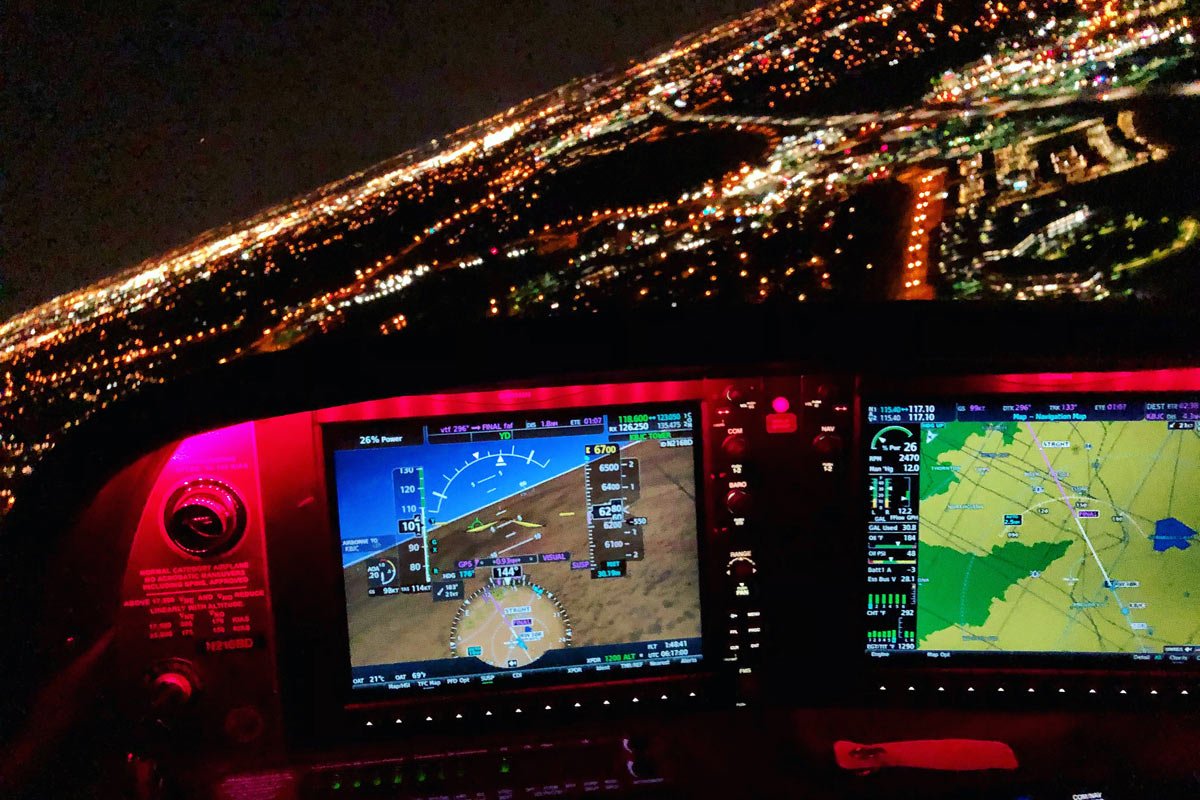
Before you head out for your next night flight, keep these hazards in mind...
1) Night Vision
Your eyes need about 30 minutes to adjust to the darkness. And if you’re using a flashlight in the cockpit, make sure it has a colored lens on it. White light can destroy your night vision in seconds.
2) Strobe Lights
In most cases, you shouldn’t use your strobe lights until you’re ready for takeoff. Strobe lights can blind other pilots on the ramp, as well as during taxi. In this picture, we’re using our nav lights until we get to the runway. At that point, we’ll turn on our strobes for takeoff..
3) Autokinesis
If you stare at a single light, it can appear to start moving. Keep scanning the horizon to prevent it from happening to you.
4) False Horizon
The right combination of street lights or clouds can make a false horizon appear. Bottom line: trust your instruments!
5) Black hole effect
If you’re flying into an airport with few lights around it, it can be incredibly difficult to judge your height and distance from the runway. To avoid flying a lower than normal approach, use the VASI/PAPI lights, and if the runway has an ILS, dial in the frequency and follow the glide slope on final.
6) Traffic Pattern Procedures
Fly the traffic pattern the same way you would fly it during the day. By using consistent power, speed and configuration settings, you’ll come out on glide path when you turn final.
7) Runway lighting
When you’re approaching an airport, use high-intensity runway lighting (HIRL, 7 clicks on the mic) to locate the field. However, once you’ve found it, turn the lights down to low or medium intensity (3 clicks or 5 clicks) so you don’t blind yourself as you’re landing.
8) VASI/PAPI
If the runway you’re landing on has a VASI or PAPI, follow it. At night, it’s the best indication you have to fly a safe glide path to the runway.
Improve your landings for less than the cost of a flight lesson.
Do you have a perfect takeoff and landing every time? Neither do we. That’s why we built our Mastering Takeoffs and Landings online course.
Plus, for less than the cost of a flight lesson, you get lifetime access to tools that increase your confidence and make your landings more consistent.
