


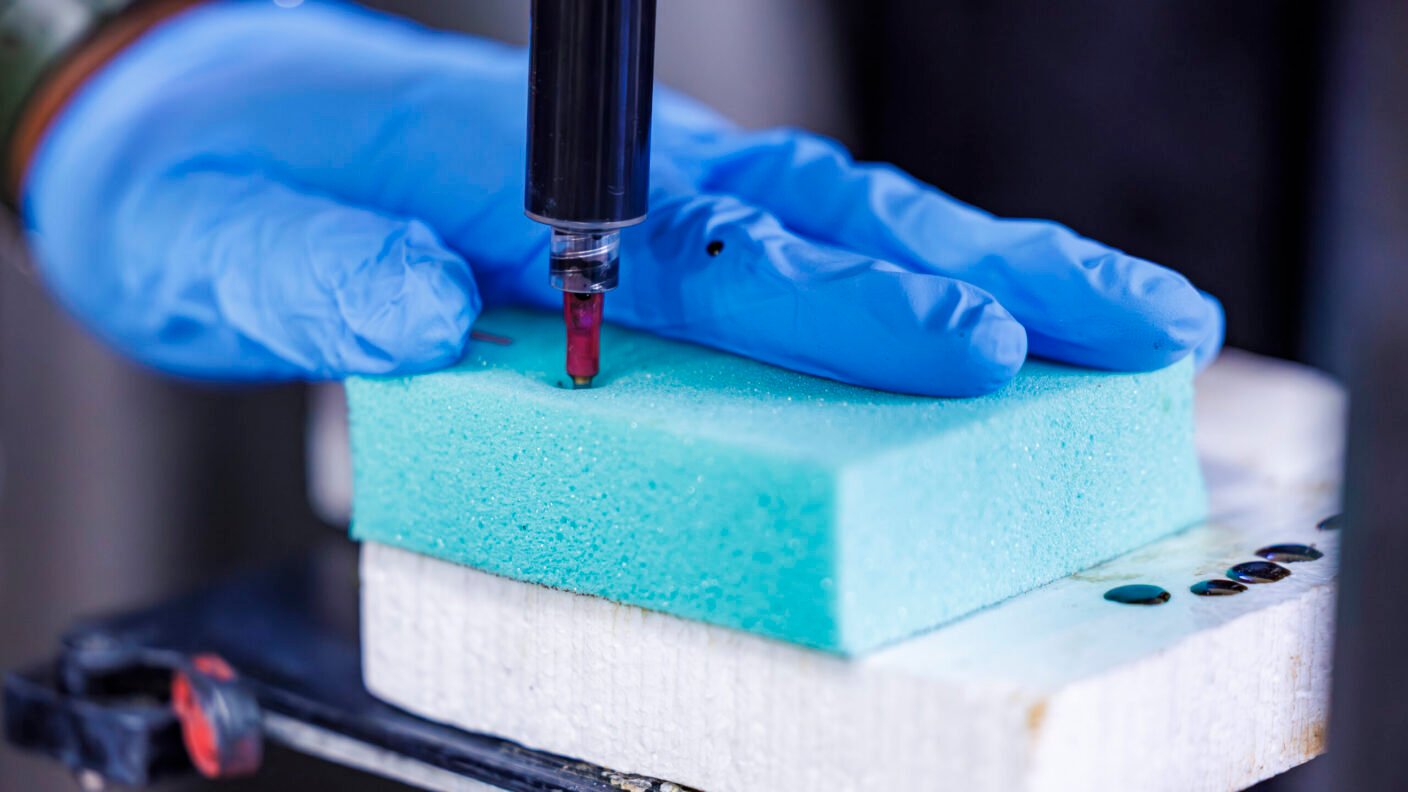
Researchers at Texas A&M University and the DEVCOM Army Research Laboratory have engineered a composite that absorbs up to ten times more energy than conventional padding, threading a 3D printed elastomeric skeleton through ordinary open-cell foam to deliver a material that is affordable and lightweight without sacrificing durability or performance.
The implications stretch well beyond protective gear, standing to reshape defense, automotive, aerospace, and consumer industries wherever energy absorption, weight reduction, and scalable production converge.
Published in the journal Composite Structures, the research was led by Dr. Mohammad Naraghi, director of the Nanostructured Materials Lab at Texas A&M’s College of Engineering, in collaboration with Dr. Eric Wetzel, team leader for Strategic Polymers Additive Manufacturing at ARL.

How the Two Materials Work Together
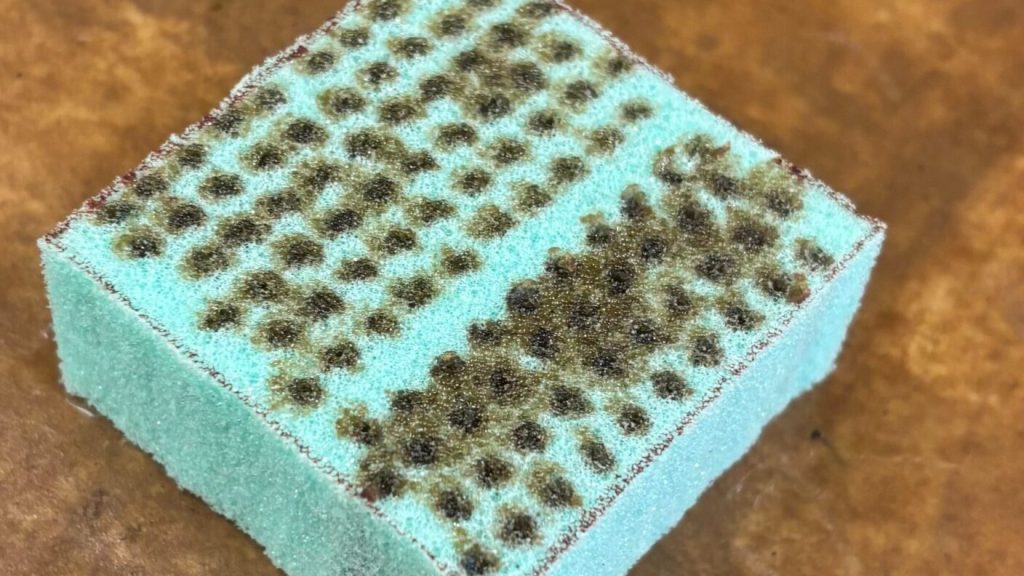
The manufacturing process behind the composite is called In-Foam Additive Manufacturing, or IFAM. Rather than fabricating a separate structure and combining it with foam afterward, IFAM deposits a network of stretchy plastic struts directly inside an existing foam block. The geometry of those struts, including their diameter, angular orientation, and spacing, can be adjusted through computer-controlled parameters to target specific mechanical outcomes.
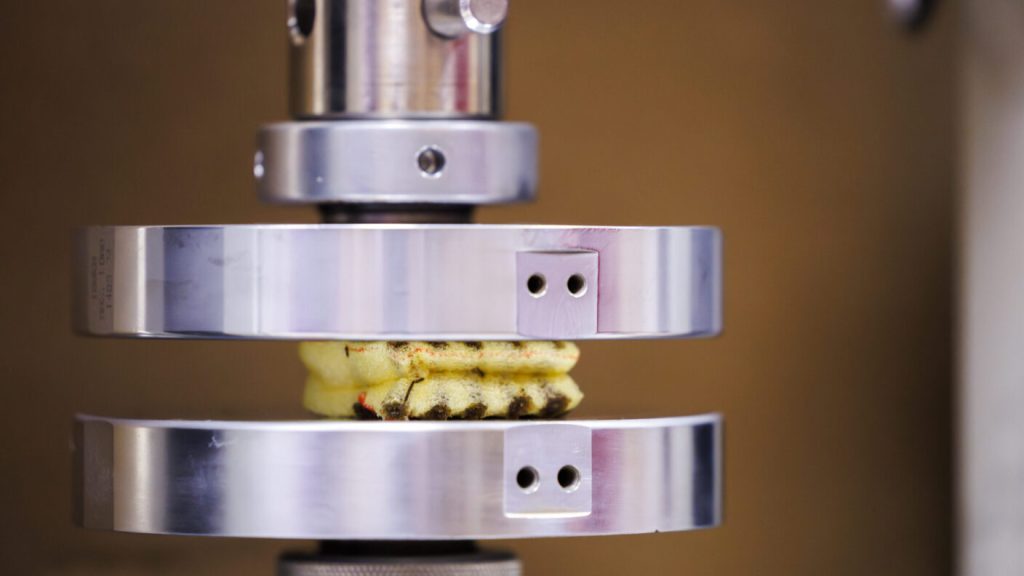
The physical interaction between the two materials is what makes the composite perform beyond the sum of its parts. During the initial phase of compression, the surrounding foam constrains the struts, preventing them from buckling prematurely. As pressure intensifies, the struts redirect force laterally into the adjacent foam, distributing stress across a wider area. This reciprocal load-sharing continues as compression deepens, enabling the composite to sustain higher forces for longer.

“The IFAM process combines the best of both worlds, providing a low cost, customizable, high performance composite energy absorber,” said Wetzel.
From Military Helmets to Passenger Seats
Army-sponsored from the start, the super foam’s first target is the battlefield. Military helmets must simultaneously stop ballistic projectiles and absorb blunt impact during falls, two demands that current padding handles poorly.
“Head and brain injuries remain a significant concern for the U.S. Army, and any material innovation that allows us to provide greater protection, while also managing comfort and keeping weights low, is a valuable step forward,” Wetzel said. “Furthermore, the IFAM process is easily transferrable to scaled, real-world manufacturing.”
The same material translates directly to civilian use. Bicycle, motorcycle, and sports helmets, car bumpers, door panels, and child safety seats are all on the team’s radar, applying the same energy-trapping principle to impacts on roads and highways.
Acoustic Control and Personalized Comfort
The composite’s tunable architecture also opens a second frontier: sound. Because strut geometry can be precisely configured, researchers believe targeted versions could trap and neutralize specific acoustic frequencies, cabin drone on aircraft, road noise in cars, or sharp resonance in buildings.
“The acoustic applications are still in the early research stages, but we would like to explore this property more, to turn the foam into an active sonic filter that outperforms current materials,” Naraghi said.
For everyday consumers, the same tunability enables zonal customization, engineering different firmness levels within a single mattress, chair, or cushion, mapped to a person’s body rather than a universal standard.
“With our hybrid foam, you could have different zones of your cushion tuned to your different preferences, firm for the neck, soft for the back, and medium for the legs. It could be entirely customized to a person’s needs, comfort and physiology,” Naraghi said.
Challenges and Limits
The composite’s most immediate limitation surfaces under repeated impact. Testing showed a 25% drop in plateau stress after the first compression cycle, likely caused by partial debonding at the foam-strut interface. Performance stabilizes sharply after that point, losing only an additional 4% across the next nine cycles, but the first-strike penalty is a concern for applications where a helmet or safety seat must perform at full capacity from the moment of initial impact.
Additionally, the study was conducted on small laboratory specimens with a resin working window of under an hour, meaning the precision achieved in controlled conditions has yet to be proven at the industrial scale the researchers are targeting.
A Field Moving in One Direction
The convergence of additive manufacturing and foam is no longer an emerging idea, it is becoming the dominant design philosophy across research labs and industry alike.
Two parallel efforts make that trajectory clear. EOS, Arkema, General Lattice, and DyeMansion, formalized it commercially through the Digital Foam Architects network, a coalition built around 3D printing flexible lattice structures that replicate and exceed foam-like behavior in consumer, medical, and industrial products. Separately, researchers at San Diego State University demonstrated that3D printed continuous carbon fiber meta-skins bonded to foam-core structures could be tuned to specific impact velocities. Each effort reflects that foam alone has reached its performance ceiling, and that additive manufacturing is the tool to push past it.
What sets IFAM apart is how far inside the material it goes. Where other approaches print around or on top of foam, IFAM embeds the structure within it, making the two materials mechanically inseparable rather than adjacent. That is precisely what positions the research not as another entry in a crowded field, but as the application of a new strategy in how deeply the two technologies can be unified.
3D Printing Industry is inviting speakers for its 2026 Additive Manufacturing Applications (AMA) series, covering Energy, Healthcare, Automotive and Mobility, Aerospace, Space and Defense, and Software. Each online event focuses on real production deployments, qualification, and supply chain integration. Practitioners interested in contributing can complete the call for speakers form here.
To stay up to date with the latest 3D printing news, don’t forget to subscribe to the 3D Printing Industry newsletter or follow us on LinkedIn.
Explore the full Future of 3D Printing and Executive Survey series from 3D Printing Industry, featuring perspectives from CEOs, engineers, and industry leaders on the industrialization of additive manufacturing, 3D printing industry trends 2026, qualification, supply chains, and additive manufacturing industry analysis.
Featured image shows 3D printed plastic columns embedded in an ordinary foam forms a hybrid “super foam.” Photo via Texas A&M University.
