



UK-based metal 3D printing powder manufacturer Metalysis has secured nearly €1 million from the European Space Agency (ESA) to tackle two problems that have long unsettled Western aerospace: where to source titanium, and how to produce it more cleanly.
The ESA funding will support a 24-month project to develop the South Yorkshire manufacturer’s proprietary Fray, Farthing, and Chen (FFC) Cambridge electrolysis process from its current batch operation into a continuous or quasi-continuous one for titanium production, with applications intended for both space and non-space industries.
Titanium’s appeal to aerospace engineers has always been straightforward. It is strong, light, corrosion-resistant, and performs reliably at extreme temperatures. The difficulties have never been with the material itself but with the world around it.
Before 2022, Russia supplied much of the titanium sponge used by Western aerospace manufacturers. That supply is now effectively closed off, and China has moved in to fill the void, today accounting for around 70% of global output. For an industry that treats supply chain security as a near-engineering concern, that is an uncomfortable place to be.

A Cleaner Route to Titanium
The standard production method, the Kroll process, brings its own set of problems. It is multi-step by nature, requiring melting, thermomechanical processing, and high-purity raw materials at each stage. It depends on chlorine gas, produces significant quantities of hazardous waste, and is energy-intensive throughout. It works, but at considerable cost to both economics and the environment.
The FFC process was developed at the University of Cambridge in 1997 with those exact shortcomings in mind. Rather than following the Kroll route, it uses molten salt electrolysis to reduce titanium oxide electrochemically, yielding titanium directly in solid-state and bypassing the multiple melting stages that make conventional production so involved.
When combined with Powder Metallurgy (PM) for Near Net Shape (NNS) consolidation, it also eliminates the thermomechanical processing steps that add further time and cost to the traditional route. The output is titanium of higher purity, produced with lower energy consumption, fewer hazardous by-products, and more precise control over alloy composition. Metalysis holds the patent.
That process currently runs in batch mode through the manufacturer’s GEN-3 and GEN-4 reactors, a configuration that serves the AM sector adequately but falls well short of what the broader bulk titanium market demands. Shifting to a continuous or quasi-continuous operation is the central objective of the ESA project, and achieving it will require expertise well beyond what any single company holds.
To get there, Metalysis is leading a five-company consortium drawn entirely from the UK and EU. The British partners are Lucideon Ltd, TTP Plc, and NCHG Ltd, joined by Austria’s RHP-Technology GmbH, which contributes specific powder metallurgy expertise. Across the group, the consortium covers ceramics processing, materials science, electrochemistry, process development, and powder metallurgy, bringing together the full spread of disciplines the project demands.
Rt Hon. John Healey, MP for Rawmarsh and Conisbrough & UK Secretary of State for Defence said, “This is great news for South Yorkshire. Metalysis is a world-leading innovator, and this investment from the European Space Agency is a strong vote of confidence in the cutting-edge advanced manufacturing taking place right here in our region.”
The Race to Secure Titanium Supply
The urgency around securing Western titanium supply is being addressed on the other side of the Atlantic as well. In the United States, materials company IperionX secured a contract worth up to US$47.1 million from the US Department of Defense (DoD) to build a fully integrated domestic titanium supply chain, from mineral extraction through to metal production.
The funding covers two phases over two years, targeting both a critical minerals project in Tennessee and a titanium manufacturing campus in Virginia. Like the Metalysis project, it is built around proprietary non-Kroll production technologies, reflecting a broader recognition that solving the supply problem and production process problem are increasingly the same challenge.
The demand side of that equation is also shifting. In early 2026, Canadian titanium powder supplier Tekna received a purchase order for Ti-6Al-4V powder worth CAD 1.5 million for laser powder bed fusion (LPBF) 3D printing, placed by an undisclosed US defense Tier-1 supplier.
The volume represented a threefold increase over previous orders from the same customer, following a separate CAD 2.0 million titanium powder order from another US defense Tier-1 supplier announced just weeks earlier. Both orders extend deliveries through 2026, pointing to an AM sector where defense-driven demand for qualified titanium powder is not easing.
3D Printing Industry is inviting speakers for its 2026 Additive Manufacturing Applications (AMA) series, covering Energy, Healthcare, Automotive and Mobility, Aerospace, Space and Defense, and Software. Each online event focuses on real production deployments, qualification, and supply chain integration. Practitioners interested in contributing can complete the call for speakers form here.
To stay up to date with the latest 3D printing news, don’t forget to subscribe to the 3D Printing Industry newsletter or follow us on LinkedIn.
Explore the full Future of 3D Printing and Executive Survey series from 3D Printing Industry, featuring perspectives from CEOs, engineers, and industry leaders on the industrialization of additive manufacturing, 3D printing industry trends 2026, qualification, supply chains, and additive manufacturing industry analysis.
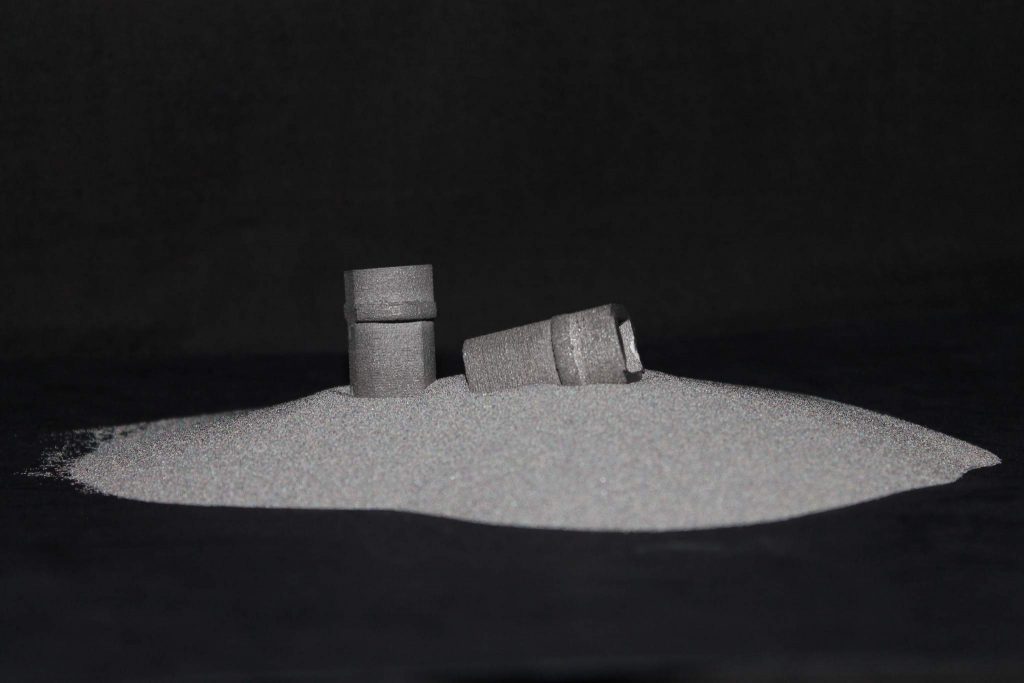
Featured image shows demonstration of the flow of Metalysis metal powders. Photo via Metalysis
