


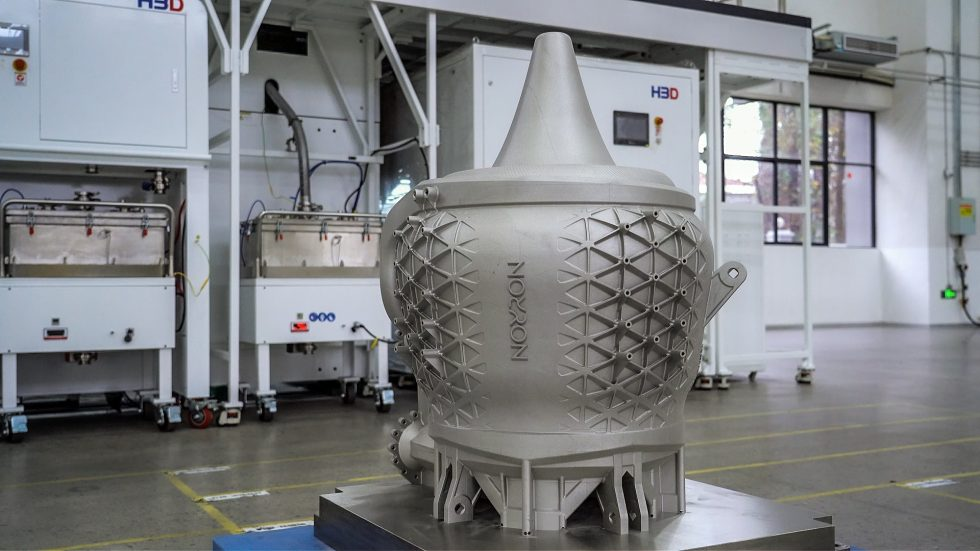
LEAP 71, a Dubai-based computational engineering company, and HBD, a Shanghai manufacturer of metal additive manufacturing systems, have produced a 3D printed aerospike rocket engine generating 200 kN of thrust. The one-meter-tall engine was exhibited at TCT Asia 2026 in Shanghai, where the companies presented the component as a demonstration of large-format metal additive manufacturing for aerospace propulsion.
The engine, designated XRA-2E5, was designed using LEAP 71’s Noyron computational engineering model and manufactured by HBD using its HBD 800 laser powder bed fusion system. According to the companies, the engine was printed as a monolithic part in Inconel 718 during a continuous build lasting 289 hours.

Large-format LPBF used to manufacture monolithic rocket engine
HBD states that the HBD 800 metal 3D printer used for the build features a ten-laser configuration and a build volume of 830 × 830 × 1250 mm, allowing production of large aerospace components in a single build. The companies report that the aerospike engine geometry includes internal channels and shallow overhang structures intended to test the limits of large-scale LPBF manufacturing.
The engine uses a cryogenic methane and liquid oxygen propellant system and incorporates regenerative cooling, with methane circulating through the outer chamber and liquid oxygen cooling the central spike. The design follows an aerospike architecture, which differs from conventional bell-nozzle engines by maintaining efficiency across a wider range of atmospheric conditions.
Josefine Lissner, CEO of LEAP 71, said the project was intended to demonstrate how computational design combined with additive manufacturing could enable propulsion geometries that are difficult to produce using conventional methods. Kevin Chen, Director of Marketing at HBD, said the build was completed on the first attempt, which the company described as a validation of the stability of its large-format LPBF platform.
Computational engineering model used for propulsion development program
The engine was generated using Noyron, a computational engineering model that produces functional mechanical designs based on physics-driven rules and manufacturing constraints. The XRA-2E5 follows two smaller aerospike engines previously developed using the same system.
The companies state that the 200 kN engine is intended for use in upper-stage propulsion for reusable launch vehicles and forms part of an ongoing propulsion development program conducted with Aspire Space for the Oryx spacecraft project.

LEAP 71 propulsion program scales toward reusable launch systems
The aerospike engine builds on LEAP 71’s ongoing propulsion development work, which has focused on using computational engineering and metal additive manufacturing to produce increasingly large rocket engines. In earlier testing, the company demonstrated smaller 20 kN methalox engines generated using its Noyron design system, part of a broader effort to validate automatically generated propulsion hardware through physical and hot-fire testing.
Subsequent work expanded the program toward larger propulsion systems, with LEAP 71 previously outlining plans to develop engines in the meganewton thrust class intended for heavy-lift and reusable launch vehicles. These projects form part of a longer-term strategy to combine computational design with additive manufacturing to produce complex engines that would be difficult to fabricate using conventional methods.
The propulsion research is linked to the Oryx spacecraft program being developed with Aspire Space, which aims to build a reusable launch system capable of operating efficiently across a wide range of flight conditions. Such vehicles require propulsion systems that maintain performance from sea level to vacuum, one of the reasons aerospike architectures have continued to attract interest despite their manufacturing complexity.
3D Printing Industry is inviting speakers for its 2026 Additive Manufacturing Applications (AMA) series, covering Energy, Healthcare, Automotive and Mobility, Aerospace, Space and Defense, and Software. Each online event focuses on real production deployments, qualification, and supply chain integration. Practitioners interested in contributing can complete the call for speakers form here.
To stay up to date with the latest 3D printing news, don’t forget to subscribe to the 3D Printing Industry newsletter or follow us on LinkedIn.
Explore the full Future of 3D Printing and Executive Survey series from 3D Printing Industry, featuring perspectives from CEOs, engineers, and industry leaders on the industrialization of additive manufacturing, 3D printing industry trends 2026, qualification, supply chains, and additive manufacturing industry analysis.
Featured image shows the XRA-2E5 rocket engine. Photo via LEAP 71.
