


![As seen from above, the Red Sands Ranch (1XS4) in Mason, Texas, acts as a secret aviation destination. [Credit: John Gilbert]](https://tbh.express/wp-content/uploads/2026/03/Airplane-Camping-in-Texas-Discovering-the-Red-Sands-Ranch-1XS4.jpg "Airplane Camping in Texas: Discovering the Red Sands Ranch (1XS4)")
Although Texas encompasses 171.9 million acres of terrain ranging from high desert to swampy marshes, it’s not a state that’s considered “open to the public.” With the Texas Parks & Wildlife Department considering it a “private lands state” at over 93 percent, it might seem like a place of last resort for a recreational pilot looking to skip their way from riverbed to mountaintop.
While airplane camping and off-airport flying may be more difficult, it all comes down to who and what you know when it comes to “flying the skies less traveled” across the Lone Star State.
Hidden Gem
Located 83 nm northwest of Austin and about 7 miles southeast of Mason, Texas (population 2,152) lies Red Sands Ranch (1XS4), a 2,950-foot long-by-60-foot-wide grass runway catering to adventurous aviators, airplane campers, and pilots looking to throw quite the party. Marked as a private airport on the VFR sectional chart, this is one of many “private” airstrips across the state of Texas open to the public.
Founded in 2003 by Austin resident and pilot John Gilbert, the ranch was born from a need for a new mission. After starting and selling a successful software company—an endeavor he said nearly ended in a heart attack—and enduring a retirement that lasted only two weeks, Gilbert realized he needed a project. This 250-acre stretch of land along the Llano River, a scenic tributary of the Colorado River, proved to be just that.
While Red Sands is a favorite fly-out destination for the local pilot community, it’s far from your typical rural grass strip. It functions primarily as a sprawling, high-end rental resort with the spirit of a boutique Texas waterpark. The crown jewel of the property (besides the airstrip) is a massive 53-foot free-form pool complex, anchored by a towering four-story water slide.
Beyond the pool, the ranch boasts nearly half a mile of river frontage where visitors can use provided kayaks and paddleboards to navigate the Llano River’s shifting rapids and calm pools.
The property, designed for constant activity, also features lighted courts for tennis, basketball, and pickleball, alongside a “Party Shed” filled with billiards and vintage neon decor for late night story swapping.
Overnight accommodations are eclectic, ranging from native-stone cabins and spacious bunkhouses to a renovated 1968 Airstream. At the heart of it all sits an open-air cabana, featuring a professional kitchen and large glass doors that can be closed to keep the social atmosphere warm during cool Texas Hill Country nights.
For those seeking a more rugged and economical escape, Gilbert has curated a dedicated space for airplane campers. Frustrated by the lack of fly-in camping options in Texas, he established a campground at the north end of the strip shaded by Texas’ iconic live oak trees.
“I wanted a place where pilots could bring their kids, land and camp for free, and have access to the river,” Gilbert said.
This pilot-centric area is a work in progress but already serves as a functional retreat. Soon it will feature a full bathhouse, shaded kitchen structure, and solar power for charging devices.
Gilbert, who flies a Cessna 206 and a Bearhawk, typically lands to the north and utilizes the runway’s steep upslope to stop well before the runway’s halfway point. The strip has seen everything from CubCrafters Carbon Cubs and Aviat Huskies to a twin-engine Bamboo Bomber.
In addition to familiarizing themselves with the runway, pilots should also take note of the ranch’s unique quirks. While Red Sands’ most notorious residents, rattlesnakes named Nacho and Queso, are now safely housed in a custom habitat near the pool, Gilbert still advises sleeping in a tent rather than under the wing due to the native wildlife.
“The ranch used to be a lot wilder than it is now,” he said. “But there’s still tarantulas, snakes, and scorpions living in the trees and crawling on the ground.”
While sleeping in a tent at Red Sands is strongly recommended, there’s one aspect of recreating at Red Sands that is non-negotiable.
“We have a very unfriendly neighbor on the eastern side of the strip,” said Gilbert. “Flying on that side of the runway should be avoided at all costs.”
In addition to the not-so-nice neighbor, on weekdays Northrup T-38 Talons from San Antonio often pass through the river’s bluffs on low-level training routes. According to Gilbert, the tradition started years ago when he told an Air Force fighter pilot guest to “come buzz us.” They have been doing it ever since.
Before heading to Red Sands, Gilbert encourages pilots to visit ForeFlight or the Recreational Aviation Foundation’s website for more information. But most importantly he said it’s important to call ahead to coordinate an arrival time and receive a safety briefing.
Fly With C3 Air
If you’re feeling inspired to visit Red Sands but are looking for a checkout flight before flying the family out for a weekend camping trip, Tres Clinton is your definitive local resource.
As the founder of C3 Air—based at Burnet Municipal Airport (KBMQ), just 50 nm east of the ranch—Clinton has made it his personal mission to share the best of the Texas Hill Country with aviators of varying skill sets. Specializing in tailwheel, seaplane, and off-airport operations, he maintains an extensive fleet ranging from a Top Cub on amphibious floats to a Cirrus SR20.
“I love doing something I have a real passion for,” Clinton said. “I wasn’t meant to sit behind a desk.”
His genuine excitement for going beyond the standard flight training environment translates into a unique and exhilarating curriculum. Whether it’s a tailwheel checkout in a Piper Super Cub or a first flight to a local gravel bar, Clinton takes pride in introducing pilots to opportunities that extend far beyond a standard lap in the pattern at the local county airport.
“Off-airport and tailwheel instruction are my absolute favorite gigs,” he said. “We’re blessed with a beautiful place to do that kind of flying and training.”
Although my time as a student at C3 Air has mainly been dedicated to the demands of my instrument rating in the Cirrus SR20, that didn’t mean I wasn’t allowed to have a little tailwheel fun. After all, I was in desperate need of some stick-and-rudder flying to break up the IFR monotony and Plane + Pilot magazine cycle.
Paired with my recent discovery of the Red Sands Ranch, it was the perfect excuse to text Clinton and ask for a tailwheel refresher and introduction to Gilbert’s grass strip.
“Twist my arm,” Clinton replied.
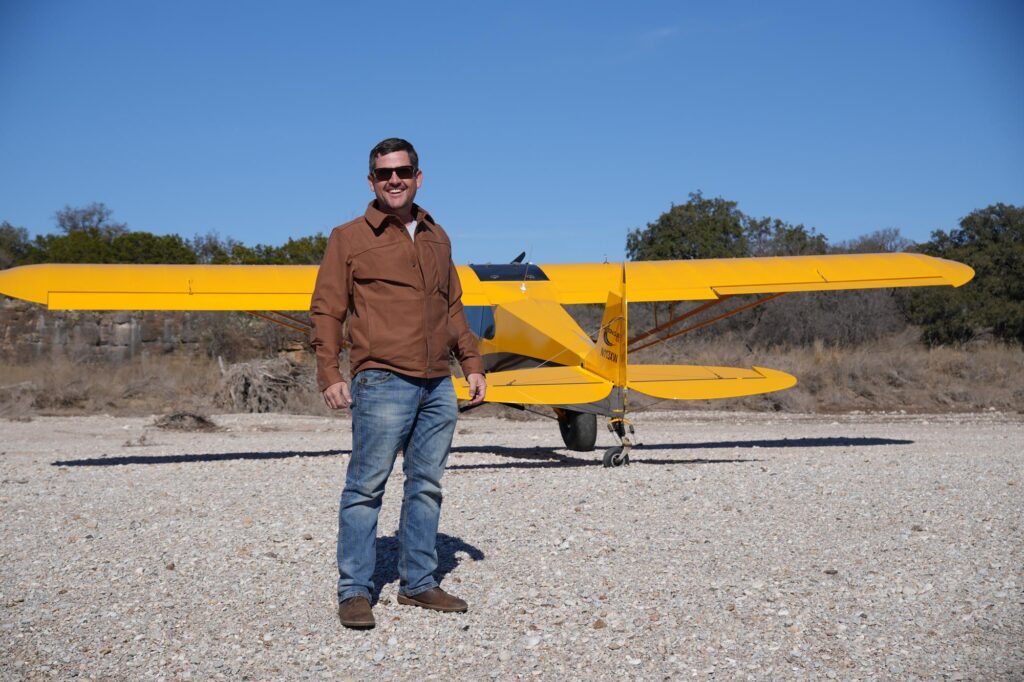
Within a few days, I met Clinton at the Burnet airport and soon found myself in the front seat of the Carbon Cub. After performing a prestart flow I had probably recited well over 200 times, I felt right back at home in the yellow taildragger.
“Wow, I’ve missed this,” I said to Clinton as I donned my Sky Cowboy flight helmet.
“Let’s see if those feet still work,” replied Clinton from the back seat.
Admittedly a bit rusty on the ground handling from my more recent nosewheel flying, the opportunity to knock off the dust far surpassed the feeling of slight embarrassment.
“The real test is seeing how many times you call this thing a Cirrus,” Clinton said jokingly just before I announced our departure.
“Well, thanks for the reminder,” I said as I keyed the mic to most certainly announce that a yellow Carbon Cub was departing Runway 19.
With my tailwheel lined up on centerline and eyes on the horizon, I added full power, and the familiar sounds of the Cub’s Titan engine roared to life.
“Everything’s good and in the green,” I said as I glanced down at the Garmin G3X. “Let’s fly.”
“Hey, nice work. You’re still a tailwheel pilot after all,” said Clinton as he patted my shoulder as we climbed away from the runway.
Feeling thankful to be back, and with an uneventful takeoff behind me, Clinton and I enjoyed a low-and-slow, 20-minute sightseeing flight toward Red Sands.
As we chitchatted, my peaceful tailwheel flight was suddenly and distinctly interrupted. Thinking I had caught a glimpse of a shadow or bird off the Cub’s right wingtip, I couldn’t believe my eyes.
Less than a quarter-mile away, a T-38 Talon raced past our wing at blistering speed. Not thinking we would actually see one of the Air Force fighter trainers Gilbert had so casually mentioned, Clinton said they’re far more common than you might expect.
“There’s typically a second one. Let’s get low and keep an eye out,” Clinton said.
Pulling the power to idle and pointing our nose at the ground, I stayed low for the last few remaining minutes of the flight.
With that bit of a scare behind me, I quickly found myself staring directly at Red Sands Ranch. As we were approaching the runway from the east, Clinton was quick to point out the unfriendly neighbor on what one unassuming pilot might consider a left downwind leg for Runway 17.
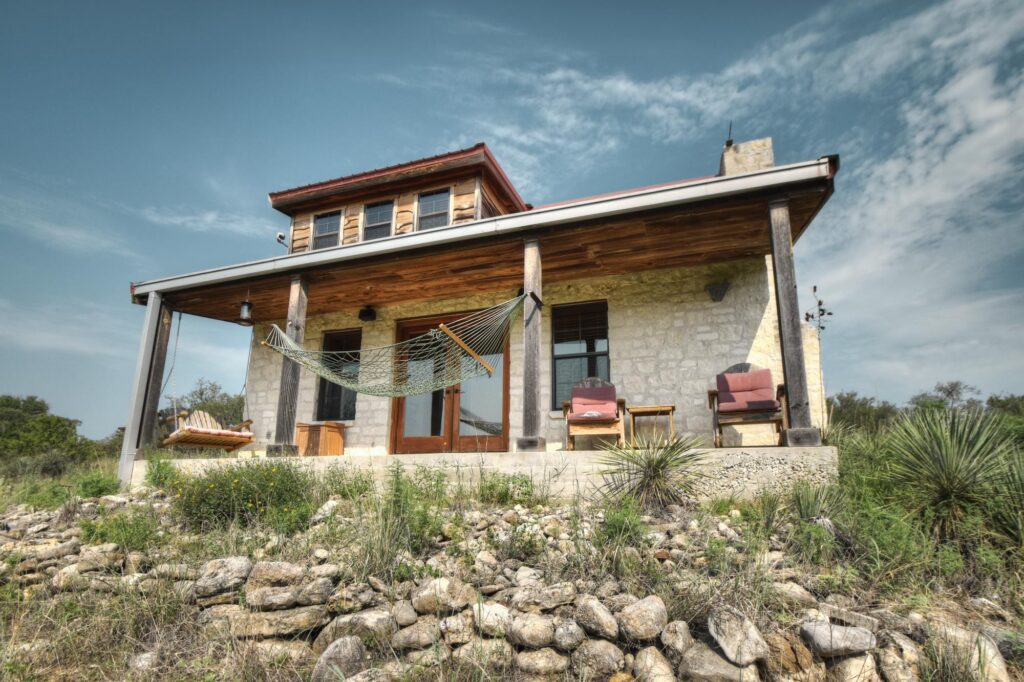
“Stay far away from that house,” said Clinton as I guided our nose toward the north end of the strip.
Setting up for a left downwind for Runway 35, Clinton suggested that I make this first approach an inspection pass to look for deer and wet areas, as the runway had been covered in a rare-for-Texas mix of snow and ice the day before.
With a scenic view of the river’s bluffs directly off my nose on downwind, I turned base and pulled the power back. Shooting for around 50 mph and an altitude of about 100 feet, I balanced power and altitude to get a safe view of the drier-than-expected runway.
A quarter of the way down the runway, I took particular note of its dramatic upslope, and slightly farther down, power lines that had once crossed the strip.
With no wildlife in sight and no muddy areas worth mentioning, I added full throttle and turned crosswind.
“Where’s your touchdown point?” asked Clinton.
“Well, before that hill starts getting too dramatic,” I replied.
“Sounds good. Let’s do it,” said Clinton.
Reminding myself to not make a fool of myself, I added a notch of flaps abeam my imaginary touchdown point and pulled the power to idle. Making a sweeping turn, at a slightly faster airspeed than I should have been, I reminded myself I was not flying the Cirrus.
Taking the extra step to ensure I didn’t create my own problems, I loosened up, took a deep breath, and let the Cub do what it does best—fly.
With my eyes locked on the top of the hill a quarter of the way down the runway, I began my flare. Within a few seconds, the airplane landed in a completely stalled three-point attitude.
“I’ll take it,” I said as I celebrated my first tailwheel touchdown in months.
“You got that right. Now let’s go celebrate with some lunch,” said Clinton.
As we stepped out of the Cub to pull a Yeti cooler from the baggage compartment, the true scale of the ranch came into focus. I had heard the stories, but nothing prepared me for the reality of a “pilot’s resort.”
Framed by sweeping Hill Country views where limestone bluffs meet the deep greens of the Llano River valley, the ranch feels like a secret not meant to be discovered. Even with its impressive resort-like features, the landscape remains remarkably untouched.
Whether you’re seeking the serenity of a night under the stars or the high energy of an epic fly-in bash, Red Sands Ranch serves as a reminder that the best-kept secrets in Texas are rarely found on the beaten path, proving it’s not what you know, but who you know. Your next airplane camping adventure could only be one phone call away.
This article first appeared in the March/April 2026 issue of Plane + Pilot magazine.
