


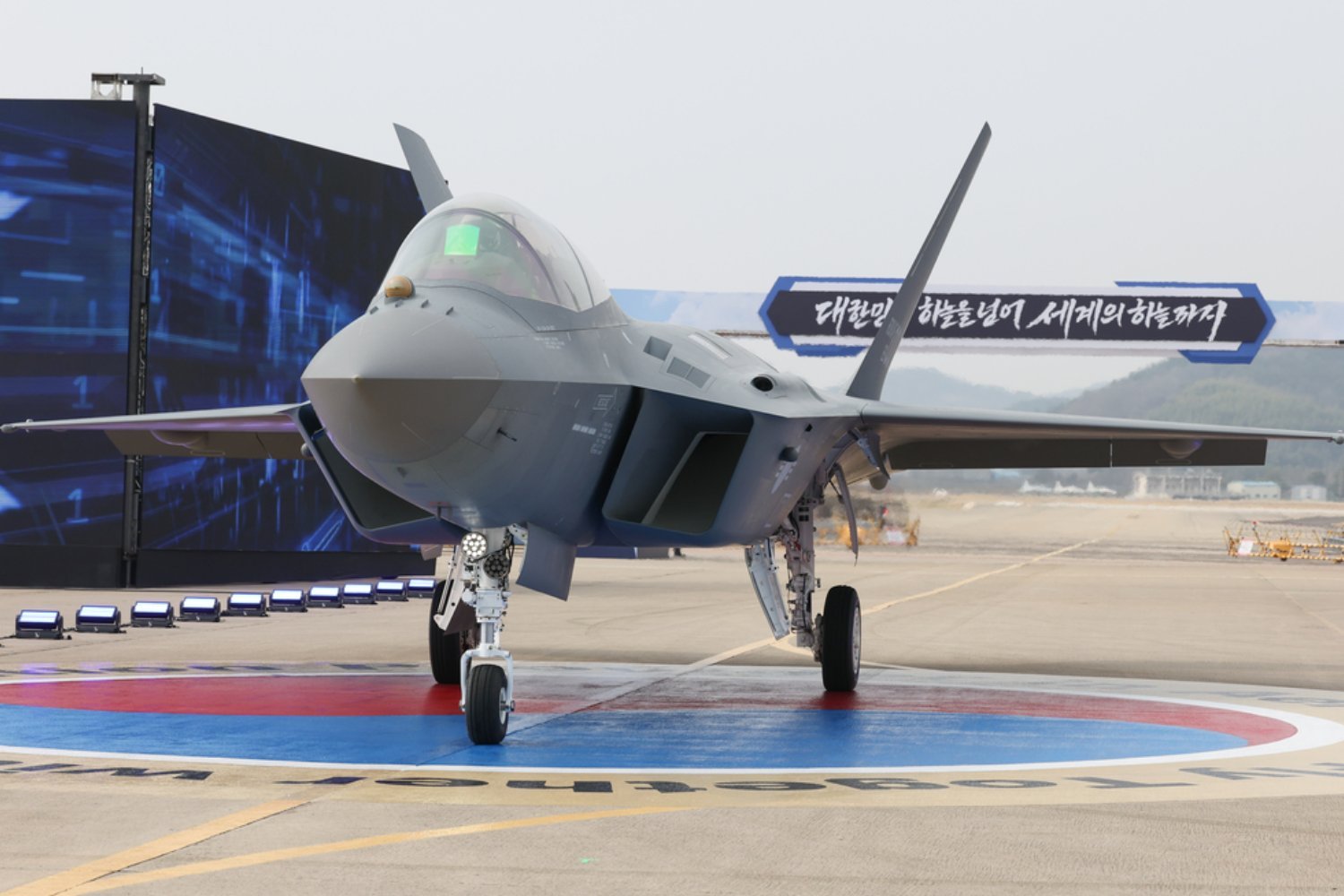
South Korea has unveiled the first series-produced KF-21 fighter, with the aircraft presented on March 26 at Korea Aerospace Industries (KAI) facilities in Sacheon.
The jet is a two-seat variant and is the first built to production standard following several years of development and flight testing. The program was launched in 2016, with the first prototype rolled out in 2021 and its maiden flight completed in 2022. Six prototypes have since been used in the test campaign.
The KF-21 is intended to replace the Republic of Korea Air Force’s aging F-4 and F-5 fighters, while operating alongside newer platforms such as the F-35A already in service.
Follow us: WhatsApp | BlueSky | Google News | Instagram | LinkedIn | Facebook
Seoul opted for a design that avoids the full complexity of a fifth-generation fighter, focusing instead on a configuration often described as “4.5-generation.” The aircraft does not prioritize stealth to the same extent as designs like the F-35, but incorporates systems such as an AESA radar and infrared search and track (IRST).
In its initial configuration, the KF-21 carries weapons externally, including beyond-visual-range air-to-air missiles such as the MBDA Meteor. Future versions are expected to introduce internal weapons bays and expanded capabilities, while concepts shown during the rollout include an electronic warfare variant.
South Korea is also studying concepts involving coordination between the KF-21 and unmanned systems, including domestically developed drones, with the two-seat version offering potential for mission control roles.
Current plans call for the ROKAF to field 40 aircraft by 2028 and expand the fleet to 120 jets by 2032.

The KF-21 enters a competitive market that includes Turkey’s KAAN fighter, China’s J-10C and export-oriented J-10CE, as well as the widely adopted fifth-generation F-35.
Indonesia, a junior partner in the program that has faced repeated delays in its financial commitments, has continued to signal interest in the aircraft. At the same time, Jakarta has pursued other options, including agreements for the Rafale, participation in the KAAN program and discussions with China over the J-10CE.
