


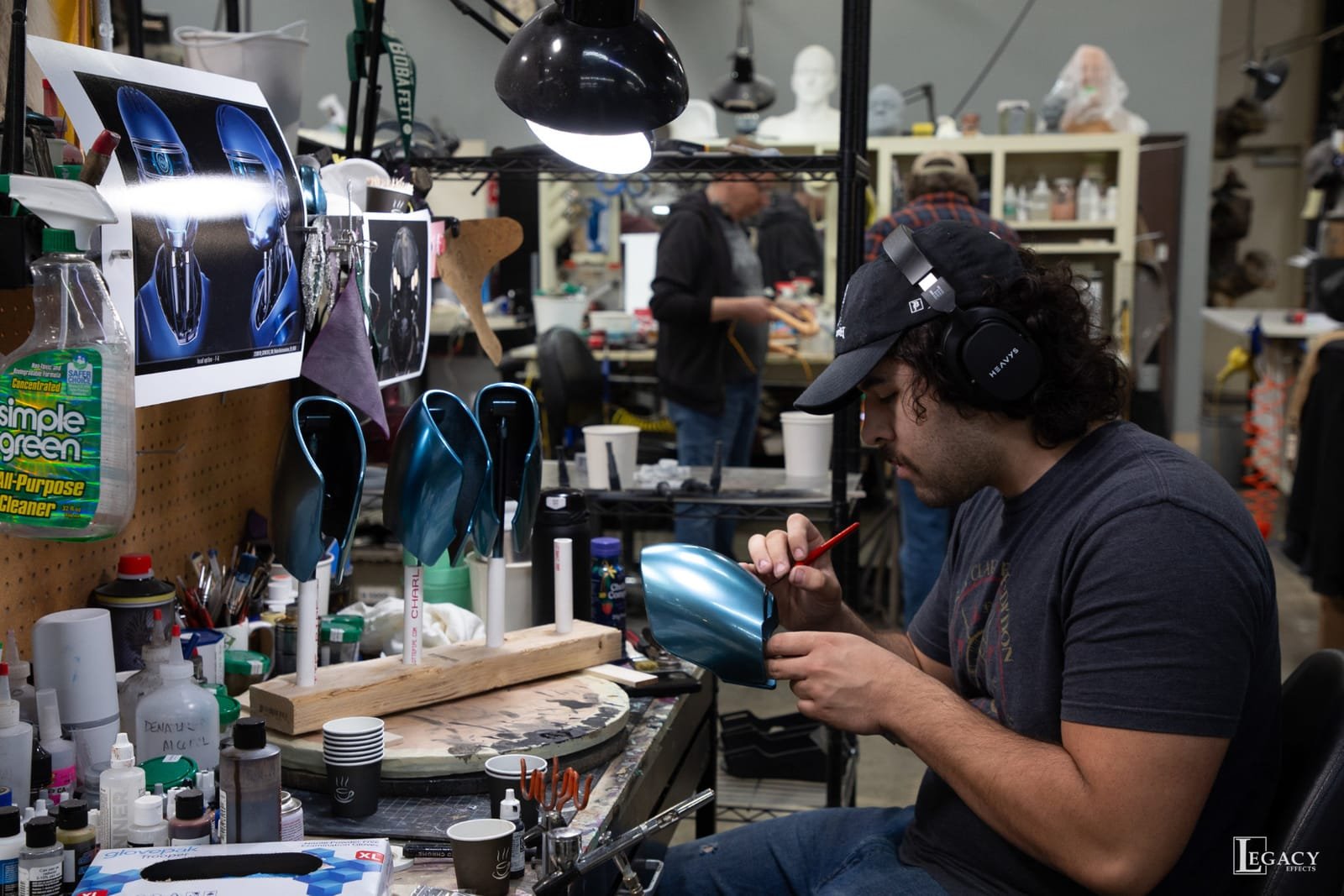
Legacy Effects, US visual effects studio, transformed how physical production assets are built during the making of Superman 2025 by integrating Bambu Lab‘s X1C 3D printing systems mid-production into nearly every corner of their fabrication workflow. The result was a faster iteration, lighter stunt suits, and camera-ready parts that once required slower, costlier processes, all without a single on-set failure.

A Studio Modernizes Its Craft
The studio entered production facing a familiar pressure: shrinking schedules, growing complexity, and a workflow that forced trade-offs between turnaround speed and part quality. Their existing fleet of industrial machines, from Stratasys and Markforged to WASP and Raise3D systems, each had strengths, but none erased the gap between a quick rough print and something ready for camera.
That changed when the team began testing Bambu Lab’s X1C on the Hammer of Boravia armor. What started as a trial quickly revealed something unexpected: parts were coming off the machine fast and polished. As the studio noted internally, the platform had reached a point where FFF output was “of sufficient quality to serve not only as prototypes but, in some cases, as final parts.” The fleet expanded, and Bambu Lab became the backbone of their fabrication pipeline.

What Got Built and How
The scope was broader than most would expect. Full stunt suits for the Hammer of Boravia and LexCorp Raptors were assembled as multi-part FFF prints, fitted to performers, stress-tested through action choreography, and revised, sometimes multiple times in a single day.
Mr. Terrific’s mechanically transforming flying chair combined printed structural components with MJF joints and metal hardware, then went through sanding, priming, and painting to achieve a reflective hero finish. For the Fortress of Solitude’s animatronic robots, internal brackets and articulation mechanisms were first printed in PLA, then migrated to PA-CF once tolerances were confirmed, cutting weight and collapsing what had previously been multi-component metal assemblies into single integrated parts.
Material choices were deliberate throughout. PLA handled rapid iteration and decorative surfaces. TPU (95A) stood in for silicone during actor fit testing, Mr. Terrific’s T-shaped mask had to flex with realistic facial movements before the final version. PA-CF supported structural loads, replacing metal parts. Additionally, the team successfully ran Markforged’s Onyx filament through the X1C on a generic profile, achieving output speeds that outpaced the filament’s native hardware.

Ripple Effects on the Production Floor
The deeper shift wasn’t just in individual parts, it was in how departments worked together. Digital sculpts and scanned clay models moved directly into the printer without interpretation or rework on the shop floor. Engineering teams ran five or six part revisions in a day, while mold-making and art teams worked in parallel rather than waiting in sequence. Large assemblies printed once became masters for urethane castings, giving stunt performers lighter, better-fitting suits without sacrificing surface detail.
The absence of on-set failures was cited as a meaningful benchmark, a confirmation that 3D printing has moved from a support role into something closer to a primary fabrication tool in high-end practical effects work.
The studio anticipates increased use of 3D printing in future productions. This growth is expected to create demand for larger-format machines, along with reliable hardware and connected workflows. The team is also looking at improving how print jobs are managed and transferred across shifts, with the aim of reducing manual steps during extended production runs.

3D Printing Across Film Productions
3D printing lets producers turn complex digital designs into precise, tangible props and miniatures that traditional fabrication cannot match. Beyond creativity, it solves critical constraints of accuracy, repeatability, and production speed, making scenes and effects possible that would otherwise be too costly, risky, or technically unfeasible.
For the final season of Stranger Things, production teams used 3D printing to solve a safety challenge, creating life-sized, digitally scanned replicas of child actors to stand in during a dangerous climactic sequence involving the massive “Mind Flayer” set piece.
In Frankenstein (2025), Guillermo del Toro used 3D printing to produce a 30-foot “maxiture” gothic tower, accurately replicating intricate set details while accelerating production and reducing reliance on full-scale builds. In Pinocchio (2023), del Toro printed mechanical heads, torsos, and replacement parts, allowing multiple facial expressions and preserving fine textures that would be difficult to achieve manually.
3D Printing Industry is inviting speakers for its 2026 Additive Manufacturing Applications (AMA) series, covering Energy, Healthcare, Automotive and Mobility, Aerospace, Space and Defense, and Software. Each online event focuses on real production deployments, qualification, and supply chain integration. Practitioners interested in contributing can complete the call for speakers form here.
To stay up to date with the latest 3D printing news, don’t forget to subscribe to the 3D Printing Industry newsletter or follow us on LinkedIn.
Explore the full Future of 3D Printing and Executive Survey series from 3D Printing Industry, featuring perspectives from CEOs, engineers, and industry leaders on the industrialization of additive manufacturing, 3D printing industry trends 2026, qualification, supply chains, and additive manufacturing industry analysis.
Featured image shows the engineer is performing surface finishing on the 3D printed parts of the Animatronic Robot. Photo via Bambu Lab.
