


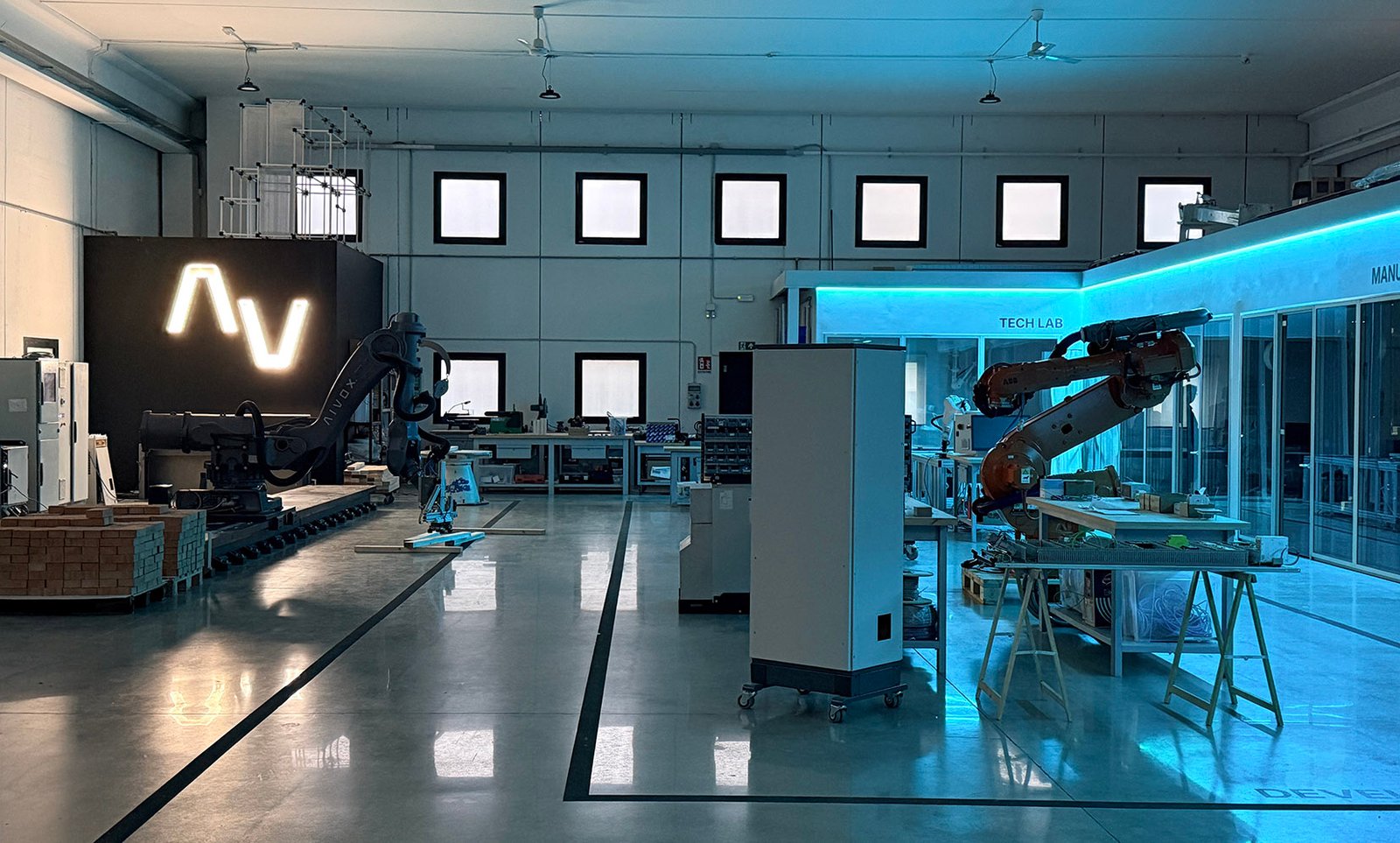
Rapid Fusion, an Exeter-based large-format additive manufacturing company, is targeting a €1 million expansion after signing an exclusive agreement with Aivox, an Italian engineering and innovation consultancy, to enter the Italian market. The deal focuses on customers in architecture, fashion, medtech, and Northern Italy’s naval sector. The British manufacturer already supplies equipment to customers in Australia, Dubai, Greece, and the United States, while discussions with several potential customers in Italy have reached an advanced stage.
Under the agreement, the Milan-based consultancy will use, market, and integrate the Exeter company’s LFAM platforms into custom manufacturing systems for Italian clients. These include Zeus, Apollo, Medusa, and Cerberus, a containerized unit intended for remote locations. Zeus is now being shipped to Monza, where it will be installed on rails at Aivox’s dedicated lab for live demonstrations, customer trials, and product development work tied to projects already being carried out by its 15-person engineering team.
“This is a very exciting moment for our business and takes us into a new European territory that is on the verge of really embracing large format additive manufacturing and all the speed, quality and design flexibility it gives you,” said Jake Hand, founder and CEO of Rapid Fusion. “Having Aivox on board is a massive coup. It is one of Italy’s leading innovation consultancies and a company that thrives on delivering new solutions to real-world engineering problems.” Hand also pointed to the Monza facility as an important part of the agreement. “The facility in Monza also has an amazing development lab that acts as a prototyping/new product introduction nerve centre for clients. This is a fantastic environment to initially house Zeus and our other solutions as the relationship develops.”

Talks began last year when Aivox CEOs Matteo Lomaglio and Francesco Perego opened discussions on custom LFAM systems based on Rapid Fusion’s PE320 extruder technology. After visiting the Exeter firm’s demonstration center to review its 3D printing range, both sides agreed to form an exclusive relationship. Hand said the Italian partner can provide hardware and software support for bespoke systems and pointed to its industrial background through the LITIX Group. “Aivox’s team has extraordinary technical knowledge and can provide full end-to-end bespoke hardware and software solutions. They also have great industrial DNA from being part of the LITIX Group,” he said. “We believe there is a €1m opportunity by the end of this year and – from there – who knows? The potential is huge in Italy for our technology.”
“Our approach is to work at the intersection of design, software and manufacturing, which gives us a fantastic opportunity to identify and embed Rapid Fusion’s solutions into our work and with customers in Italy,” said Francesco Perego, CEO of Aivox. Matteo Lomaglio added: “Traditionally there has been slow adoption of 3D printing in our market, but this is changing, and we believe this is the right time to help educate the market and demonstrate what can be achieved with LFAM.” He concluded: “Speed, repeatable quality, ease of iteration and an increasingly wide material portfolio has seen it move from a prototyping to a powerhouse of manufacturing.”
Investment and localized infrastructure shape LFAM expansion
Recent activity in large-scale additive manufacturing shows expansion depends on capital deployment and regional production capacity. Italian manufacturer Caracol, which develops robotic LFAM systems for polymer composites and metal wire arc processes, raised $40 million in Series B funding to scale operations across Europe, the United States, and Asia-Pacific. Part of that investment is being directed toward software, automation, and AI, while a new 6,000 sq. ft facility in Austin is designed to assemble and deliver up to 100 robotic systems annually, supporting customers in aerospace, automotive, construction, and design. The move links expansion directly to physical capacity and system deployment at scale.
A similar approach is visible in Europe, where proximity to customers and supply chains is shaping expansion decisions. Conflux Technology, an Australian manufacturer of metal 3D printed heat exchangers, recently established a UK hub to support regional demand across aerospace, automotive, energy, defense, and e-mobility. The site is expected to begin with research and development and materials certification before scaling into production, addressing constraints tied to supply chain responsiveness and technical support. Europe already accounts for more than a third of the company’s business, making localized infrastructure a requirement rather than a growth option.

3D Printing Industry is inviting speakers for its 2026 Additive Manufacturing Applications (AMA) series, covering Energy, Healthcare, Automotive and Mobility, Aerospace, Space and Defense, and Software. Each online event focuses on real production deployments, qualification, and supply chain integration. Practitioners interested in contributing can complete the call for speakers form here.
To stay up to date with the latest 3D printing news, don’t forget to subscribe to the 3D Printing Industry newsletter or follow us on LinkedIn.
Explore the full Future of 3D Printing and Executive Survey series from 3D Printing Industry, featuring perspectives from CEOs, engineers, and industry leaders on the industrialization of additive manufacturing, 3D printing industry trends 2026, qualification, supply chains, and additive manufacturing industry analysis.
Featured image shows Aivox development lab in Monza, Italy. Photo via Rapid Fusion.
