


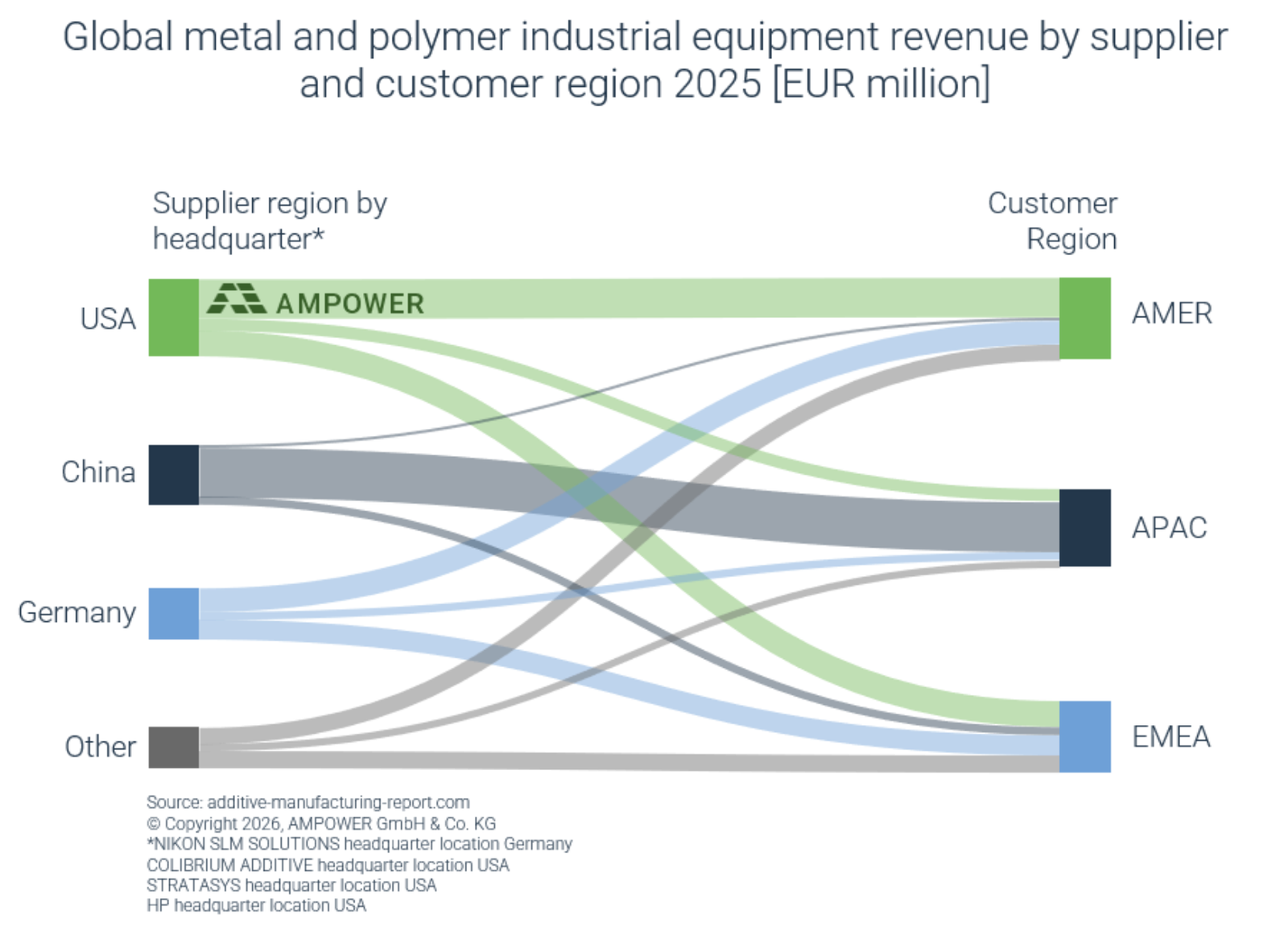
German consultancy AMPOWER has published its AMPOWER Report 2026 reporting that the industrial AM market returned to growth in 2025 after stagnating in 2024, reaching a volume of over €11 billion (approx. $12.7 billion). Its latest annual market study puts sector growth at 5.6% last year, driven by stronger demand for part production and higher material consumption. Although that result fell below the previous year’s forecast, the firm slightly raised its projected long-term annual growth rate for the total market to 13.5% over the next five years.
Lower-cost equipment played a central role in that recovery. Unit sales rose in the lower-price machine segment, even as revenue in that category remained nearly flat. Because the study is balanced in euros, a weak US dollar reduced the calculated growth rate. Customs uncertainty also affected buyer investment decisions, particularly given the United States’ position as a major market for additive manufacturing systems and materials.

One of the report’s main new areas of focus is desktop polymer systems priced below €10,000 (approx. $11,546). That segment grew by more than 30% in 2025 and is gaining industrial relevance. Companies are increasingly building large-scale print farms rather than relying solely on expensive individual industrial systems. Matthias Schmidt-Lehr, a partner at the Hamburg-based consultancy, said: “We are seeing the market regain significant momentum after the flatline in 2024. The development in the desktop segment is particularly exciting; it is no longer reserved for hobbyists but is increasingly meeting industrial requirements and challenging traditional classifications”.
Metal additive manufacturing showed continued fragmentation alongside consolidation. The ten largest manufacturers of metal powder bed fusion systems accounted for about 78.3% of global revenue in 2025, down from 80% a year earlier. At the same time, new suppliers, particularly from China, continued entering the market. Defense and space, along with consumer industries, remained the main growth drivers for metal AM. Over the past four years, military OEMs and startups recorded growth rates exceeding 20% as they used the technology to solve supply chain issues and produce drones and next-generation components.

Research for the 2026 edition drew on more than 300 personal interviews with additive manufacturing managers and directors involved in both technical and commercial activities. Data collection for the 2025 cycle exceeded 50,000 data points, while responding equipment OEMs represented about 90% of the globally installed base. Alongside supplier input, the analysis placed particular emphasis on user interviews to support a demand-oriented view of future market development. The report is available online and as a PDF through its dedicated website.
Additive manufacturing growth is returning unevenly
Recent hardware data from market intelligence firm CONTEXT shows that additive manufacturing demand is recovering at the market’s extremes rather than across the board. Entry-level systems priced at $2,500 or below posted 18% year-over-year shipment growth in Q3 2025, while industrial machines above $100,000 rose 3%, marking a return to growth at the high end after a prolonged slowdown. That rebound remained narrowly concentrated: metal powder bed fusion system shipments increased 25%, China’s industrial system shipments rose 22%, and aerospace, defense, and domestic Chinese manufacturing accounted for much of the momentum. Midrange and professional categories, by contrast, continued to decline at double-digit rates, reinforcing how uneven the recovery remains.

Findings from the Wohlers Report 2026 executive summary point to a similar shift in where value is being created. Global additive manufacturing revenue reached $24.2 billion in 2025, up 10.9%, with services contributing $11.7 billion after 15.5% growth, while printer sales and servicing rose just 3.6% to $6.2 billion. End-use part production represented 39.8% of applications among surveyed users, indicating deeper use in manufacturing, but returns remained uneven, with only 39% consistently reporting positive results. That distribution helps clarify the latest market data: growth is no longer defined simply by machine sales, but by how systems are used, where demand is concentrated, and whether they solve production and supply chain constraints.
3D Printing Industry is inviting speakers for its 2026 Additive Manufacturing Applications (AMA) series, covering Energy, Healthcare, Automotive and Mobility, Aerospace, Space and Defense, and Software. Each online event focuses on real production deployments, qualification, and supply chain integration. Practitioners interested in contributing can complete the call for speakers form here.
To stay up to date with the latest 3D printing news, don’t forget to subscribe to the 3D Printing Industry newsletter or follow us on LinkedIn.
Explore the full Future of 3D Printing and Executive Survey series from 3D Printing Industry, featuring perspectives from CEOs, engineers, and industry leaders on the industrialization of additive manufacturing, 3D printing industry trends 2026, qualification, supply chains, and additive manufacturing industry analysis.
Featured image shows over 80% of industrial AM machines come from USA, China and Germany. Image via AMPOWER.
