


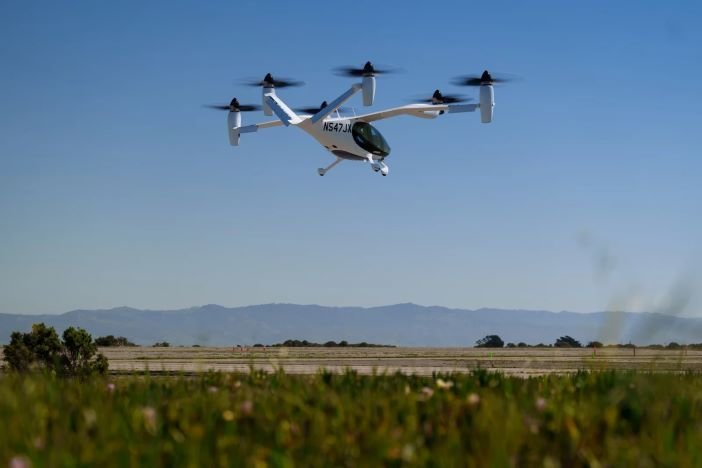
Joby flies first FAA-conforming eVTOL aircraft
Joby Aviation has begun flight testing its first FAA-conforming aircraft for Type Inspection Authorization (TIA), built using airframe and components approved by FAA Designated Engineering Representatives.
FAA test pilots are expected to begin formal TIA evaluations later this year. Joby’s vertically integrated manufacturing approach with most components designed, tested and produced in-house underpins its ramp to four aircraft per month by 2027 from expanded facilities in Marina, California and Dayton, Ohio. (Joby Aviation)
X-59 resumes envelope expansion flight testing after cockpit warning proves false positive
NASA’s Lockheed Martin X-59 Quesst low-boom supersonic demonstrator returned to flight on 26–27 March after a cockpit warning light cut short its second flight on 20 March. The alert was traced to a false positive.
With test pilot Jim Less now at the controls, the programme is expanding the flight envelope toward Mach 1.4 at 55,000 ft, beginning from roughly 230 mph / 12,000 ft and stepping up to 260 mph / 20,000 ft. The aircraft is powered by a modified F414-GE-100 engine.
The flight test program’s end goal is community over-flight acoustic surveys, which will provide data to enable commercial supersonic flight over land by reducing loud sonic booms to a quiet “thump”. (Aviation Week, NASA)
Sikorsky delivers autonomous Black Hawk to US Army
Sikorsky has completed flight testing and delivery of a UH-60MX Black Hawk helicopter fully integrated with its Matrix autonomy suite – the first full-authority fly-by-wire, optionally piloted UH-60 in the US Army fleet.
The open-architecture system provides automated landing-zone detection, obstacle avoidance in degraded visual environments, and a scalable baseline for future uncrewed operations. DEVCOM will use the aircraft to develop tactics and procedures for optionally piloted and autonomous rotorcraft missions. (Lockheed Martin)
RTX hybrid-electric demonstrator advances toward flight
RTX’s regional turboprop demonstrator aircraft, which combines a Pratt & Whitney thermal engine with a 1 MW-class electric motor and 200 kWh battery pack from Collins Aerospace and H55 completed its first full-power ground runs.
The project targets a 30% fuel-efficiency improvement over current advanced turboprops. Key engineering challenges include managing high-voltage arcing in the battery system and achieving competitive power-density in the motor and controller.
Ground integration is set to continue over the next year before first flight, supported by Canadian federal and Quebec provincial funding. (RTX)
DLR flight tests wake vortex avoidance system in live traffic
Germany’s DLR conducted five flight-test campaigns using its ISTAR research aircraft to evaluate the Wake Encounter Avoidance and Advisory (WEAA) system against live commercial air traffic.
Across 120 wake-vortex encounters, the system integrated real-time weather, aircraft, and air-traffic data to predict vortex locations and warn pilots. Initial assessments confirmed broad agreement between predicted and observed vortex positions.
Detailed quantitative analysis of the dataset is now underway to refine prediction accuracy. (DLR)
ESA self-healing composite for reusable launchers passes tests
Under ESA’s FIRST! initiative, Swiss company CompPair, Belgian firm Com&Sens, and CSEM demonstrated Project Cassandra, a carbon-fibre composite structure with embedded fibre-optic damage sensors and integrated 3D-printed aluminium heating grids.
When cracks form, the material is heated to 100–140 °C, activating an internal healing agent that reflows to repair damage. Test panels up to 40×40 cm have validated damage monitoring, homogeneous heating, and self-repair, including under cryogenic thermal-shock conditions relevant to propellant tanks. The next phase targets a full-scale cryogenic tank demonstrator. (ESA)
ESA explores laser-based debris collision avoidance with OMLET
ESA’s European Space Operations Centre is developing OMLET (Orbit Maintenance via Laser MomEntum Transfer).
The concept uses high-power ground-based lasers with precision pointing and adaptive optics to nudge space debris away from collision trajectories. The approach complements to the tracking and cataloguing lasers ESA already operates.
The OMLET program is currently moving from requirement definition into design and implementation. (ESA)
Isar Aerospace to launch Astroscale’s ELSA-M debris-removal demo
Isar Aerospace is working with Astroscale to deliver the ELSA-M In-Orbit Demonstration mission aboard its Spectrum launch vehicle from Andøya, Norway.
The 520 kg ELSA-M servicer will capture and de-orbit an end-of-life Eutelsat OneWeb satellite, advancing commercial active-debris-removal services.
The mission, which is being supported by the UK Space Agency through ESA’s ARTES programme, requires precise orbit targeting to enable rendezvous, a capability Isar highlights as a differentiator for its vertically integrated launcher. (Isar Aerospace)
French research targets composites for engine warm zones
Toulouse-based research institute IRT Saint Exupéry is leading studies and experiments toward composite materials capable of withstanding the elevated temperatures found in turbofan engine environments, aiming to replace titanium components.
The work, which is linked to LEAP-1A engine applications, is exploring higher-temperature polymer-matrix systems to cut weight while maintaining structural integrity in warm-area nacelle and engine surroundings. (Aviation Week)
UK establishes sovereign CMC manufacturing capability
Bath UK-based Cross Manufacturing built the country’s first pilot-scale production line for Ceramic Matrix Composites (CMCs).
CMCs are ultrahigh-temperature materials capable of withstanding over 1,000 °C while remaining lightweight and strong.
Funded by the MoD’s Chief Scientific Adviser and developed in partnership with Dstl, demonstrator nose cones, curved panels, and high-temperature seals have been mechanically tested at 1,000 °C. The facility aims to reduce UK reliance on overseas CMC suppliers across space, hypersonics, and advanced propulsion applications. (ADS Advance)
Saab and Cohere partner on AI for GlobalEye aircraft
Saab and Canadian AI company Cohere are to collaborate on enterprise-grade AI technologies for the GlobalEye airborne early-warning platform, initially linked to the Canadian GlobalEye opportunity.
Targeted applications include data-driven mission support, predictive maintenance tooling, and accelerated information processing, with on-premises deployment into secure aerospace environments. Technologies developed are intended to feed back into Saab’s broader international product line. (Saab)
NASA relocates PC-12 to Armstrong for expanded flight research
NASA moved a Pilatus PC-12 aircraft from Glenn Research Center to Armstrong Flight Research Center in Edwards, California to broaden its utility as a deployable research platform.
Over four years at Glenn, the aircraft supported work including a laser-terminal communications relay experiment with the International Space Station and surveillance-system studies for future urban air mobility.
A T-34 trainer has also arrived at Armstrong for pilot currency and potential pod-mounted flight-research use. (NASA)
