


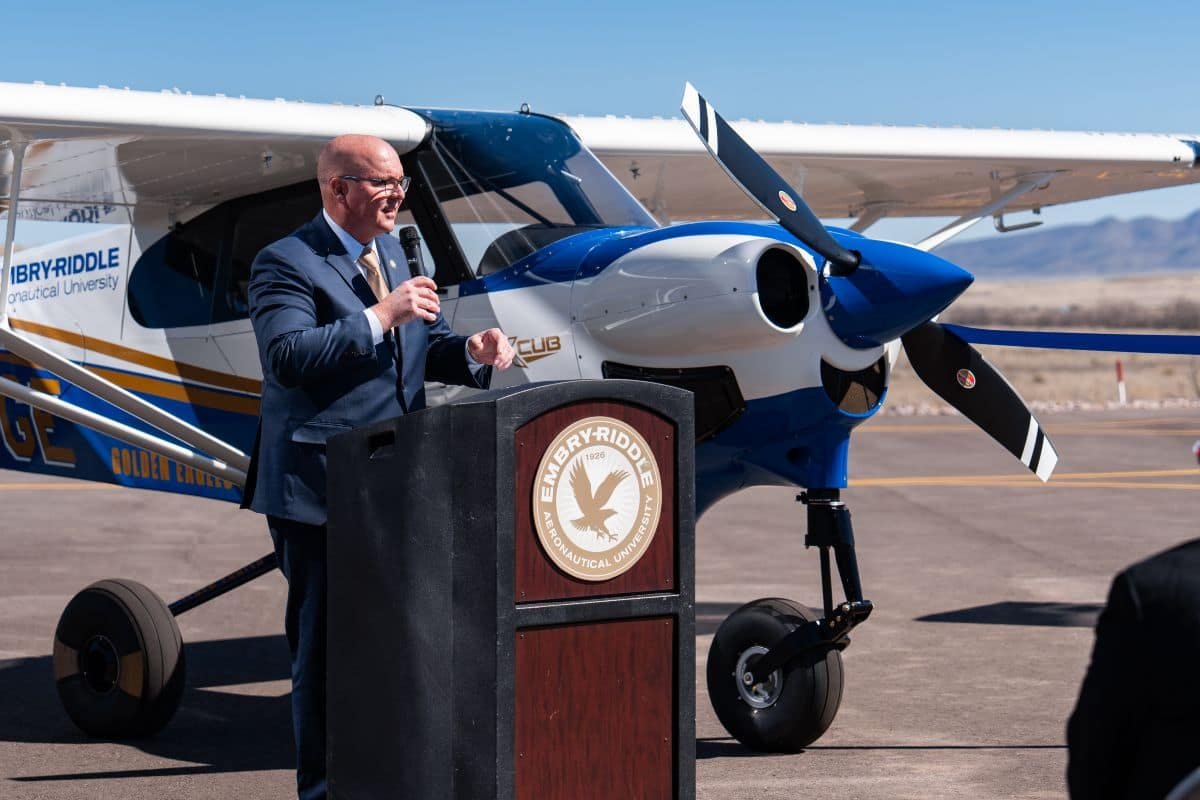
One of America’s premier aviation institutions this month completed a major upgrade to its flight training capabilities.
Embry-Riddle Aeronautical University (ERAU) on Monday announced the opening of a “cutting-edge” Strategic Academic Flight Education Complex at Prescott Regional Airport (KPRC) in Arizona, also known as Ernest A. Love Field. The centerpiece is a new northern flight operations facility comprising hundreds of thousands of square feet of ramp space, simulation technology, and other training and operational resources.
The new site will support a range of activities falling under aviation education, safety, and workforce development. City, state, and university officials attended a ribbon-cutting ceremony on March 13.
“For our students, this facility shapes the daily experience of how they learn, train, and prepare for careers in aviation,” said Jeannie Leavitt, dean of ERAU’s College of Aviation, in a statement. “It provides a modern, thoughtfully designed setting where instruction, simulation, and flight operations come together to support their development as professionals.”
The Arizona state legislature in 2022 approved funding for the complex’s infrastructure, which ERAU matched. It includes a 263,000-square-foot ramp installation and two-story facility containing dispatch, briefing, and instructional spaces.
The upgrades come amid a wave of enrollment at ERAU’s Prescott campus. Between fall 2018 and fall 2022, aeronautical science student enrollment there jumped from 486 to 857. In October, ERAU said it welcomed 913 new undergraduates to Prescott, marking the campus’ second-highest enrollment since it opened in 1978.
“This is about giving our students the kind of professional aviation environment that is the standard at Embry‑Riddle—built for flight training and grounded in safety at every level,” said Ken Witcher, chancellor of the Prescott campus.
Prescott’s $16 million flight training center debuted in 2024. It includes the 16,000-square-foot Robertson Flight Simulation Center, which contains FRASCA fixed-wing simulators and full-motion devices modeled after Cessna 172 and Diamond DA42 aircraft—the university’s primary training craft. In 2023, it said it would invest $34.4 million in the campus through 2026.
After 100 Years, Embry-Riddle Looks to the Future
ERAU last week celebrated its centennial and received a $20 million gift from Mori Hosseini, chairman of its board of trustees, and his wife, Forough Hosseini. Other donors have contributed $175 million toward the university’s latest fundraising effort, which seeks to secure $300 million in philanthropic gifts by 2030. The money would support scholarships, faculty recruitment and retention, hands-on learning, and the creation of new centers of excellence.
At the same time, ERAU is investing in the future of aviation. Last year, its Florida campus took delivery of state-of-the-art simulators that allowed it to join the FAA’s Enhanced AT-CTI program, which sends graduates who pass the air traffic skills assessment (ASTA) directly to air traffic control (ATC) facilities for localized training. Ordinarily, ATCs must train at the FAA Academy in Oklahoma City.
The Prescott campus joined the Enhanced AT-CTI in September after installing simulators designed to replicate tower operations and run over a dozen scenarios used by the FAA Academy.
In 2024, ERAU began transitioning trainees from the Cessna 172 to Pipistrel’s Velis Electro in anticipation of a new wave of electric aircraft. Over the next three years, it will send students on trips to Brazil to study electric aircraft thermal management. Students and faculty are also studying the safe operation of uncrewed aircraft systems (UAS) and other autonomous aircraft.
Also in 2024, the university partnered with the Advanced Air Mobility Association (AAMA)—a nonprofit with ties to Embraer and its subsidiary Eve Air Mobility that aims to create “roadmaps” for AAM integration—to give students access to AAM projects and internships with member companies.
ERAU is further collaborating with GOAA to study AAM integration at Orlando International Airport (KMCO). Under a $1.4 million NASA grant, it is studying safe, quiet air taxi operations in urban environments and under turbulent conditions. Another $6.7 million NASA research effort is exploring how AAM vehicles could be equipped with real-time contingency response capabilities.
