


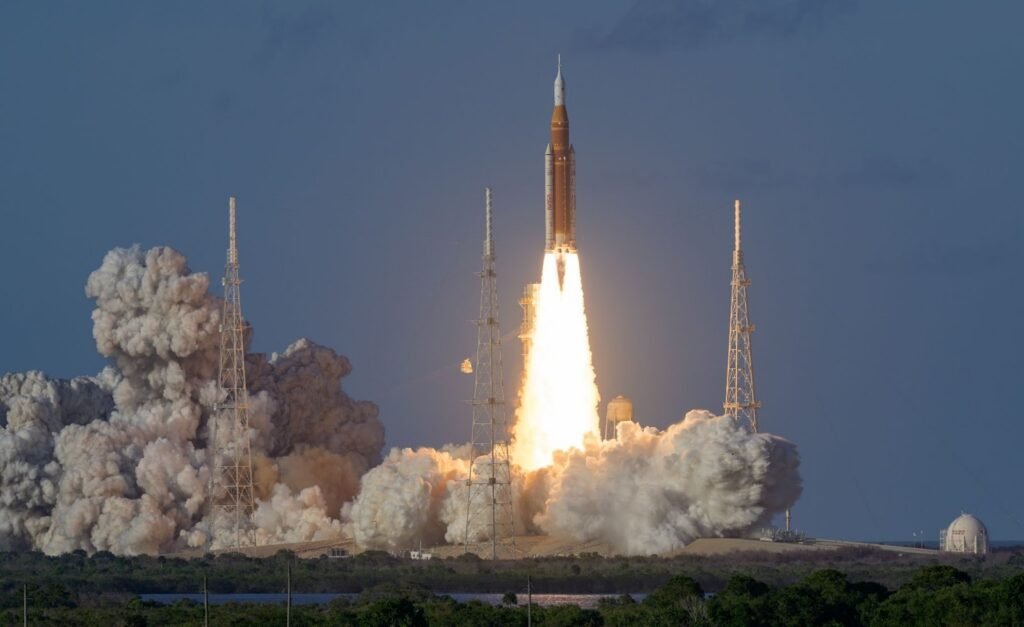
After orbiting the Earth twice, four astronauts have officially begun their four-day journey to the moon.
Friday marks the start of flight day three for NASA’s historic Artemis II mission, which is sending three Americans and one Canadian farther from Earth than any human has ever ventured. It is NASA’s first crewed mission to lunar orbit since the Apollo era more than half a century ago.
The astronauts on Thursday night cleared what John Honeycutt, manager of NASA’s Space Launch System (SLS) program, described in March as one of the mission’s most treacherous phases—the final burn that will send them on a figure eight-shaped trajectory 230,000 miles from home.
“America is back in the business of sending astronauts to the Moon,” NASA Administrator Jared Isaacman wrote in a social media post. “This time, farther than ever before.”
That burn, called a translunar injection (TLI), had to be extremely precise. It placed the crew, traveling in NASA’s Integrity Orion capsule, on course to not only reach the moon but slingshot around it. On the way back, Integrity will disengage its propulsion systems and instead rely on the Earth and moon’s natural gravity to pull it home, attempting a maneuver called a free return. Three trajectory correction burns will be the only times Integrity itself assists.
Engineers had to calculate the exact timing and power of the TLI burn—as well as Integrity’s Earth orbit—to ensure gravitational forces make a free return possible. Historically, the maneuver has been used as an emergency rather than primary trajectory. The ill-fated Apollo 13 in 1970 is the only mission to travel around the moon in a free return. Apollo 12 used a hybrid free return on approach to the moon in 1969.
“Today, for the first time since Apollo 17 in 1972, humans have departed Earth orbit…Orion is operating with crew for the first time in space, and we are gathering critical data, and learning from each step,” Lori Glaze, acting associate administrator for NASA’s Exploration Systems Development Mission Directorate, said in a statement Thursday. “Each milestone we reach marks meaningful progress on the path forward for the Artemis program. While we have eight intensive days of work ahead, this is a big moment, and we’re proud to share it with the world.”
NASA astronaut and Artemis II mission specialist Chrisina Koch spent Thursday morning preparing Integrity’s systems for the TLI. The burn is performed by the main engine on the Orion European Service Module, built by a consortium led by Airbus. It produces 6,000 pounds of thrust, enough to take an automobile from zero to 60 mph in under three seconds.
For TLI, the engine fired for about six minutes and burned about 1,000 pounds of fuel. Flight controllers at mission control in Houston monitored engine performance, guidance, and navigation data to confirm that the spacecraft is on course.
The TLI followed an exciting first day for Artemis II, the first time SLS and Orion are flying with crew.
After a brief hold to address an issue with Orion’s Launch Abort System (SLS), Wednesday’s countdown resumed, and SLS fired its engines and boosters about 10 minutes later at 6:35 p.m. EDT. It generated about 8.8 million pounds of thrust—17 percent more than the Apollo-era Saturn V—to clear the launch tower at Kennedy Space Center in Florida.
Day one saw the astronauts arrive in low-Earth orbit. Main engine cutoff (MECO) and separation of the SLS core stage from Integrity went off without a hitch. The SLS interim cryogenic propulsion stage (ICPS) then took command, conducting a series of burns to raise Integrity’s orbit for the TLI.
On Wednesday night, the astronauts took manual control of Integrity, which can be commanded autonomously or without crew. The ICPS was jettisoned and used for target practice during a proximity operations demonstration, as the astronauts maneuvered toward and around it for about 70 minutes.
The test simulated docking with another spacecraft in orbit—something that will be required for crewed lunar landings on future Artemis missions, beginning in 2028.
Late Wednesday night, Koch also took on the unexpected task of fixing Integrity’s deep-space toilet after a malfunction.
It was both a humorous moment and a reminder that Artemis II is above all a test flight. The toilet is the first installed aboard a crewed spacecraft headed to deep space—one of many firsts the mission will achieve.
What’s Next for Artemis II?
Crewmembers completed many objectives on flight day one. But the most exciting parts of the mission are still to come.
Flight Day 2 for the @NASAArtemis II mission is winding down as the crew preps for sleep after a busy day.
Goodnight Crew. Goodnight Moon.pic.twitter.com/9Hk8vvbPP0
— NASA (@NASA) April 3, 2026

Getting to the Moon
The next few days will likely be the quietest. On Friday, Koch, NASA astronaut Victor Glover, and Canadian Space Agency (CSA) astronaut Jeremy Hansen will practice CPR in space. Glover and NASA astronaut Reid Wiseman will check out the spacecraft’s medical kit, which includes a thermometer, blood pressure monitor, stethoscope, and otoscope.
On Saturday morning, Koch is expected to test the connection between Integrity’s emergency communications system and NASA’s Deep Space Network (DSN)—an international array of massive satellites that enable long-distance calls from orbit and far beyond. At various points in the mission, Integrity will fly beyond the range of traditional navigation and communications systems, tapping into the more robust DSN that has not been tested in decades.
Astronauts on Saturday will also snap photos of celestial bodies through Integrity’s windows.
They will also spend time exercising on the spacecraft’s flywheel mechanism, which weighs about 30 pounds and is roughly the size of a carry-on suitcase. Like a yo-yo, it gives the astronauts as much load as they put into it, up to 400 pounds. Exercise is critical for deep space missions, as microgravity weakens bones and muscles.
Sunday will mark another exciting step, as the moon’s gravitational pull on Integrity surpasses the Earth’s. Most of the day will be spent evaluating orange crew survival system suits, which the Artemis II astronauts are the first to wear. They are designed to protect the crew through launch and reentry, but crewmembers will spend most of the mission in plainclothes.
The Historic Flyby
Flight day six Monday contains the mission’s most anticipated moment—the first crewed lunar flyby in half a century.
The astronauts will come within 4,000 to 6,000 miles of the lunar surface, closer than any human has come in decades. At that distance, the moon will appear about the size of a basketball held at arm’s length. NASA has been sending probes to map the moon for decades, but human eyes could pick up on subtleties that machines can’t. Crewmembers will spend much of the day collecting photos and video.
As they orbit the moon, the crew is expected to break the record distance of 248,655 miles from Earth achieved on Apollo 13. The astronauts will lose communications with Houston for 30-50 minutes as they travel around the lunar farside, becoming the first humans to see certain portions of it.
In lunar orbit they will also practice emergency procedures, test Integrity’s radiation shelter, and conduct a few science experiments.
NASA on Thursday added one new phase to the flyby—observation of a solar eclipse. As the sun moves behind the moon from the crew’s perspective, it will monitor for meteoroids striking the moon’s surface, appearing as flashes of light, as well as planets and other landmarks.
Getting Home
With Artemis II’s lunar objectives complete, all that remains will be getting the crewmembers home. For the most part, they will sit back and allow natural gravity to run its course.
The last critical phase will be atmospheric reentry, which also carries a degree of risk.
Integrity has a heat shield that is designed to protect it and the crew from external temperatures around 3,000 degrees Fahrenheit as it hits about 25,000 mph during reentry. The exact same mechanism flew on Artemis I in 2022. However, its heat-absorbing material unexpectedly cracked and chipped away, puzzling engineers.
After determining the issue, teams modified the Artemis II reentry profile to reduce stress on the heat shield, rather than replace it. A new heat shield will be installed for future missions.
Glaze, acting associate administrator of the NASA branch that manages systems development for the Artemis campaign, said in March that the Artemis II astronauts and management team “all agreed that we’ve got a good heat shield.”
“The question was, are we gonna be able to hit that entry interface and get them back on Earth safely?” Glaze said.
Entry interface is the point Integrity reenters the atmosphere. NASA calculated the trajectory to minimize a buildup of gases in the heat shield, which was found to have caused the issue on Artemis I.
“The main thing that I want to do is I want to hit that damn entry interface right down the middle and make sure that I bring the crew home safely,” said Honeycutt.
However, Artemis II has already cleared the phases Honeycutt highlighted as the mission’s most risky—the TLI, ascent to Earth orbit, and perigee raise maneuver that adjusted that orbit.
Assuming all goes to plan, the astronauts will splash down in the Pacific Ocean on flight day 10 on April 11. A series of parachutes will deploy to slow it from reentry velocity to a measly 17 mph. If Integrity lands upside down or on its side, fear not—airbags will deploy to flip it upright.
Finally, the astronauts will disembark—likely to joyous cheers, having gone where no human has gone before.
