


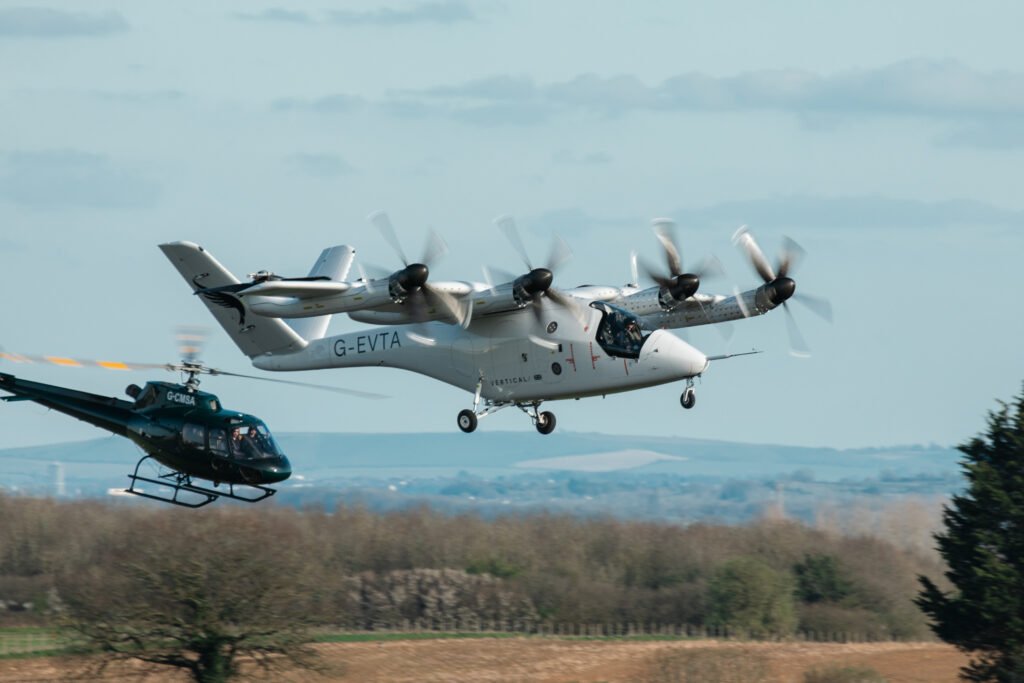
The U.K.’s leading developer of electric vertical takeoff and landing (eVTOL) aircraft is showing that its air taxi concept is not just science fiction.
Last week, Vertical Aerospace completed a piloted transition from hover to forward flight using a full-scale aircraft prototype, the company said Monday. The test demonstrated one half of the core capability of eVTOL models—vertical takeoff with propellers, acceleration to wingborne flight, and deceleration into a vertical landing.
Vertical test pilot Paul Stone was at the controls of the prototype for the flight on Thursday at Vertical’s test center at Cotswold Airport (EGBP). Stone spooled up the aircraft’s propellers for a vertical takeoff and hover, tilted its four front propellers forward, stowed its four rear propellers, and accelerated into wingborne cruise.
“The aircraft performed exactly as designed, transitioning smoothly and under full control—proving the core elements of Vertical’s distributed electric propulsion and tiltrotor technology at full scale, in real flight conditions,” said David King, Vertical’s chief engineer, in a statement.
The test flight ended in a conventional runway landing. Next, Vertical will need to showcase the transition from wingborne flight back to hover. Per the company, that is the last step in its prototype flight test campaign.
“From the moment the front propellers tilted and the aircraft began to accelerate, the response was exactly as the simulation predicted,” Stone said. “The aircraft handled the transition with a level of confidence that gives me great optimism for everything that comes next.”
Vertical is not the first eVTOL developer to complete a transition flight, which it called the “most significant technical milestone” in its history.
American manufacturers Beta Technologies and Joby Aviation achieved piloted transitions from liftoff through touchdown in 2024 and ’25, respectively. Archer Aviation completed a remotely piloted transition but has yet to do so with a pilot in the cockpit. Boeing’s Wisk Aero, which is developing an autonomous eVTOL model, began full-scale prototype flight testing in December and will also need to demonstrate the maneuver.
The milestone comes at a key time for Vertical as the company looks to ramp up its certification efforts.
Vertical in 2025 estimated that it will cost about $700 million to certify Valo, its flagship air taxi. In its latest earnings report, the manufacturer said it had about $93 million in cash and cash equivalents at the end of 2025 and that it expects to receive an additional $28 million through tax relief and government grants.
Combined with $50 million raised in March, that funding will support Vertical’s certification efforts through 2026, it said last week. Also in March, Vertical announced an agreement in principle to raise up to $850 million. It plans to spend about $195 million over the next 12 months as it ramps up flight testing, certification, and manufacturing.
Bringing an Air Taxi to Market
Thursday’s transition flight test will support Vertical’s certification of Valo, unveiled in December in London.
The company has since displayed Valo in New York City, Miami, and Atlanta as it tours the U.S. It has shared potential route maps for New York and Florida. In New York, connections could include John F. Kennedy International Airport (KJFK) and East Hampton Airport (KJPX) on Long Island, and Newark Liberty International Airport (KEWR) and Teterboro Airport (KTEB) in New Jersey. The aircraft could ferry commuters, enable aerial sightseeing, conduct medical transfers, and shuttle people to events at MetLife Stadium across the Hudson River.
At launch, Valo is designed for four passengers. But its cabin is large enough to accommodate six in the future. The air taxi will have an all-electric range of 100 miles, with room for six checked and six carry-on bags. A hybrid-electric variant could extend the range to 300 nm without impacting its 1,200-pound payload.
Valo’s eight battery packs power eight propellers, with four on the front wing tilting forward to support both vertical and cruise flight. Controls consist of a simple joystick, three flight control computers, and Honeywell’s Anthem flight deck and fly-by-wire system.
The transition flight follows nearly two years of testing with VX4 prototypes that have demonstrated individual phases of operation, such as only hover or only wingborne flight. They have also flown in open European airspace and between airports.
Vertical began transition testing in November under a Permit to Fly from the U.K. Civil Aviation Authority, its chief regulator. It seeks concurrent certification with the CAA and European Union Aviation Safety Agency (EASA) for commercial passenger transport by 2028.
Whereas the CAA will hold eVTOL designs to the 10-9 safety standard and commercial airline standards for electronic hardware and software, Vertical believes the FAA will levy lighter requirements. That could make U.S. certification a simple endeavor.
Vertical is conducting testing with three full-scale prototypes and plans to build seven conforming Valo aircraft for formal CAA evaluations. Beyond completing the transition, its goals for 2026 include public demonstrations, producing the first full-scale Valo, and progressing its hybrid-electric variant.
American air taxi rivals are also accelerating flight testing in 2026. As soon as this summer, Beta, Joby, Archer, and Wisk will begin operations under the FAA’s three-year eVTOL Integration Pilot Program (eIPP). Under the eIPP, the regulator will permit certain activities with precertified aircraft—including flights into airports or for revenue—across 26 states.
