


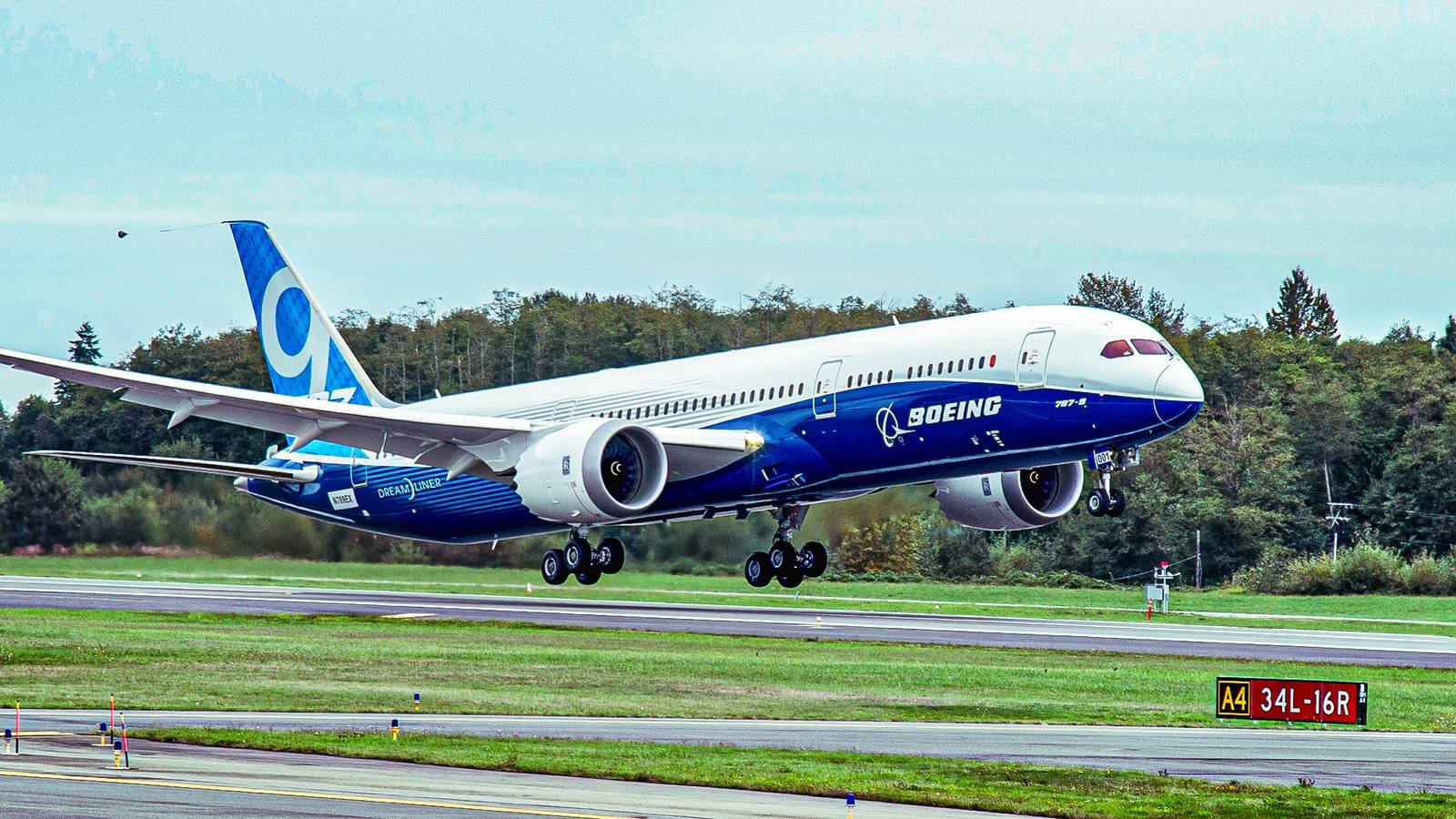
The Boeing 787 has been one of the most consequential aircraft in commercial aviation history. The plane has become history’s second-most ordered widebody, and today, there are over 1,000 in service with dozens of airlines worldwide. While the 787 is often thought of as a ‘new’ aircraft, it’s now been in service for almost 15 years, and 2025 was one of the 787’s best sales years yet, with 368 total orders. For context, the 787 outsold the competing Airbus A330neo and A350 combined in 2025.
The Boeing 787 is one of the most innovative airliners ever built regarding its technology and construction, and the plane’s attributes as a result have allowed it to truly transform modern long-haul flying. While all three variants of the 787 are exceptional planes, the 787-9 is by far the most successful due to its optimal size, exceptional range, and fuel efficiency, while the larger 787-10 is also becoming more popular as it grows in capability. Meanwhile, the smallest 787-8 is no longer being ordered by most airlines as it’s less capable than the 787-9 and has worse per-seat costs.
The Design Of The Boeing 787 Dreamliner
The Boeing 787 is a twin-engine widebody aircraft, built in three variants. The 787-8 is the smallest variant, and is most comparable in size to an Airbus A330-200. The 787-9 is a stretched variant with higher weight capabilities, and is similar in size to an Airbus A330-300. The 787-10 is a simple stretch of the 787-9 with the same weights, and is roughly halfway in length between the Boeing 777-200 and Airbus A380, while retaining the same wing as its smaller siblings.
While the 787 was originally promoted as a Boeing 767 replacement, it can seat nine passengers per row in economy and therefore seats significantly more passengers. However, the plane’s three sizes are attractive to airlines, as it’s significantly smaller than a Boeing 747 or a 777-300ER, which once dominated long-haul flying. While the 787-10 is much closer to these planes in size, it costs virtually the same to operate as the smaller 787-9, meaning that the extra seats are extra gravy.
The 787 is incredibly innovative in its technology, including its lack of a bleed air system, futuristic cockpit, and software systems. The biggest innovation, however, is its construction, as the 787 was the first airliner to be made out of 50% carbon fiber reinforced polymer (CFRP) by weight, and roughly 80% by volume. Composite materials like CFRP are significantly lighter than traditional aircraft aluminum alloys, which means that Boeing could design a significantly lighter aircraft than before. With the 787, however, Boeing instead created a heavier plane but with more capability.
The Engines Of The Boeing 787

In addition to the 787’s construction, its engines are also critical to its performance and efficiency. The Boeing 787 is powered by either the General Electric GEnx-1B or the Rolls-Royce Trent 1000, and both are some of the most impressive jet engines ever built. The GEnx has a bypass ratio of 9.1:1, whereas the Trent 1000 has a bypass ratio of 10:1, and both engines have overall pressure ratios in excess of 50:1, whereas a prior generation engine like the Rolls-Royce Trent 800 has a pressure ratio of roughly 40:1.
The GEnx and Trent 1000 make greater use of advanced materials like CFRP in their construction, and they also have fewer parts than prior engines. While the Rolls-Royce Trent 1000 has suffered severe reliability issues across its service history, the GEnx-1B has been remarkably reliable for airlines, lowering maintenance costs for airlines since the engines have fewer issues and last longer. In addition, the 787’s lack of a bleed air system further lowers fuel burn.
The Trent 1000 and GEnx engines are extremely fuel-efficient, which has contributed to the 787’s overall success. The GEnx has been the more dominant of the two engines, but the Trent 1000 has also been ported to the Airbus A330neo as the Trent 7000, while Rolls-Royce has been continuously improving the Trent 1000’s durability and fuel efficiency to better compete against the GEnx.

Why Is United Airlines The Only US Operator Of This Modern Widebody Aircraft?
The 787-10 has sold fewer than 400 examples, and its only US operator is United.
The Boeing 787 Compared To Its Predecessors

Historically, the Boeing 747 was the dominant aircraft type for long-range flying, and its unmatched range was the primary reason behind its sales success. This peaked with the Boeing 747-400, which was the most successful 747 model with 694 sales, and had a range of nearly 7,300 NM (13,500 km). The Boeing 747 was largely succeeded by the Boeing 777-300ER in the 2000s and early 2010s, as it was slightly smaller than the 747-400 while being significantly more efficient and having virtually the same range.
But although the 777-300ER was an improvement over the 747 in terms of fuel efficiency, it’s still a giant aircraft that will seat between 300 and 370 passengers in many configurations. A Boeing 787-9, in contrast, will typically seat 220 to 290 passengers while burning a fraction of the fuel. Meanwhile, its range is 7,875 NM (14,585 km) when specced with the latest Maximum Takeoff Weight (MTOW) of 259 tons. This means that it’s one of the most capable airliners ever built, while being small and therefore low-risk.
Aircraft | Entry-Into-Service | MTOW | Range |
|---|---|---|---|
Airbus A350-1000 | 2018 | 322 tons | 9,000 NM (16,700 km) |
Airbus A340-500 | 2003 | 380 tons | 9,000 NM (16,700 km) |
Boeing 777-200LR | 2006 | 347.5 tons | 8,555 NM (15,850 km) |
Airbus A350-900 | 2015 | 283 tons | 8,500 NM (15,750 km) |
Airbus A380-800 | 2007 | 575 tons | 8,100 NM (15,000 km) |
Boeing 787-9 | 2014 | 259 tons | 7,875 NM (14,585 km) |
Airbus A340-600 | 2002 | 380 tons | 7,800 NM (14,450 km) |
Boeing 747-8i | 2012 | 447 tons | 7,800 NM (14,450 km) |
Boeing 777-300ER | 2004 | 351 tons | 7,370 NM (13,649 km) |
Boeing 747-400 | 1989 | 397 tons | 7,285 NM (13,490 km) |
Boeing 777-200ER | 1997 | 298 tons | 7,065 NM (13,084 km) |
But while ultra-long-haul routes are flashy and exciting, the 787 also excels on shorter routes. In practice, a 787-9 typically burns roughly the same amount of fuel as a Boeing 767-300ER, but will often carry close to 50 additional passengers. The 767 was popular with airlines because of its small size and low operating cost, so swapping a 767 for a 787-9 greatly increases revenue potential. Meanwhile, the 787-10 adds another 20-40 seats, and even the 787-10 has significantly more range than a 767, at 6,760 NM (12,519 km) with the latest 260-ton MTOW option.
The Boeing 787’s Impact On Airline Networks

The Boeing 787 was promoted by Boeing as enabling ‘point-to-point routes’, in which smaller cities could be connected directly without passengers having to connect through a third airport, as is the case in the traditional ‘hub-and-spoke’ model. This didn’t end up happening, as airlines instead are mainly using the 787 to open up service to smaller spokes. Because of the 787’s range and overall efficiency, these new routes range in length from British Airways’ transatlantic flights to Cincinnati, all the way to Qantas’ nonstop European routes from Perth.
Four out of the world’s top ten longest flights are operated by the Boeing 787-9, and nine of the world’s top 25 longest flights use the 787-9. While most of the routes that it operates could have technically been flown by the Boeing 747 or 777, these planes were both larger and more expensive to operate, which meant that they could only open up long routes between major cities, such as New York and Hong Kong. These planes would not have been able to economically operate routes such as Dallas/Fort Worth to Brisbane or Vancouver to Bangkok.
While the shine of the 787 may have dulled slightly as the plane has become more common and therefore normalized, its combination of efficiency and capability remains game-changing. Ultra-long-haul routes are expensive to operate and have traditionally been quite sensitive to oil prices, but they’ve exploded in popularity and have persisted across the past several years. Compared to before, when only two large cities could support ultra-long-haul routes, the 787-9 has now enabled hundreds of new city pairs to be connected nonstop.

This Is How Fast The Boeing 787 Dreamliner Can Fly
All three Dreamliner variants can reach the same maximum speed.
Why The Boeing 787 Wins Against Rivals

The Boeing 787’s contemporary is the Airbus A350, but the A350 is a fundamentally larger and more capable aircraft. The A350-900 is slightly smaller than the Boeing 787-10, while the A350-1000 is sized identically to the Boeing 777-300ER, and both variants are heavier with larger wings than the 787 to support higher gross weights that allow longer ranges. The A350-900 can be specced with an MTOW of 283 tons and fly a distance of 8,500 NM (15,750 km), while the A350-1000 can be rated for up to 322 tons and fly a distance of 9,000 NM (16,700 km).
The Airbus A330neo is sized much closer to the Boeing 787-8 and 787-9 variants, but the A330-900 lacks the range of the 787-9, while the A330-800 is too small and too heavy to be economical, similar to the 787-8. The advantage of the A330neo is pricing, low integration costs for existing A330 operators, as well as a small efficiency advantage on shorter routes, up to roughly 4,000 NM (7,400 km). The A330neo hasn’t been nearly as popular as either the A350 or 787, but it was also far cheaper to develop.
Aircraft | Sales |
|---|---|
Boeing 787-9 | 1,445 |
Airbus A350-900 | 1,081 |
Boeing 787-10 | 496 |
Airbus A330-900 | 461 |
Boeing 787-8 | 424 |
Airbus A350-1000 | 367 |
Airbus A350F | 101 |
Airbus A330-800 | 12 |
Boeing 787 | 2,365 |
Airbus A350 | 1,529 |
Airbus A330neo | 473 |
Airbus has two products to capture the low-end and high-end of the widebody market, while Boeing has one product that performs just as well or even better on the majority of missions. The A350 burns slightly more fuel than the 787, but it can fly further and carry more payload. However, the 787 is also a lower-risk aircraft to operate, which has boosted its sales against the A350, while its superior fuel burn on many longer routes has won it contests against the A330neo.
