


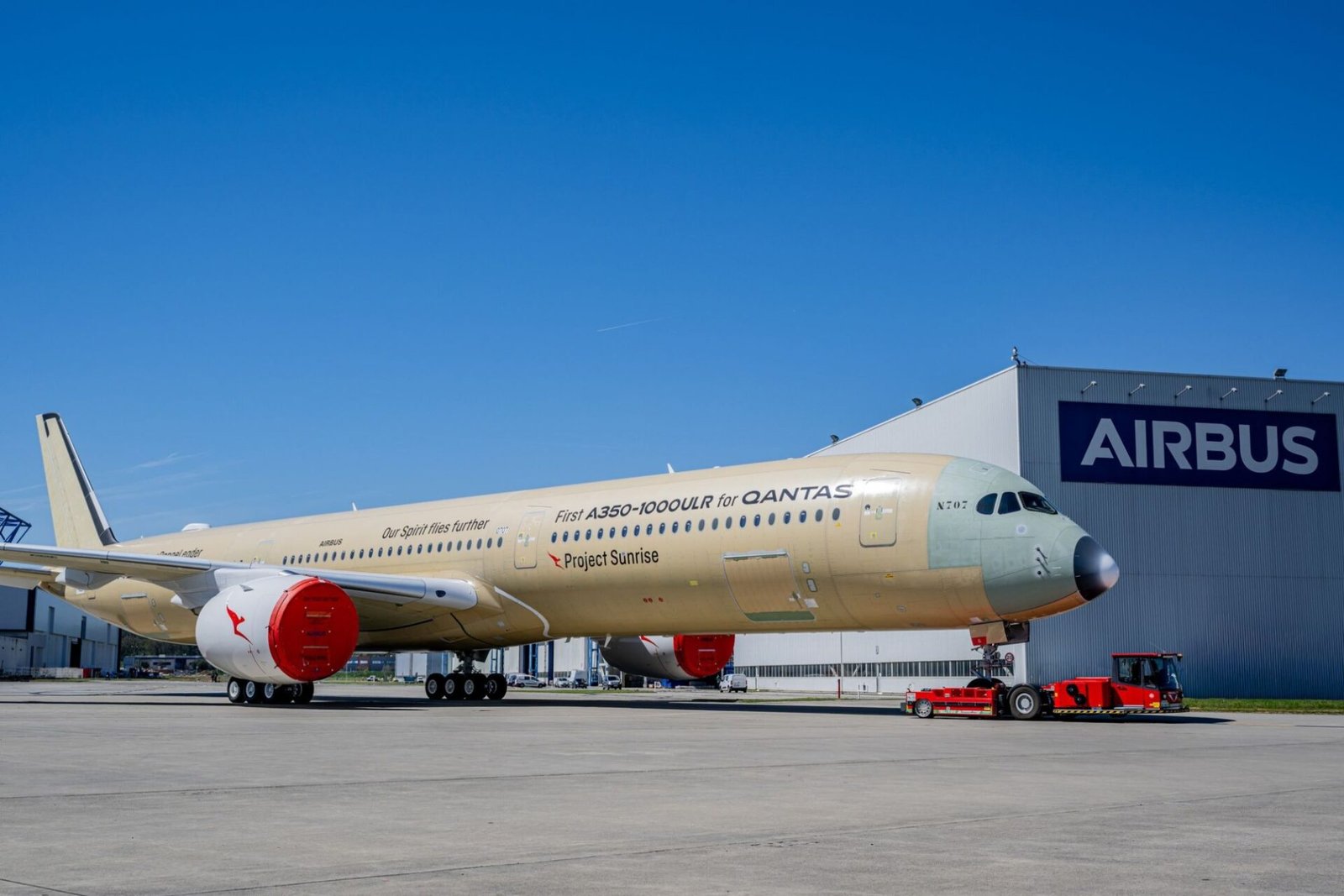
Qantas’ first ultra-long-range A350 has emerged from the Airbus assembly line in Toulouse, France, bringing the airline’s long-awaited Project Sunrise closer to reality.
The aircraft, carrying the French test registration F-WZNK, rolled out on April 12, 2026, fully assembled with Rolls-Royce Trent XWB-97 engines, wings, fuselage, and landing gear attached. It will now undergo ground checks followed by a two-month flight testing program before delivery to Qantas by the end of this year.
Commercial services are expected to begin in early 2027.
What Project Sunrise means for travelers
When operations launch, Qantas will offer nonstop flights from Sydney Kingsford Smith International Airport (SYD) to both London-Heathrow Airport (LHR) and New York’s John F. Kennedy Airport (JFK), covering nearly 10,000 nautical miles over approximately 22 hours.
The direct routing will shave up to four hours off current one-stop options and allow the carrier to bypass traditional Middle Eastern hub connections on Europe-bound services.
The extended range comes from an additional 20,000-liter fuel tank installed in the rear of the aircraft.
Fewer seats, more space
The Qantas A350-1000ULR will carry just 238 passengers, significantly fewer than the roughly 350 seats found on standard A350 configurations. About 40% of the cabin will be dedicated to premium classes, including First, Business, and Premium Economy.
Onboard amenities include a Wellbeing Zone designed to encourage movement during the lengthy flights, along with healthy snacks and drinks. The cabin will also feature lighting calibrated to circadian rhythms to help combat jet lag, plus complimentary high-speed Wi-Fi.
A nod to aviation history
Qantas plans to name each of its 12 A350s on order after stars, a tribute to the airline’s World War 2-era Catalina flying boat operations. Those wartime endurance flights between Australia and Sri Lanka (then Ceylon) stayed airborne long enough for crews to witness two sunrises, inspiring the Project Sunrise name nearly a century later.
First announced in 2017, the project faced significant delays due to the COVID-19 pandemic and ongoing supply chain challenges at Airbus. The rollout in Toulouse marks a turning point after years of setbacks.
The name of the first aircraft in the fleet is expected to be revealed by the middle of 2026.
