Skip to main content
This article is published in
Aerospace Daily & Defense Report part of Aviation Week Intelligence
Network (AWIN), and is complimentary through
Apr 24, 2026. For information on becoming an AWIN Member to
access more content like this, click here.
Robert Wall
April 17, 2026
Credit: BAE Systems
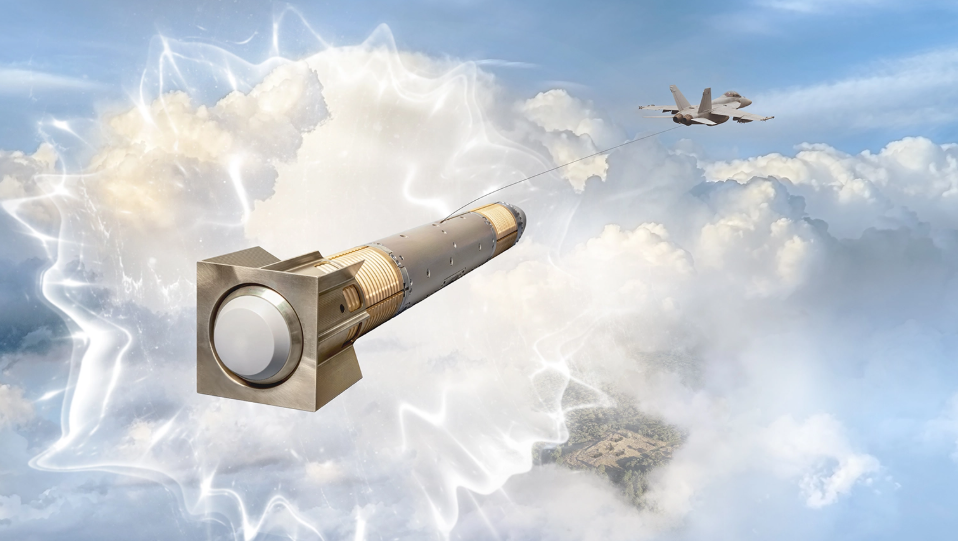
The U.S. Navy is gearing up for the first procurement of dual-band decoys for Boeing F/A-18E/Fs to boost the fighter’s self-protection capability against radar-guided missiles.
Almost eight years after embarking on the effort to field such a capability “as soon as feasibly possible,” the Navy said it plans to buy around 120 dual-band decoys in the coming fiscal year and the subsequent two budget cycles. Production should reach around 20 decoys a month. It plans a contract award in June 2027, the service said in an April 17 market survey. Decoy deliveries should start as early as within ten months of contract award but no later than 18 months after, it added.
The system would improve missile-defeat capabilities beyond the standard ALE-50 towed decoy and the ALE-55 fiber-optic towed decoy. These systems are reeled out by fighters and emit a signal to lure enemy missiles to attack them rather than the fighter. Going to a dual-band system is intended to keep pace with the evolution in threat systems that operate over different frequencies.
BAE Systems says its dual-band decoy that uses gallium nitride-based solid-state power amplifiers maintains all the interfaces of the ALE-55. The system can operate with different onboard technique generators, it noted. The Navy said its contract would also cover other customer requirements, without naming them.