


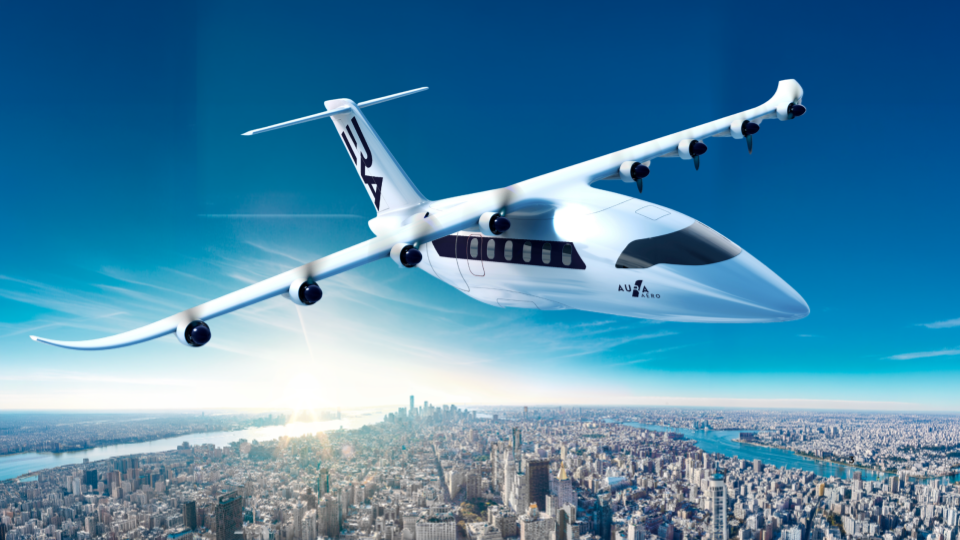
French manufacturer Aura Aero is hoping that fresh funding will get its ambitions to launch a 19-seat, hybrid-electric regional airliner on track.
The manufacturer last week said it is now targeting 2027 for the first flight of its flagship Era, a slip from earlier predictions of late 2026. When asked about the test program by FLYING, Jérémy Caussade, co-founder and CEO of Aura, committed only to first flight in “less than two years”—meaning it could slip further to 2028. Late 2029 or early 2030 remains the certification target for the model.
Caussade said Aura will begin building aircraft at its Toulouse-Francazal Airport (LFBF) facility in 2029 and at its site at Daytona Beach International Airport (KDAB) in Florida in 2030. Those too are delays.
As recently as March, Aura planned to open the Toulouse facility—where it is targeting annual production of 100 Era aircraft and 50 of its Integral family of aircraft by 2035—in 2028. The 500,000-square-foot Florida site, also designed to churn out 100 Era aircraft per year, was previously scheduled to open that year as well.
A windfall of cash could help rein in those schedules—or at least keep them static.
Aura last week raised 50 million euros in a Series A round that included Bpifrance—the French public sector investment bank—the European Innovation Council (EIC) Fund, Safran Corporate Ventures, and Florida Opportunity Fund. It received a further 120 million euros in subsidies from the EIC Fund, French government, and state of Florida.
Another 170 million euros from the state of Florida and Space Florida, which Caussade said will come at the start of 2027, is earmarked for the company’s planned Era assembly site in Daytona Beach. Last year, the company opened a smaller factory in Florida to produce its Integral family of two-seat aerobatic trainers, including the all-electric Integral E.
“This dual industrial footprint is a key part of Aura Aero’s strategy to combine scale, responsiveness, and cost competitiveness, while staying close to our main markets,” Caussade told FLYING.
Aura in a news release said the new funding—about $400 million in total—is equal to what it has raised since its founding.
“We are already scaling up our industrial capacity to meet demand and ensure on-time delivery for our customers,” Caussade said.
Aura’s Next Era
Despite some hiccups, Caussade believes Aura is ready to move from concept to execution.
The company said it has more than 700 preorders for Era, including 20 firm orders with deposits. Caussade said more than half of those commitments are from North America. About one-third are from the U.S.
“We see strong demand on both sides of the Atlantic,” he said. “The U.S. market is growing fast…Overall, we expect a fairly balanced split in the long term, with the U.S. potentially becoming as large as or even slightly larger than Europe.”
Caussade expects similar demand for the Integral family.
“The U.S. represents a particularly large opportunity, as it is the world’s biggest pilot training market, with very high fleet renewal needs and a growing demand for modern, cost-efficient, and safer training aircraft,” he said. “Given this, the U.S. market for Integral could ultimately represent a significant share, especially in the long term as training demand continues to grow globally.”
Aura’s Integral R, a 150 knots model with a range of 530 nm designed for recreational flyers, entered service last April. The company delivered three in 2025 and expects to sell 15 more this year, for about 450,000 euros each. The Integral S, designed for training, is progressing toward certification.
With new funding, Aura hopes to advance its next-generation models—Era, Integral E, and the Enbata medium-altitude long endurance (MALE) drone.
The Integral E—the family’s all-electric variant that Aura says will have a flight endurance of up to 90 minutes—is already in testing, with certification targeted for 2027.
Caussade told FLYING that Era’s certification is “progressing as planned” but has also faced “its share of challenges.” He said the company will begin manufacturing parts for the first Era prototype in the coming weeks. He added that the program is nearing a “crucial milestone” without specifying what it could be.
Last week, Caussade implied that Aura may need additional funding to support future phases of testing. It hopes for Era to offer a cruise speed of 300 knots and range of 900 nm, with plans for business, cargo, and medical configurations.
Aura aims to fly Enbata, billed as Europe’s version of the General Atomics MQ-9 Reaper, by the end of 2026. Developed with partners including Thales and Safran, the drone will have military use cases such as reconnaissance as well as civil applications such as search and rescue. It is designed to fly autonomously with up to one ton of cargo. Caussade said the design has been “fully finalized,” with construction on the wing and fuselage underway.
Seeking sales to defense customers could give Aura more funding to pursue its other projects. The company’s Integral M is designed to train future armed forces pilots. It is also developing a military variant of Era, the Intruder, that Caussade said will be “particularly quiet” and capable of operations with short runways.
“The aircraft can carry out various military missions such as reconnaissance, troop or official transport, medical evacuation, or cargo operations,” he said.
In addition, Aura is looking to get aircraft into customers’ hands more easily with options such as leasing.
“Beyond that, we are indeed exploring more innovative and disruptive models that would enable our customers to operate our aircraft, potentially including usage-based approaches, such as paying per flight hour rather than purchasing the aircraft outright,” starting with Integral, Caussade said.
That kind of financing model could give Aura a leg up on European competitors such as Maeve Aerospace, VoltAero, and Elysian Aircraft. North American rivals include Heart Aerospace—which recently moved operations from Sweden to Los Angeles—Evio, Horizon Aircraft, and a handful of electric air taxi developers pursuing regional, hybrid-electric designs.
