


With AMA: Energy 2026 just around the corner, 3D Printing Industry is taking a closer look at the role of additive manufacturing in the energy sector. In this critical industry, a missing forged component does not just delay a shipment. It can ground an entire maintenance operation for the better part of a year.
Forging queues, foundry backlogs, and multi-supplier coordination have long been accepted as the cost of doing business in energy manufacturing. But as lead times stretch beyond twelve months for critical high-performance alloy components, more OEMs are looking at large-scale metal AM as a way to take back control of their supply chains.
I sat down with Yash Bandari, Director of Business Development at Fastech Engineering to understand how that shift is playing out on the ground and what it will take for the approach to scale across the sector.
The 2026 edition of our AMA: Energy online conference returns this month. Register now!
Large-Scale AM Enters the Supply Chain Conversation
When Bandari describes how these conversations typically begin, the trigger is almost always accumulated pressure. “Energy OEMs typically approach us when they face long lead times, supply chain constraints, or limited manufacturing flexibility with traditional processes such as forging or casting,” he explains.
For most OEMs that reach out to Fastech, finding an alternative is already a settled decision. The real challenge is qualifying one fast enough to matter.
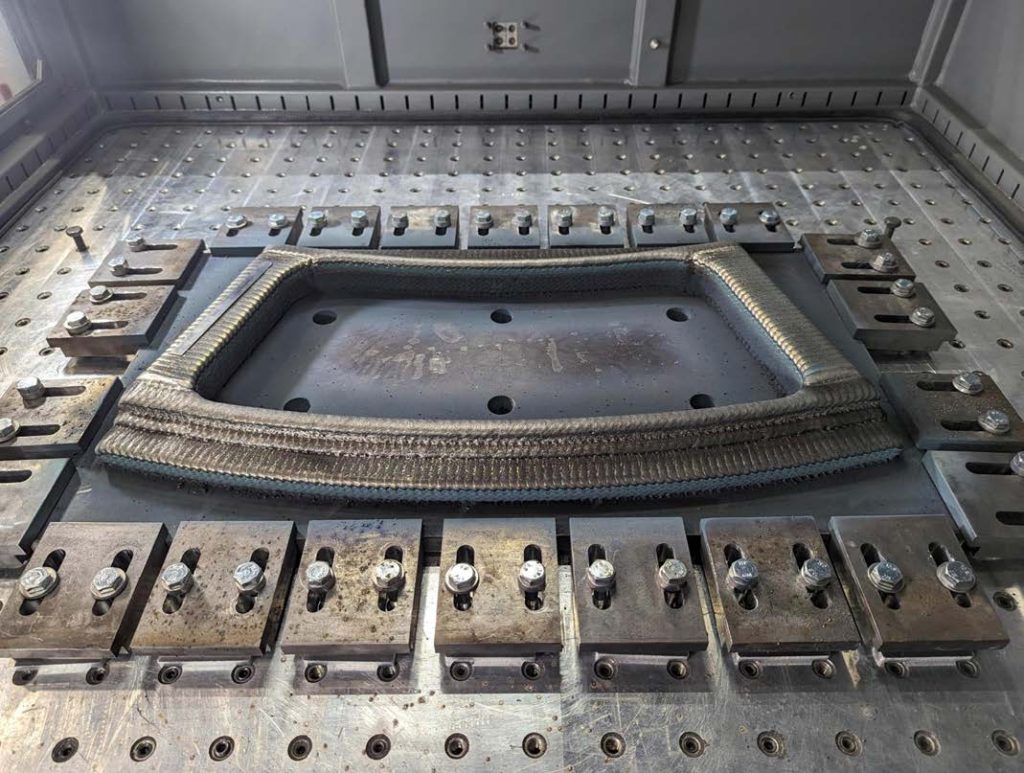
The contract manufacturer’s solution to that pressure relies on two wire-based processes. Wire arc additive manufacturing (WAAM) deposits material at rates of 1 to 5 kg/h using a MIG-based system, suiting large and thick components where deposition speed is the priority.
On the other hand, laser-wire directed energy deposition (LW-DED) runs slower at deposition rates of 0.4 to 0.6 kg/h but produces a finer surface finish, making it better suited to parts with tighter geometric requirements.
Both feed into CNC machining and dimensional inspection handled in-house. These processes “allow material to be added precisely where it is needed,” Bandari says, “reducing waste and minimizing machining compared to traditional subtractive approaches.”
The Director shared a recent example where Fastech manufactured a nickel-alloy component for Siemens Energy using the WAAM process, produced as a new build. The shift from conventional sourcing to additive did not happen overnight. “Engineering groups are often the first to evaluate additive manufacturing because it allows them to assess design flexibility, material performance, and near-net-shape manufacturing benefits,” Bandari explains.
“Once technical feasibility is demonstrated, procurement teams begin to evaluate AM as a supply chain strategy, particularly when it can reduce dependence on large forgings, specialized castings, or constrained suppliers.” Leadership alignment, he adds, is what ultimately allows the transition to stick.
Where Additive Manufacturing Makes Economic Sense
Bandari is careful not to overstate where the technology earns its place, and he is direct about the circumstances where it makes sense. The strongest candidates are large, high-value components with long lead times or constrained supply chains.
That typically means turbine hardware, structural brackets, manifolds, and large housings in nickel-based alloys. Geometries with cylindrical shapes, rings, or large hollow structures benefit most from near-net-shape deposition, which cuts out significant machining, and that reduction in machining translates directly into cost savings.
For instance, on a stainless steel component, LW-DED came in around $10,000 less than WAAM due to reduced machining time alone. For nickel-based alloys, where machining is considerably more expensive, that gap can widen to between $40,000 and $50,000.
He is equally candid about the parts where conventional manufacturing still holds the stronger hand. “High-volume components with simple geometries are still typically more cost-effective to produce through casting, forging, or conventional machining,” he says. “Similarly, parts that require extremely tight tolerances across the entire geometry are often better suited to traditional manufacturing methods.”
Adding to that, repair and refurbishment are growing in relevance alongside new-build work. For ageing infrastructure where original tooling or suppliers no longer exist, DED offers an option that goes beyond lead time reduction. “Additive manufacturing allows components to be recreated or redesigned based on digital models,” Bandari says, “enabling operators to continue maintaining critical infrastructure even when traditional manufacturing routes are no longer practical.”
The same thinking is starting to reshape how energy companies approach spare parts. Maintaining large physical inventories of high-performance alloy components is expensive, and “large-scale AM shifts spare parts strategies from stockpiling physical components to maintaining qualified digital manufacturing capabilities,” Bandari says.
“This approach can reduce the need for large spare part inventories while still ensuring availability when maintenance events occur.” For legacy systems where original tooling is gone entirely, on-demand manufacturing from qualified digital models may be the only viable path.
Qualification and Certification Remain the Critical Barriers
Beyond the manufacturing process itself, qualification and certification remain the most significant barriers to adoption. “Establishing robust qualification procedures and material datasets takes time and investment,” the Director says.
Energy systems operate in demanding environments where component failure carries serious consequences, and OEMs need confidence that 3D printed parts match the mechanical properties and traceability requirements of forged or cast equivalents.
For alloys like Inconel 625, 718, and Haynes 282, the validation work is substantial. These materials are well understood through conventional processes, but their behaviour through wire-based additive deposition requires independent verification before OEMs will commit to production.
“The main bottlenecks typically occur at the intersection of material qualification, inspection protocols, and certification requirements,” Bandari says. “While the manufacturing technology itself has advanced significantly, broader adoption often depends on how quickly the surrounding ecosystem continues to mature.”
What emerges from the conversation is a picture of adoption that is selective and deliberate, moving component by component where the supply chain case is clearest.
“In practice, additive manufacturing provides the most value when it addresses clear supply chain challenges, material efficiency concerns, or geometric constraints that conventional manufacturing processes struggle to accommodate,” Bandari says.
The technology has been production-ready for some time. But the pace of adoption now depends on how quickly the qualification and certification infrastructure catches up to it.
The 2026 edition of our AMA: Energy online conference returns on April 30th. Register now!
3D Printing Industry is inviting speakers for its 2026 Additive Manufacturing Applications (AMA) series, covering Energy, Healthcare, Automotive and Mobility, Aerospace, Space and Defense, and Software. Each online event focuses on real production deployments, qualification, and supply chain integration. Practitioners interested in contributing can complete the call for speakers form here.
To stay up to date with the latest 3D printing news, don’t forget to subscribe to the 3D Printing Industry newsletter or follow us on LinkedIn.
Explore the full Future of 3D Printing and Executive Survey series from 3D Printing Industry, featuring perspectives from CEOs, engineers, and industry leaders on the industrialization of additive manufacturing, 3D printing industry trends 2026, qualification, supply chains, and additive manufacturing industry analysis.
Featured image shows AMA: Energy 2026. How 3D Printing is used in the Energy Sector.
