


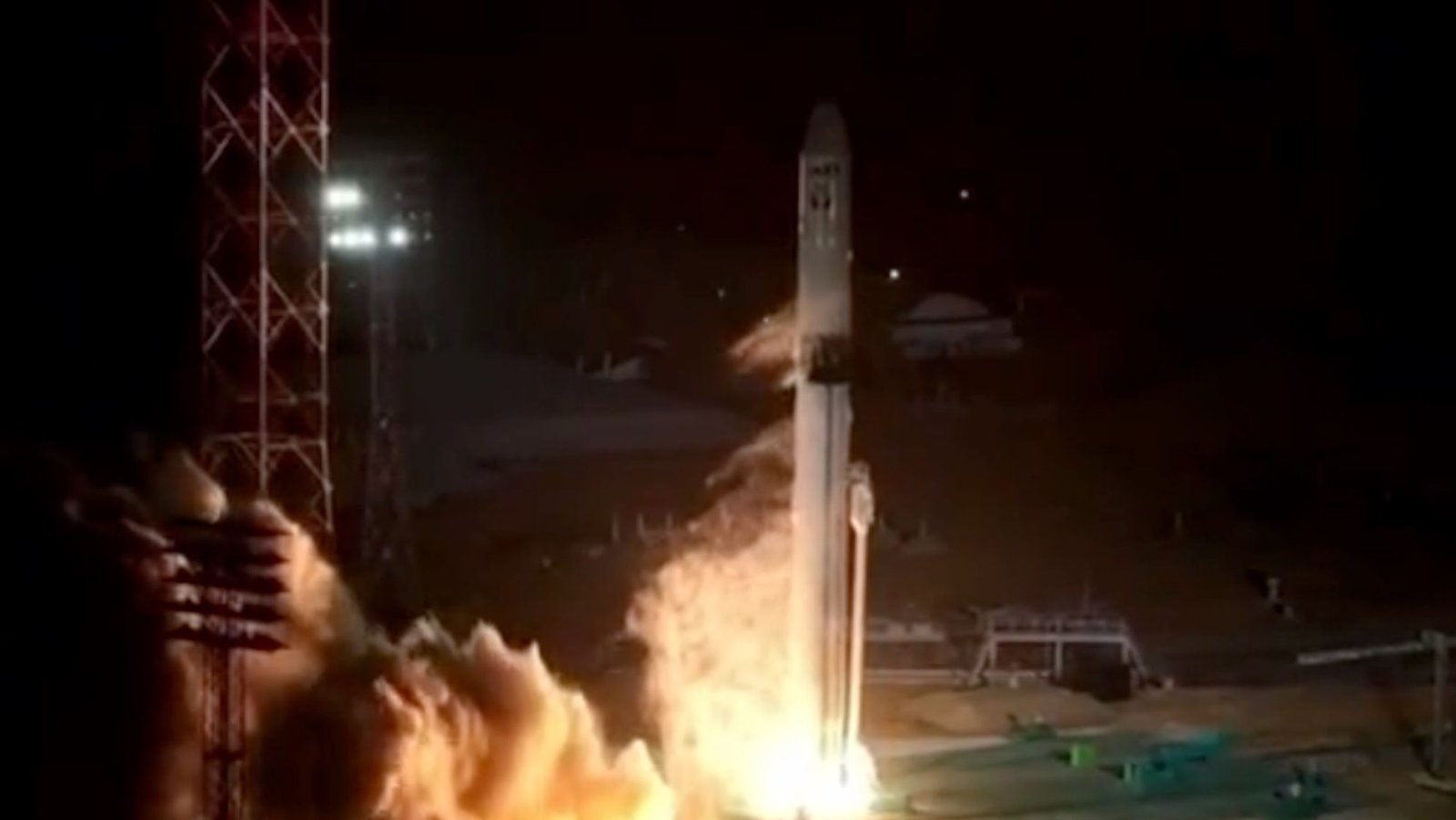
Russia’s new Soyuz 5 rocket has taken to the skies at long last.
The Soyuz 5 lifted off for the first time ever on Thursday (April 30), rising off a pad at the Russia-run Baikonur Cosmodrome in Kazakhstan at 2:00 p.m. EDT (1800 GMT; 11:00 p.m. local time in Baikonur).
“The first test launch of the new Soyuz 5 rocket was a success!” officials with Russia’s federal space agency, known as Roscosmos, said via the Telegram app on Thursday.
“The first and second stages of Soyuz 5 performed as planned, and a mockup was launched onto the calculated suborbital trajectory, followed by a reentry into an area in the Pacific Ocean previously closed to shipping and aviation,” they added in another Telegram post.
Thursday’s launch was a long time coming for the Soyuz 5, which has been in development since 2017. It “was designed to replace the medium-class Zenit vehicles built in Ukraine and provide Russia with a first-stage booster for [a] future super-heavy rocket,” according to RussianSpaceWeb.com.
Roscosmos originally hoped “that the low-cost vehicle would complement the Angara family of rockets for domestic needs and would make Russia competitive again on the international launch market,” the outlet added.
The Soyuz 5’s homegrown nature took on added importance for Russia in February 2022, when the nation invaded Ukraine, which has long been a powerhouse of rocket design and manufacturing. That invasion is ongoing, so Ukraine is also putting its rocketry expertise to use against Russia these days.
It’s unclear, however, if the new rocket will attract international customers. Russia has lost most of its space partnerships due to the Ukraine invasion, and the Soyuz 5 doesn’t seem like enough of a breakthrough to revive any.
The rocket is comparable in size and lifting power to SpaceX‘s workhorse Falcon 9; the Soyuz 5 can haul about 20 tons (18 metric tons) to low Earth orbit, compared to 25.1 tons (22.8 metric tons) for the SpaceX launcher. But the Falcon 9’s first stage is reusable, whereas the Soyuz 5 is a completely expendable vehicle.
