


WASHINGTON — More than two months after NASA announced revised plans for the Artemis 3 mission, the agency has provided few details about the mission itself amid signs its schedule may be slipping.
NASA announced Feb. 27 it was revising its plans for future Artemis missions, with Artemis 3 — originally planned to be the program’s first crewed landing attempt on the moon — converted into a test flight in low Earth orbit, where Orion will rendezvous with lunar landers being developed by Blue Origin and SpaceX.
NASA billed the mission as an analog to Apollo 9, the early 1969 mission that tested the Lunar Module in low Earth orbit before the Apollo 11 landing later that year. The agency said a successful Artemis 3 would set up landing attempts on Artemis 4 in early 2028 and Artemis 5 in late 2028.
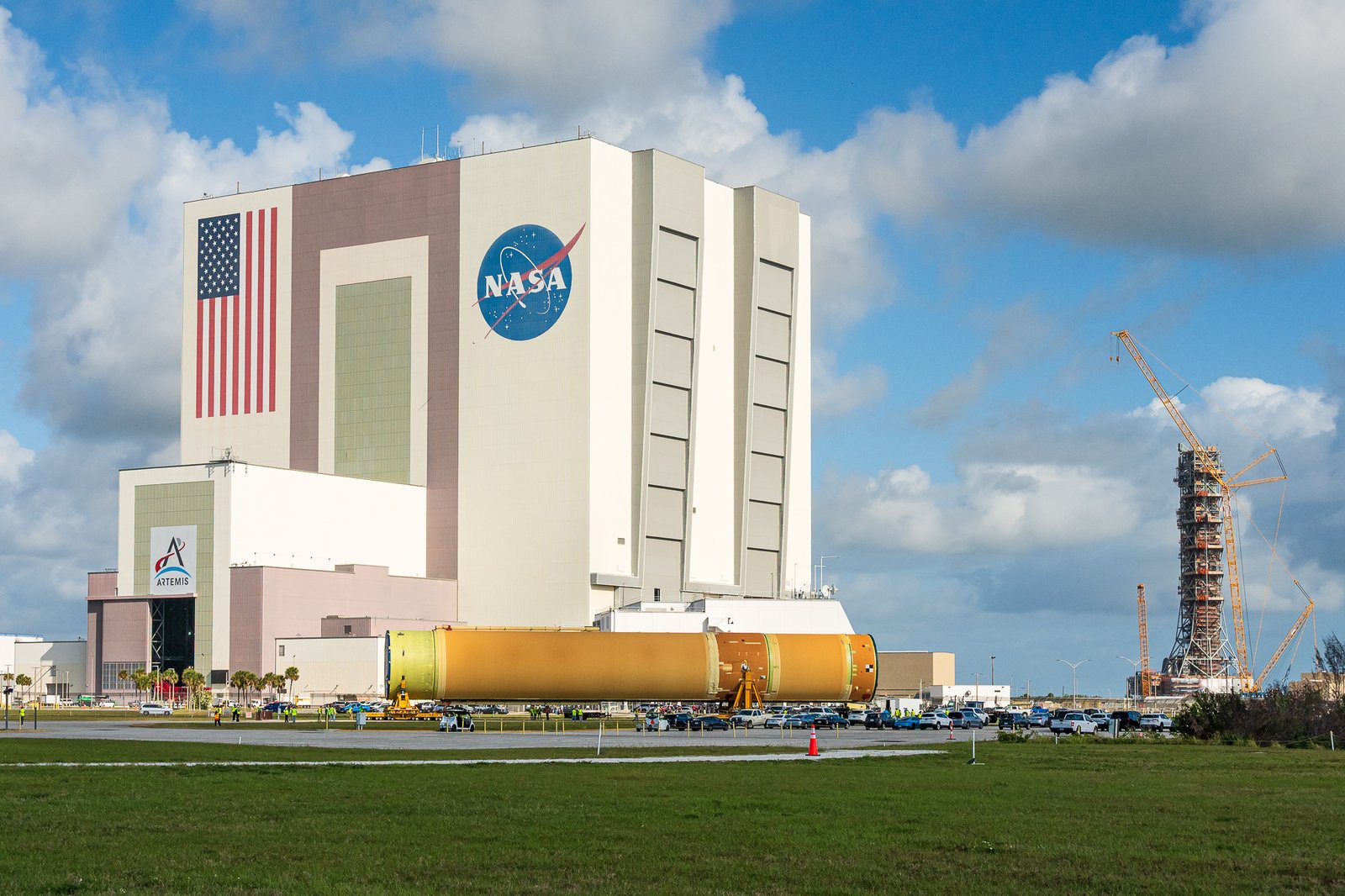
Many of the elements needed for Artemis 3 are coming together at the Kennedy Space Center. Most of the core module of the Space Launch System arrived at the center and was moved into the Vehicle Assembly Building April 28. There, workers will attach the core stage’s engine section, which arrived at the center last summer.
Segments for the SLS solid rocket boosters started arriving at KSC in April, with the remainder expected to arrive by train from Northrop Grumman’s Utah factory in the summer. Work continues on the Orion spacecraft for Artemis 3, including mating its crew capsule and service module in the summer.
But while those preparations continue, the agency has provided few details about the revised mission profile. Even high-level details, like the planned orbit for the mission and its duration, have yet to be announced by NASA.
The change in the mission from a lunar flight to one in LEO is unlikely to require significant changes to Orion itself. “From an Orion perspective, it’s not much different,” said Howard Hu, NASA Orion program manager, in an interview shortly before the Artemis 2 launch. Most of the work, he said, involved reanalyzing various abort scenarios and ensuring sufficient power and thermal control for the spacecraft in Earth orbit.
There may be changes, though, to SLS. Artemis 3 was to use the final Interim Cryogenic Propulsion Stage, or ICPS, a stage based on the Delta 4 upper stage. With NASA canceling the Exploration Upper Stage intended for later SLS launches, and with Artemis 3 now remaining in low Earth orbit, there has been discussion about flying SLS without an upper stage, preserving the ICPS for Artemis 4 and giving engineers more time to modify the Centaur upper stage for later Artemis missions.
The concept of operations for the Artemis 3 mission remains uncertain. “What our ultimate goal would be is to be able to do the orbital rendezvous, proxops, maybe docking with both providers,” Kent Chojnacki, deputy program manager for NASA’s Human Landing System (HLS) program, said in another interview just before the Artemis 2 launch.
That coordination will be challenging. “We have to find a common orbit. We have to find a common launch opportunity, and orchestrating a launch of an SLS, two HLSs will be some kind of feat,” he said. “We’re working on what the art of the possible is there.”
When NASA announced the revised Artemis 3 mission, the agency said another objective of the mission would be to test lunar spacesuits being developed by Axiom Space. However, the company said at the Space Symposium in April it was still awaiting details about how those tests would work.
“We’ve provided the agency with a number of options” for testing the suit on Artemis 3, said Russell Ralston, senior vice president and general manager of extravehicular activity at Axiom. “It would certainly be a valuable exercise, but we just don’t have the specifics at this time.”
That test could instead take place on the space station. “The agency has made it clear we’re going to fly a suit next year,” said Jonathan Cirtain, president and chief executive of Axiom Space. “Is that to the International Space Station? Is that with the HLS providers? To be determined.”
Another unknown is the crew for Artemis 3. NASA announced the Artemis 2 crew in April 2023 ahead of a launch then planned for late 2024. The agency, though, has not revealed a crew for the mission.
“I believe we’re not far away from announcing the Artemis 3 crew,” NASA Administrator Jared Isaacman said in an April 30 ABC News interview. “When you think about your timing, when you’re a year-plus out from a mission, that’s when you want to get them into training.”
All those uncertainties have raised doubts about the schedule for Artemis 3. NASA said in February it was targeting a launch by mid-2027.
“Our direction is no earlier than March, no later than June” of 2027, Chojnacki said of the Artemis 3 schedule.
More recently, though, Isaacman has suggested the mission would slip to late 2027. “I’ve received responses from both [HLS] vendors, both SpaceX and Blue Origin, to meet our needs for a late 2027 rendezvous and docking, and test the interoperability of both landers, in advance of a landing attempt in 2028,” he said at a hearing of a House appropriations subcommittee April 27.
“You’re talking some time mid to late 2027 when Artemis 3 would launch,” he said in the ABC News interview.
A slip to late 2027 would make it unlikely that NASA could attempt two human lunar landing missions in 2028. In the announcement about the revised Artemis 3 plans in February, the agency talked about launching missions on a cadence of every 10 months. However, if the launch of Artemis 3 slips beyond April 2027, the agency won’t be able to fly both Artemis 4 and 5 in 2028 even if it manages to launch later missions every 10 months.
Isaacman, at the House hearing, stuck to the goal of two crewed lunar landing attempts in 2028, saying the agency had sufficient funding to do so. “Maybe two at bats in 2028,” he said.
