


A product designer has a discontinued component on her desk, something a client needs replicated exactly. The geometry is all there in the physical part. What’s missing is a reliable way to turn it into a file, because the scanners she’s tried before either wash out on the polished metal finish or lose tracking on the featureless curved surfaces.
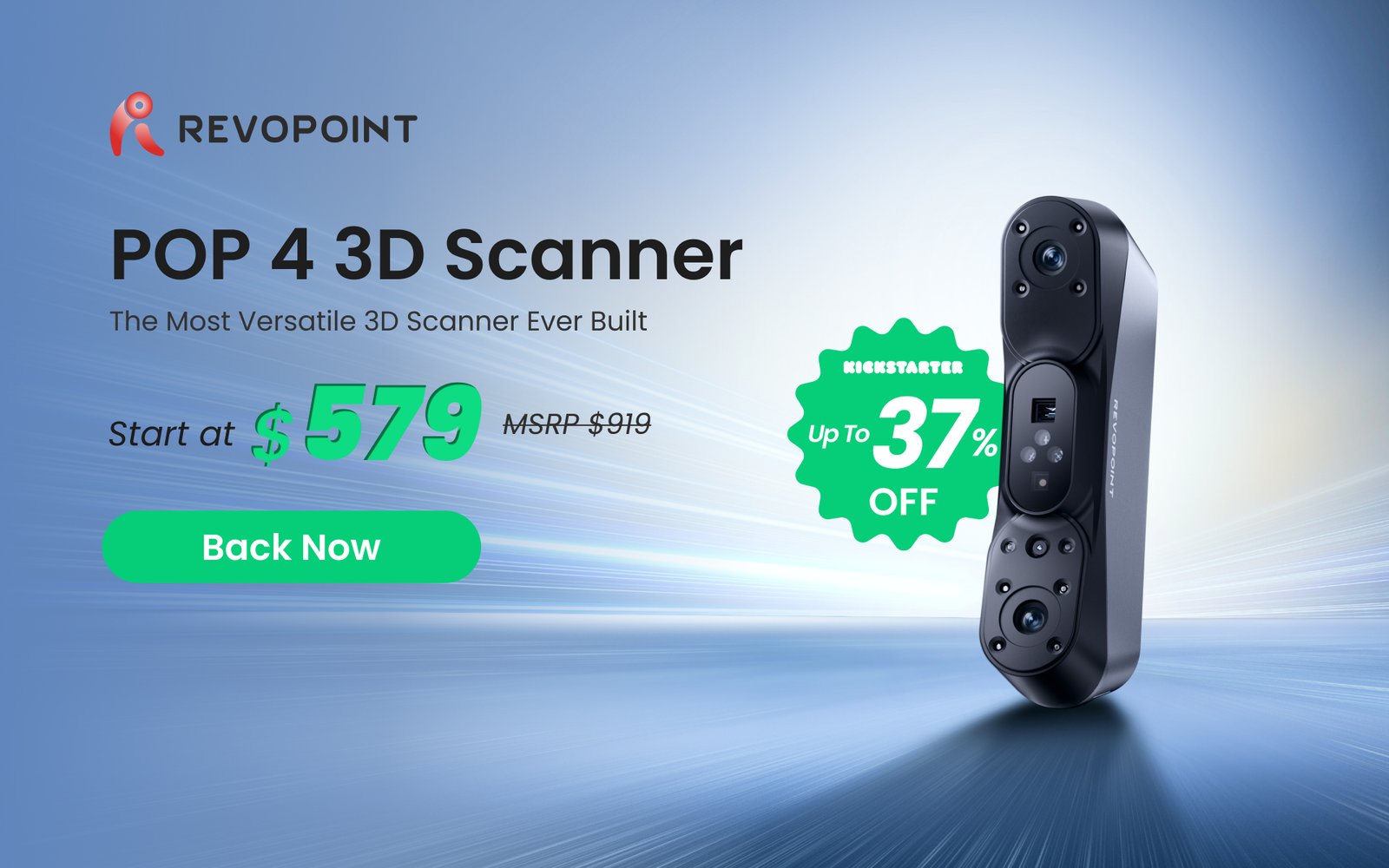
That frustration sits at the center of what Revopoint is addressing with the POP 4 3D scanner, which is launching on Kickstarter today. The pitch is straightforward: one scanner that works on shiny metal, dark surfaces, and everything in between.
Precision Scanning for Complex, Shiny Surfaces
The reason affordable handheld scanners have struggled with that kind of part is largely a light-source problem. Infrared structured light, which most consumer-grade scanners use, reflects off shiny metal in ways that confuse the sensor and goes largely invisible on dark surfaces. Blue laser handles those materials better. But blue laser has its own limitations on textured organic surfaces, on hair, on skin.
The POP 4 solves both. It does this through five scanning modes. Two use near-infrared structured light: one for detailed capture of general objects, one optimized for speed. A third is powered by coordinated dual projectors for fast, high-quality surface capture.
The remaining two are blue laser: a 30-crossed-line mode for high-reflectivity and dark materials, and a single-line mode for narrow grooves and deep holes. Users switch based on what’s in front of them, not because the scanner forces the choice.
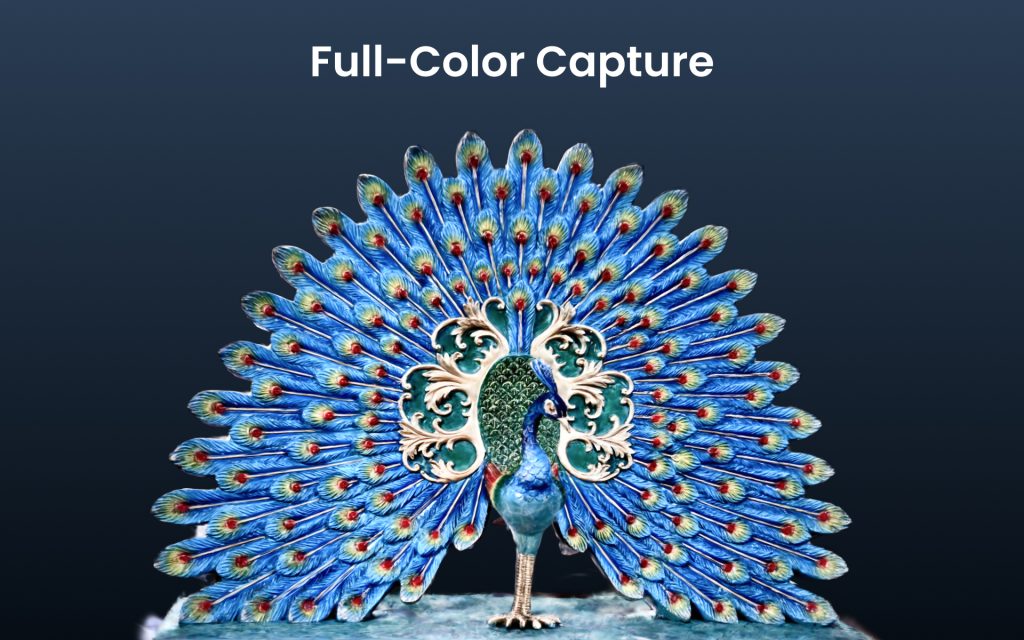
The POP 4 3D scanner achieves a fused point distance of 0.05 mm, with an industrial-grade volumetric accuracy down to 0.03 mm plus 0.05 mm/m specifically in the laser modes, and a frame rate of 105 fps in multi-line laser mode. Working distance runs from 200 to 800 mm.
Worth noting separately is the outdoor capability. The POP 4 is rated for up to 100,000 lux, roughly direct sunlight. Most structured light scanners are effectively indoor instruments because ambient light competes with the projected pattern. That ceiling opens up archaeological sites, and on-site industrial work that previously required considerably more expensive equipment.
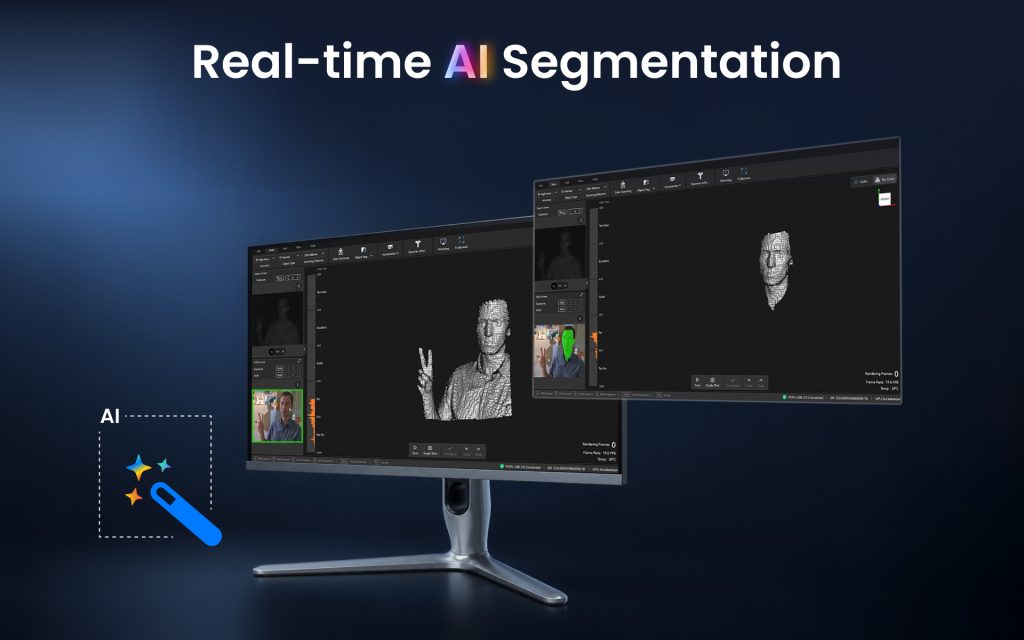
On the software side, two additions move the needle beyond incremental. Real-time AI object segmentation lets you define your target before scanning, so the scanner captures the object and ignores the surroundings. Anyone who has spent twenty minutes deleting a table from a scan knows exactly what this is worth.
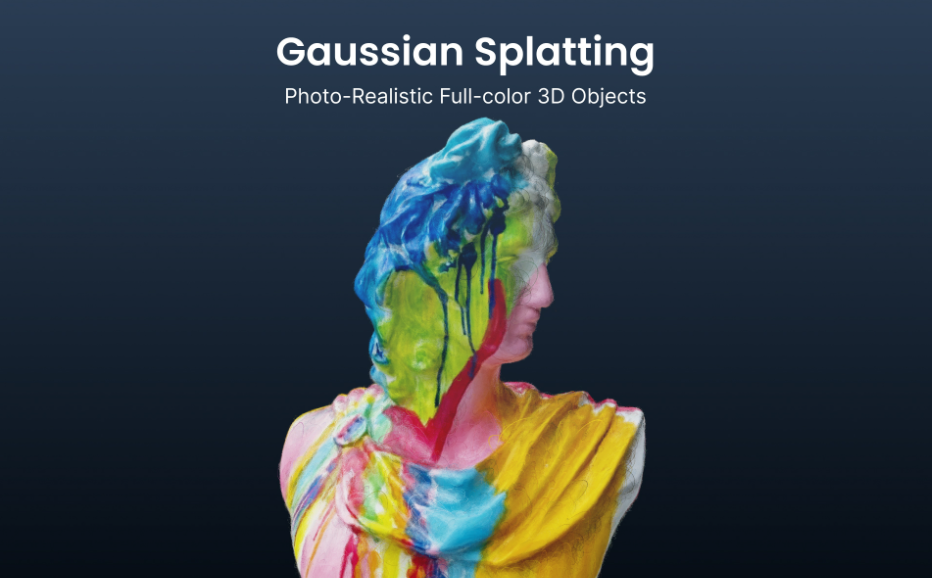
The second is 3D Gaussian Splatting output in .splat format, a photorealistic representation format gaining traction in VR and AR development, which produces something optically accurate from any viewing angle, not just dimensionally accurate.
The scanner also connects directly to Revopoint’s own software ecosystem. Scans move from Revo Scan into Revo Measure for dimensional analysis or Revo Design for reverse engineering with a single click, without exporting to a third-party tool as an intermediate step. For anyone building that workflow from scratch, it removes meaningful friction.
The 3D scanner ships with a 5,500 mAh battery grip rated for about four hours and supports Wi-Fi control from a phone or tablet. A small but practical detail for anyone scanning large objects or working outdoors, where managing a laptop and a scanner at the same time is its own problem.
Technical specifications and pricing
The POP 4 is launching on Kickstarter today at $579 for early backers, 37% off the eventual retail price of $919. Back the POP 4 3D scanner on Kickstarter here.
| Name | POP 4 |
| Scanning Type | Handheld and Desktop |
| Technology | Blue Multi-line Laser, Near-Infrared Full-field Structured Light and VCSEL Structured Light |
| Scannable Object Size | Small to Medium |
| Single-frame Accuracy, up to | Line Laser Accuracy: 0.03 mm Full-field Structured Light Accuracy: 0.08 mm VCSEL Structured Light Accuracy: 0.10 mm @ 300-500 mm, 0.20 mm @ 500-800 mm |
| Volumetric Accuracy | 0.03 mm + 0.05 mm × L (m), L is the length of the object. (Note: Using Multi-line Laser Mode) |
| Fused Point Distance, up to | 0.05 mm |
| Working Distance | 200 – 400 mm (Multi-line Laser Mode) |
| 250 – 500 mm (Full-field HD Mode and Hybrid HD) | |
| 300 – 800 mm (VCSEL Mode) | |
| Single Capture Area at Nearest Distance | 131 × 134 mm at 200 mm |
| Single Capture Area at Furthest Distance | 312 × 269 mm at 400 mm (Multi-line Laser, Full-field ) 505 × 538 mm at 800 mm (VCSEL mode) |
| Angular Field of View (H × V) | 46 × 37 ° |
| Minimum Scan Volume | 10 × 10 × 10 mm |
| Maximum Scan Volume | 2 × 2 × 2 m |
| Scanning Speed | Multi-line Laser Scan: 80 – 105 fps (NVIDIA GPU), 40 – 60 fps (CPU) Full-field Structured Light Scan: 15 – 20 fps VCSEL Structured Light Scan: 20 – 30 fps |
| Point Return Rate, up to | Multi-line Laser: 2,000,000 Points/s Full-field Structured Light Scan: 5,000,000 Points/s |
| RGB Camera Resolution | 1.3 Megapixels |
| Color Scanning | Yes |
| Tracking Methods | Feature, Marker, Global Marker, Color |
| Outdoor Scanning | Yes Lighting Environment Requirements, Multi-line Laser ≤ 50,000 lux VCSEL ≤ 100,000 lux (When using the multi-line laser mode with an outdoor filter, scanning is possible in lighting conditions of up to 100,000 lux.) |
| 3D Light Source | 30 Blue Cross Laser Lines 1 Blue Single Laser Line (Deep-Hole Mode) Near-Infrared Full-field Structured Light Near-Infrared VCSEL Structured Light |
| Fill Lights | 8 (4 Infrared LEDs + 4 Blue LEDs) |
| RGB Lights | 2 |
| Built in Chip Computing | Depth Map Computing |
| Buttons | 4 |
| Minimum PC Requirements | macOS CPU: M1 Pro/Max/UltraRAM ≥ 16 GB Windows CPU: Intel i7 13th Gen or AMD Ryzen 7 5800RAM ≥ 16 GB GPU: NVIDIA GeForce RTX 3060 (8 GB) Note: 1. If you’re unsure about the CPU configuration, please ensure that the CPU has cores ≥8, threads ≥16, and a base frequency ≥2.4GHz. 2. Only in Laser Line Scanning modes, a dedicated graphics card is required for acceleration. AMD and MAC GPUs do not currently support acceleration. |
| Recommended PC Requirements | macOS CPU: M3 Pro/Max/Ultra or better RAM ≥ 24GB Windows CPU: Intel i9 12th Gen or better RAM ≥ 32 GBGPU: NVIDIA RTX 4060 (8 GB) or better |
| Mobile Requirements | Android System Version: 9.0 or better; RAM ≥ 8 GB; Storage ≥ 128 GB iPhone Models after iPhone X; System Version: iOS 14.0 or better; RAM > 4 GB; Storage ≥ 64 GB iPad 10th Gen iPad or later Note: Multi-line scanning mode does not support standalone mobile phone operation. It requires the scanner to connect to a PC via WiFi to work, with the screen being cast to the mobile phone in real-time. Full-field scanning mode and VCSEL scanning mode can be used independently with a mobile phone. |
| Compatible Operating Systems | Windows 10/11 (64 bit), Android, iOS, macOS 11.0 or better |
| Output File Formats | PLY, OBJ, STL, ASC, 3MF, GLTF, FBX, Splat |
| Ready to Print 3D Models | √ |
| Wi-Fi | 6 |
| Bluetooth | 4.1 |
| Connector Type | Type-C to Type-C USB 3.0 |
| Power Requirements | DC 5V, 2A |
| Scanner Weight | 286 g |
| Dimensions (L × W × H) | 160 × 30 × 72 mm |
| Special Object Scanning | Please use scanning spray when scanning transparent or specular surfaces |
| User Recalibration | Yes |
| Power Bank Capacity | 5500 mAh (4 hours of battery life under average power consumption) |
| Supported Accessories | Marker Block Kit, Mobile Kit (4th Gen), Dual-axis Turntable (Ⅱ) |
| Note | 1. Accuracy is how close a measured value at a single angle is to the actual (true) value. The data was acquired in a controlled lab environment. Actual results might vary, subject to the operating environment. 2. Class 1 Laser: Avoid direct eye exposure for extended periods! Refer to Standards for Class 1 Lasers for details. 3. Some products have flashing lights, which may not be suitable for people with photosensitive epilepsy. |
3D Printing Industry is inviting speakers for its 2026 Additive Manufacturing Applications (AMA) series, covering Energy, Healthcare, Automotive and Mobility, Aerospace, Space and Defense, and Software. Each online event focuses on real production deployments, qualification, and supply chain integration. Practitioners interested in contributing can complete the call for speakers form here.
To stay up to date with the latest 3D printing news, don’t forget to subscribe to the 3D Printing Industry newsletter or follow us on LinkedIn.
Explore the full Future of 3D Printing and Executive Survey series from 3D Printing Industry, featuring perspectives from CEOs, engineers, and industry leaders on the industrialization of additive manufacturing, 3D printing industry trends 2026, qualification, supply chains, and additive manufacturing industry analysis.
Featured image shows the Revopoint POP 4 3D scanner available for $579 on Kickstarter. Image via Revopoint.
