


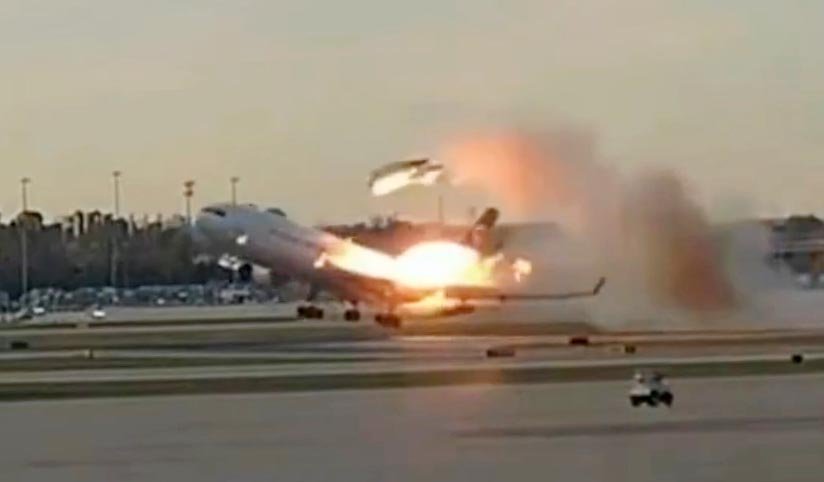
LOUISVILLE, Ky. — The National Transportation Safety Board (NTSB) has released chilling airport surveillance footage capturing the precise moment a massive UPS cargo jet suffered a catastrophic structural failure, leading to a deadly crash last autumn.
The newly available video provides a clear look at the final moments of UPS Flight 2976 on November 4, 2025, showing the aircraft’s left engine and pylon completely tearing away from the wing just seconds after liftoff from Louisville Muhammad Ali International Airport (SDF).
A Sudden, Violent Separation
The flight, a scheduled domestic cargo run bound for Honolulu, Hawaii, was being operated by a 34-year-old McDonnell Douglas MD-11F wide-body tri-jet (registration N259UP).
According to preliminary NTSB data and visual evidence from the newly released footage, the takeoff roll appeared uneventful until the crew initiated rotation. Just as the aircraft lifted into the air, the No. 1 (left) engine—along with the bulk of its heavy supporting pylon—suddenly fractured and separated entirely from the wing.
Aviation physicists and investigators noted that gyroscopic precession, which exerts maximum stress on an engine pylon during rotation, caused the detached engine to exhibit highly unusual behavior:
- The Trajectory: Instead of dropping straight down, the roaring engine flipped violently backward over the wing’s leading edge.
- The Fire: As it broke loose, fuel lines ruptured instantly, igniting a massive fireball. The burning engine tumbled completely up and over the top of the fuselage before crashing onto the grass on the right side of runway 17R.
- The Damage: A severe secondary fire erupted at the torn pylon attachment point on the left wing, severely crippling the aircraft’s hydraulics and aerodynamics.
The Fatal Descent
The NTSB’s preliminary report confirms that the aircraft reached a maximum altitude of only 30 to 100 feet above the ground before losing all ability to climb. Video analysis also indicates that the tail-mounted No. 2 engine began emitting bursts of flame, suggesting it may have ingested catastrophic debris or suffered oxygen starvation from the raging wing fire ahead of it.
Unable to maintain lift with only a single functioning engine, the heavy jet entered a rapid descent.
[Louisville Runway 17R]
       │
       ├──► Left engine detaches at rotation; tumbles over fuselage
       │
       ├──► Jet clips roof of UPS Supply Chain warehouse (300-ft gash)
       │
       ├──► Wing strikes Kentucky Petroleum Recycling fuel tanks
       │
       └──► Final Impact: Grade A Auto Parts / Semi-truck parking lot
The disaster resulted in 15 fatalities, including all three UPS crew members on board and 12 people on the ground, and left more than 20 others injured.
Focus on Maintenance and Pylon Fatigue
The release of the surveillance footage coincides with ongoing NTSB investigative hearings regarding the crash. Investigators are intensely focusing on the structural integrity of the MD-11’s pylon-to-wing mounting assemblies.
Records revealed that the accident aircraft had been grounded for six weeks just two months prior to the crash to repair a cracked fuel tank, during which corrosion was also discovered along structural beams. Furthermore, unconfirmed reports have circulated regarding a two-hour maintenance delay involving the left engine on the very afternoon of the accident.
“The video confirms our worst fears regarding structural fatigue or mounting failure,” said an aviation safety expert reviewing the footage. “An engine tearing away completely on rotation points to a catastrophic mechanical or structural compromise that left the flight crew with zero chance of recovery.”
Shortly after the tragedy in November 2025, the Federal Aviation Administration (FAA) issued an Emergency Airworthiness Directive mandating immediate inspections of all remaining Boeing/McDonnell Douglas MD-11 and MD-11F aircraft operating in the United States to check for similar pylon defects.
The NTSB investigation remains ongoing, with a final report expected to detail the exact sequence of the pylon failure and outline new industry-wide safety recommendations for aging wide-body cargo fleets.
