


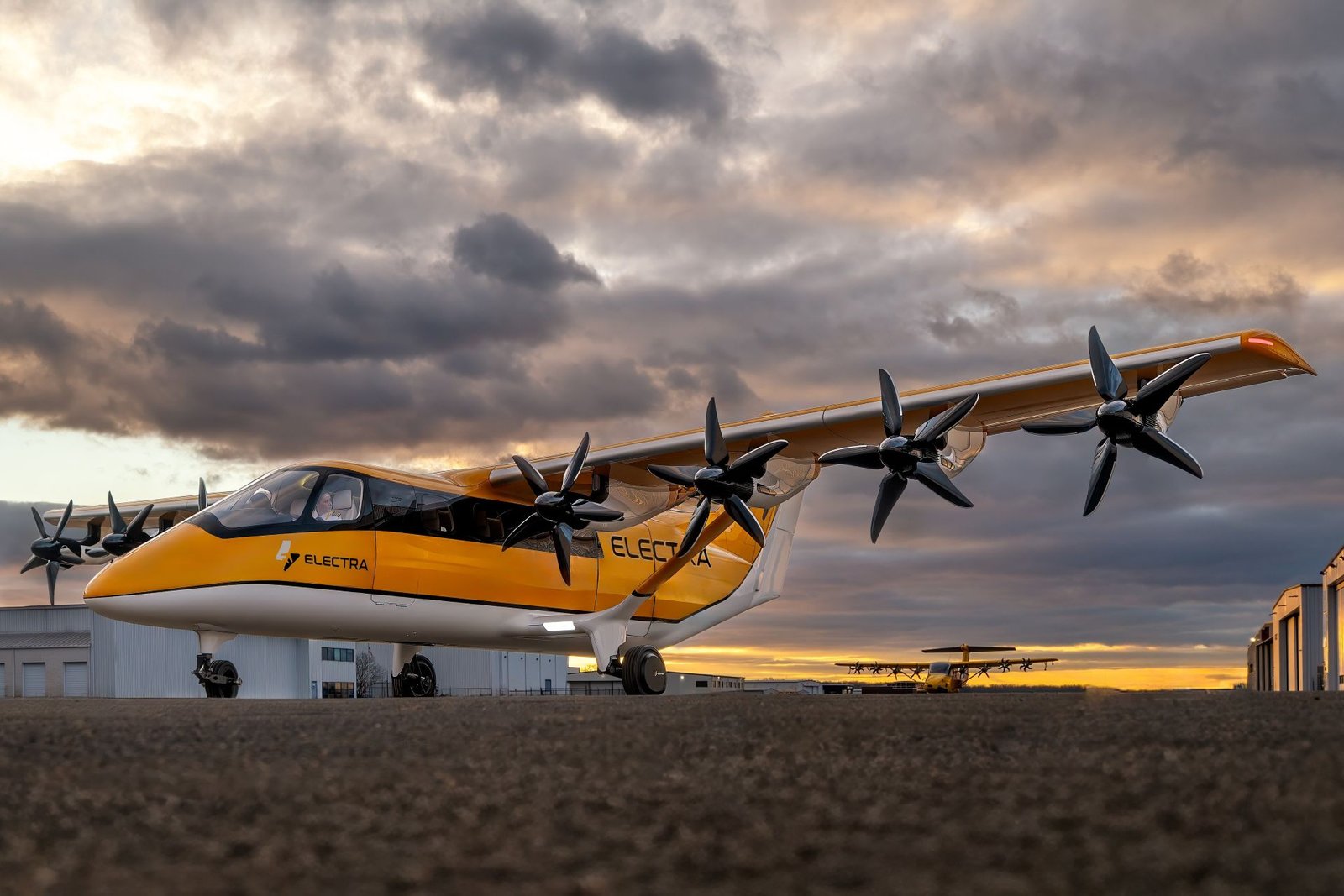
What if, rather than making the more than four-hour, peak-traffic drive from New York City to Washington, D.C., you could get there in under two hours?
That is the pitch Electra makes in its Direct Aviation Market Outlook, published Wednesday. The outlook analyzes more than 2,600 routes spanning 50 to 265 miles that lack commercial air service within 40 miles of the origin or destination. Rather than driving those trips, Electra said passengers could hop in its flagship EL9 Ultra Short—designed for operations out of soccer field-sized spaces—to save an hour or more.
Per Electra, direct aviation entails flying people “directly from where they are to where they want to go” to eliminate the “tyranny of gridlock and airport chokepoints.” The EL9, which has not yet flown, is intended for routes that are too impractical to drive and lack an aerial alternative. The company is flying a prototype, the EL2 Goldfinch, and targets certification and commercial operations toward the end of the decade.
Electra said its recently published research was “built on” a NASA-funded 2022 study from researchers at Georgia Tech University. They found that in the U.S. Northeast Corridor—which receives commercial air service at only 80 airports despite accounting for about one-fifth of the country’s population—“efficient electric and hybrid electric regional aircraft” could make air service profitable at over 140 airports.
Electra’s EL9 could be the aircraft in question. Though it is still in development, Electra has shown that the prototype Goldfinch can take off and land using just 150 feet of space—whether that is a runway or unimproved surface such as a grass field. Its key enabler is a “blown-lift” propulsion system that directs airflows over the wing into large flaps and ailerons. That forces the air downward to amplify lift and enable takeoffs at a leisurely 35 knots.
Because its hybrid-electric propulsion system limits noise, Electra believes it could install ultra short “access points” for the EL9 at noise-sensitive airports, such as Santa Monica Airport (KSMO) in California. The company further envisions operations out of rooftops, parking lots, fields, barges, and other remote or non-airport locations.
Diana Siegel, who leads commercial operations for Electra, told FLYING in February that it could even land at malls, casinos, and ski resorts.
With access points, Electra believes the EL9 could shorten rush hour drives by one hour for the more than 1,800 U.S. routes that see at least 1,000 daily drivers. It could save up to two hours on another 540 routes and three hours on a further 227, the company said.
The company’s evaluation of EL9 trip time includes the flight itself, plus an average of 20 minutes spent waiting at the access point, six minutes for EL9 ingress and egress, and the average driving time to or from the access point at the origin and destination. In other words, the estimate is a complete, door-to-door calculation.
How Electra’s Vision Could Work
Electra’s outlook analyzes a “three-month period in spring 2025 that includes location-based data, connected vehicle data, credit-card usage, and other sources to capture how people travel.”
It found that each day, 35 million passengers drove trips spanning 50 to 500 miles, amounting to 1.6 trillion passenger-miles annually. More than 6,000 routes saw at least 1,000 daily travelers, the company said.
It estimated that more than 80 percent of those routes lack practical commercial air service options, forcing travelers to resort to longer trips on the road. On 50-to-265-mile routes, only one percent of people travelled by air compared to 35 percent for 500-plus-mile trips.
Electra believes the EL9 could supplant the nation’s 487 commercial aviation routes that span 50 to 365 miles and see at least 78 passengers daily. It provided 2,618 sample routes spanning the Northeast Corridor, Texas Triangle, Southern California, Florida, and Midwest, which can be viewed on an interactive mesh network map.
The company sees four primary use cases for direct aviation.
Intercity connector flights between urban centers could save hours on commutes. Electra said a trip from New York City to Washington, D.C., would take 1 hour and 45 minutes in the EL9 versus four-and-a-half hours by car. “Small community service” flights, such as between Philadelphia and Pennsylvania State University, could have similar time savings.
Electra also envisions “leisure launchpad” services that fly people to vacation destinations. It said a flight from Manassas, Virginia, to Snowshoe Mountain Resort in West Virginia—which lacks direct commercial air service—would take just one hour compared to more than four by car.
Finally, airport feeder routes could create regional hub-and-spoke networks. Electra estimated flying from Norfolk, Virginia, to Ronald Reagan Washington National Airport (KDCA) in the EL9 would be 2 hours and 40 minutes faster than driving.
The company sees the most robust demand in the Northeast Corridor, predicting 27,000 daily EL9 trips that would require 500 aircraft. It estimated it will need to produce 12,000 to 16,000 aircraft in its first decade of operation to meet demand nationwide.
Electra’s vision may take time to materialize, however.
The company would need to install access points across its more than 2,600 proposed routes. It will also require operators to build regional shuttle networks that can accommodate its aircraft. Electra has about 2,200 provisional orders from more than 60 prospective operators, including launch customer Bristow Group, which recently signed a binding predelivery agreement for five EL9 production slots.
And then there is the aircraft itself. The EL9 is intended for short-haul, high-frequency operations in urban and suburban areas, cruising at about 175 knots. Its hybrid-electric propulsion system produces about 75 dBA of noise at takeoff and landing.
The aircraft has a projected range of 330 nm at its full payload of 3,000 pounds, or a pilot plus nine passengers and about 50 pounds of luggage each. Electra has said a military variant of the EL9 could transport 1,000 pounds over 1,000 nm.
Though the company has demonstrated 150-foot takeoffs and landings with the prototype EL2, the EL9 has yet to fly and may not take the skies until 2027. Electra in March told FLYING it plans to begin activities under the FAA’s eVTOL (electric vertical takeoff and landing) Integration Pilot Program (eIPP) with the Goldfinch before scaling up to its flagship model.
During the eIPP, Electra plans to showcase operations across Florida in partnership with regional airlines, evaluate a proposed corridor between New Jersey and New York City, and demonstrate routes connecting Atlantic City, New Jersey, to Philadelphia International (KPHL) and other nearby airports.
The eIPP will give Electra a chance to evaluate its operations in a real-world setting, which could help it determine ticket prices for future customers. The firm has not shared specific pricing but claims the EL9 will operate at one-third the cost of helicopters or eVTOL air taxis.
Electra’s outlook notes that its more than 2,600 proposed direct aviation routes are concentrated in “areas where travelers are willing to pay the cost of business-class airfare if it means time and hassle savings.” That implies it is betting on demand from premium customers in order to make operations economically feasible.
Prices could come down as Electra produces more aircraft. However, 16,000 aircraft is already a lofty target given the minimal production it has completed thus far.
