


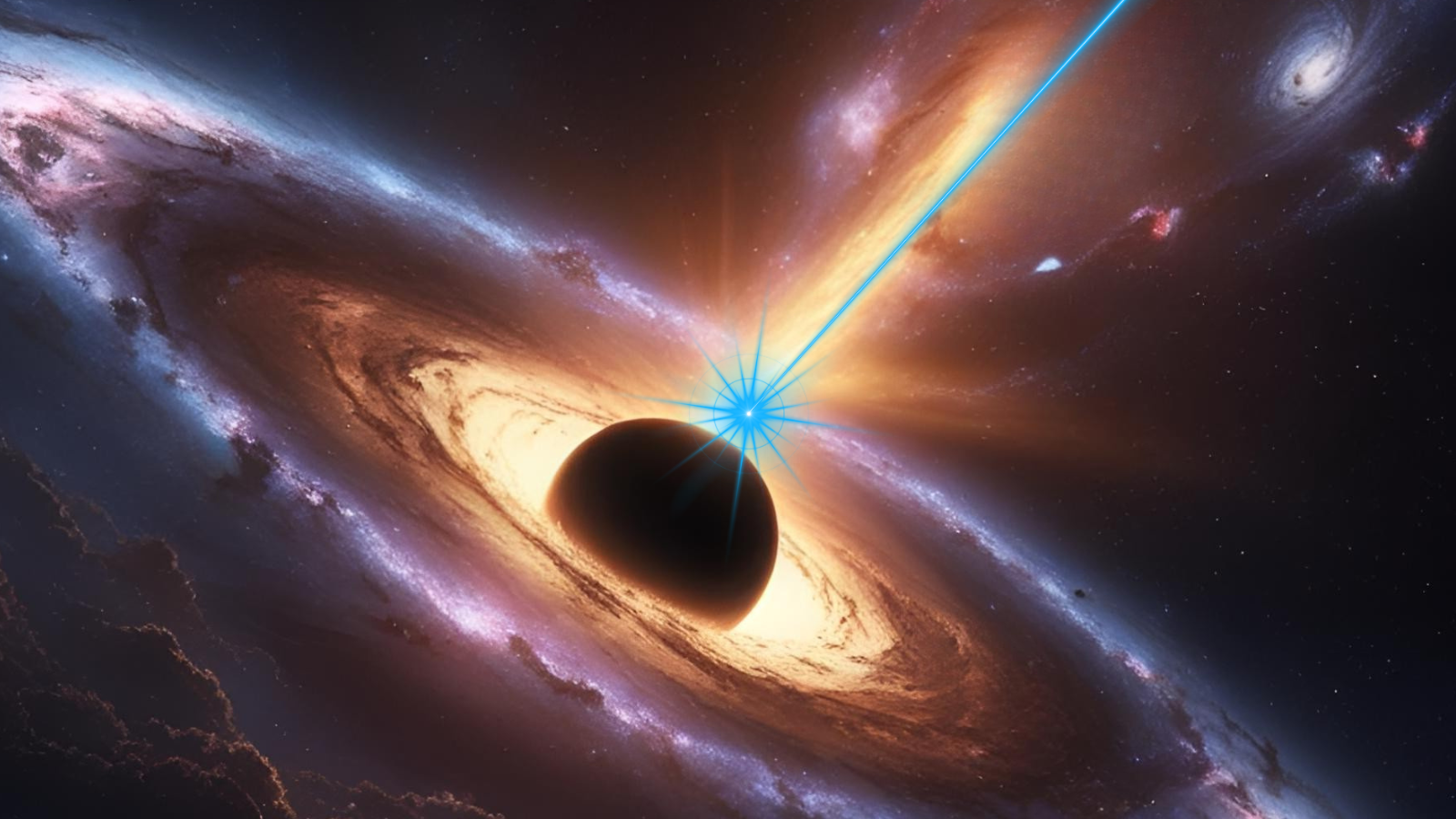
Scientists have discovered an ultra-powerful “ghost particle” or neutrino, which struck Earth and was detected in the Mediterranean Sea in 2023, may have been blasted at Earth by blazars powered by a feasting black hole engine.
Blazars are a type of quasar, the regions at the hearts of galaxies that host feeding supermassive black holes and discharge powerful jets of radiation. Blazars are different from “ordinary” quasars because their orientation means that the energy, particles, and jets of plasma they blast out are pointed directly at Earth.
The neutrino was 30 times more energetic than carried with it 30 times the energy of the previous most energetic neutrino ever detected. It arrived at Earth on Feb. 13, 2023, traveling at nearly the speed of light, and was spotted via the detection of a single muon (a subatomic particle) by the Kilometer Cubic Neutrino Telescope (KM3NeT), located 11,300 feet (3,450 meters) beneath the waves of the Mediterranean Sea. Blazars were initially suggested as the source of the particle, but this team of scientists took it upon themselves to confirm a specific class of these supermassive black hole-powered events as a possible origin.
“There are several possible explanations for the origin of this particle,” team member Meriem Bendahman, from the KM3NeT collaboration, said in a statement. “For example, it has been proposed that such neutrinos are generated when ultra-high-energy cosmic rays interact with the cosmic microwave background radiation (CMB), the residual light from the early universe. But there is also the possibility that the neutrino originates from a diffuse flux produced by a population of extreme accelerators, such as blazars.”
A high-energy ‘ghost’
Neutrinos get their nickname of “ghost particles” from the fact that they have no electric charge and are virtually massless, meaning they pass through matter with little to no interaction. In fact, as you just read that sentence, around 100 trillion neutrinos passed through your body at nearly the speed of light. That makes detecting neutrinos incredibly difficult, even when like this one, they carry an energy of 220 million billion electron volts.
For context, that is 30,000 times the energy that Earth’s largest particle accelerator, the Large Hadron Collider (LHC), is capable of achieving. In fact, to accelerate a particle to such energies, the LHC would have to be expanded from its current length of 17 miles (27 kilometers) to around 25,000 miles (40,000 kilometers), the entire circumference of the Earth.
Little wonder scientists are eager to understand where this particle came from and how it was boosted to such high energies.

The team began sorting through possible origins for this high-energy neutrino particle by acting like cosmic forensic detectives, classifying the detection of the particle as a crime scene and hunting for potential clues that point toward a culprit.
One of the first clues discovered by the researchers was the absence of an electromagnetic radiation signal in radio, optical, X-ray, or gamma rays from the same region of space that the neutrino appeared to have originated from. That is something that they would expect to see if the particle had been launched by a single explosive event like a stellar flare or a supernova.
“This does not completely rule out the possibility of a point-like source, but it leads us to consider that our neutrino may come from a diffuse background — that is, from a flux of neutrinos including contributions from many sources,” Bendahman said.
Sources like a population of black hole-powered blazars.
Bendahman simulated a population of blazars, taking into account observations of their characteristics such as magnetic field strength and the range of radiation they emit. Their simulations allowed them to vary two important parameters: the energy carried by protons compared to electrons (called “baryonic loading”) and how that energy is distributed across the protons; and how likely particles are to reach ultra-high energies. This second parameter determines how many neutrinos can be created, the neutrino flux (the intensity of a stream), and how many gamma-rays are created.
The model developed by the researchers also had to account for the lack of detection of neutrinos of similar high energies by KM3NeT, still under construction off the coast of Sicily, and by other facilities such as the IceCube Neutrino Observatory located in Antarctica. That meant any event that created such a high-energy neutrino must be relatively rare.
Additionally, as neutrino creation is accompanied by gamma-ray emission, the model had to ensure that in creating high-energy neutrinos, blazars didn’t generate enough gamma-ray radiation to exceed the extragalactic gamma-ray background measured by the Fermi space telescope.

“We modelled a realistic population of blazars with physically motivated parameters, and we found that this population of blazars could explain the origin of this ultra-high-energy event, while also being consistent with the constraints that we have regarding the gamma-ray and neutrino observations,” Bendahman said.
While the team’s findings do indeed show that a population of blazars could be responsible for this high-energy neutrino, the case is far from closed.
“We need more observational data,” Bendahman said. “We have never observed such a high-energy neutrino before, and if it turns out to come from cosmic accelerators like blazars, it would give us new insight into how these objects can emit particles at energies beyond what we previously expected.”
The team’s research was published in the Journal of Cosmology and Astroparticle Physics (JCAP).
