


The European short-haul aviation landscape has been conquered by a blue-and-yellow paradox that defies conventional corporate logic. An airline that routinely strips away basic cabin amenities, charges for hand luggage, and leaves passengers standing on cold tarmacs should be facing terminal commercial decline. Yet, Ryanair stands as an absolute financial titan, consistently outperforming legacy flag carriers that spend billions of dollars trying to pamper their client base. This guide analyzes the mechanics of the low-cost carrier model, demonstrating how intentional simplicity is utilized as a highly effective operational strategy.
Ryanair’s corporate philosophy operates on a highly disciplined baseline: reduce the physical product to its bare essentials, and treat every historical perk as an optional add-on. It means accepting a highly standardized, no-frills transit environment. However, this exact lack of traditional comfort is the core mechanical catalyst that drives the airline’s record-breaking balance sheet, rewriting the textbook on global aviation profitability.
Taking Away Everything But The Essentials
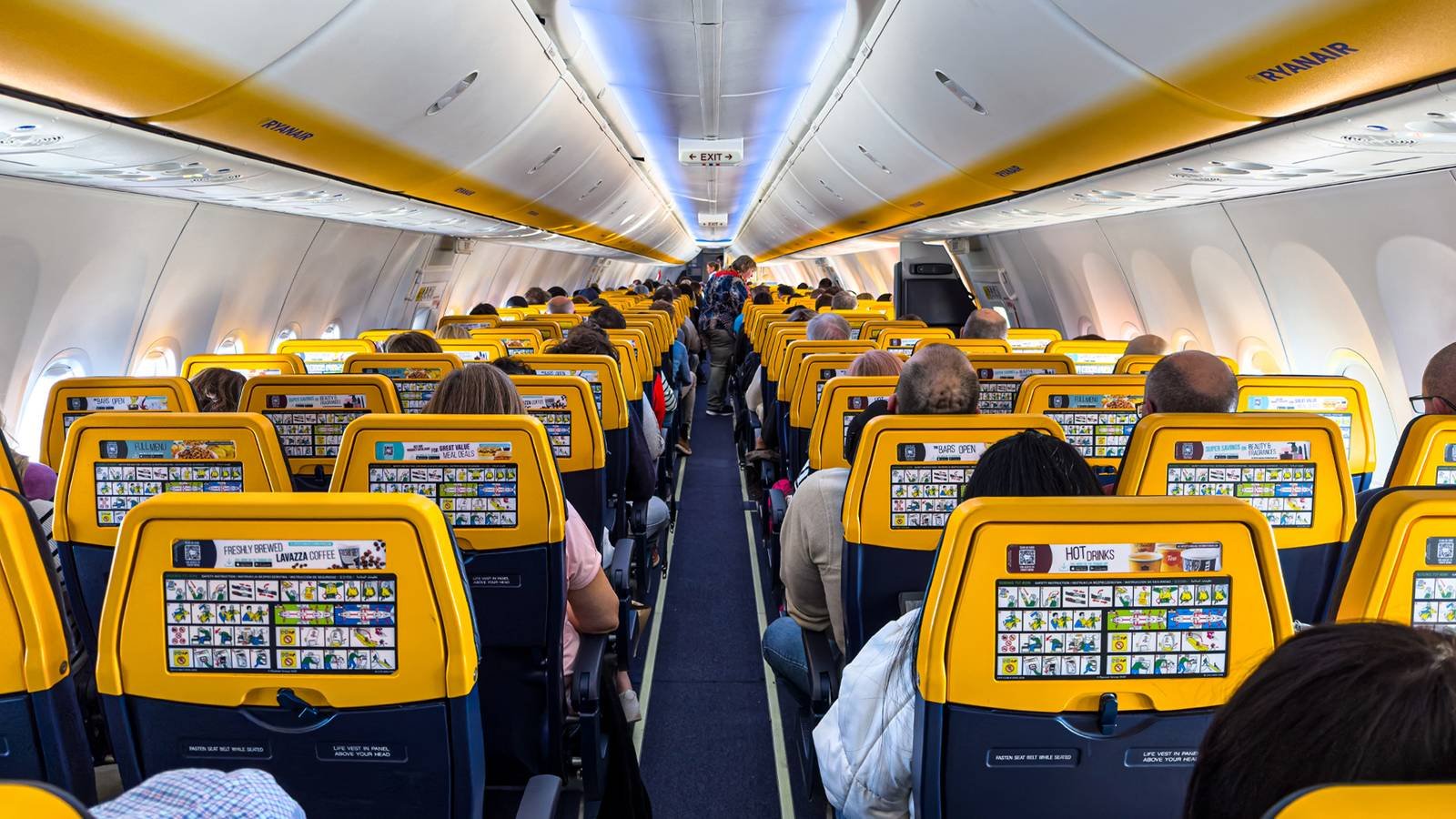
The primary point of physical interaction between a passenger and an airline is the cabin seat, an area where Ryanair has out-engineered every conceivable moving part. To the untrained eye, the thin, rigid plastic chairs feel like a compromise on passenger comfort designed to squeeze more rows into the aircraft. However, these seats are a highly sophisticated cost-reduction tool. Eliminating the mechanical reclining apparatus completely removes a high-frequency maintenance failure point, reducing the weight of the airframe and cutting long-term repair costs.
The design of the cabin rows completely eliminates traditional seatback storage pockets and loose, printed safety documentation. According to research into the carrier’s asset framework using the business model canvas template, safety information is printed directly onto the plastic structure of the headrest itself. This means there are no magazines to sort, no trash left behind in fabric netting, and no loose items for cabin crew to inspect between flights. The seat functions as a sterile, low-mass structure that requires virtually zero human intervention to reset between flights, shaving precious time off the turnarounds.
Ryanair outfits its aircraft with lightweight, non-reclining structures, drastically reducing the aircraft’s total empty weight. In an industry where every additional pound translates into higher fuel costs, scaling down cabin hardware yields far greater earnings potential for the airline.
Better In The Sky Than On The Ground

A passenger jet only generates revenue when its wheels are actively spinning at cruising altitude, and an aircraft sitting at an airport gate represents a massive accumulation of unrecovered overhead. As a result of Ryanair’s cabins being stripped of seat pockets, reclining mechanisms, and complicated cleaning requirements, flight crews can reset the entire aircraft in a fraction of the time required by full-service legacy airlines. This is exactly where the airline’s core operational metric comes into play: the legendary 25-minute gate turnaround.
Such speed is achieved through careful synchronization, with deplaning and boarding occurring almost simultaneously. There is no cabin clutter to clear, so flight attendants focus their energy entirely on security sweeps and passenger flow management, ensuring the aircraft is ready to accept its next payload the moment the previous travelers exit. Ryanair demands this kind of efficiency to squeeze additional flight legs out of every single airframe each day, maximizing the utilization of its multi-billion dollar capital assets.
Ryanair runs its fleet hotter than traditional network legacy carriers, thereby diluting its fixed fleet acquisition costs across a much larger volume of departures. The lack of interior cabin comfort is what really enables this speed, demonstrating that passenger transit times are won or lost based on how quickly a cabin can be wiped down and re-boarded.
5 Features Of Ryanair Seats That Reduce Operating Costs
These seats offer the airline many benefits.
Why So Far From The City?

A Ryanair flight frequently involves navigating remote sectors of secondary and tertiary airports rather than utilizing the main terminals of major global gateways. The airline systematically avoids prime hubs like London Heathrow or Frankfurt Main, instead anchoring its network at locations like London Stansted, Brussels South Charleroi, or Frankfurt-Hahn. It may seem counterintuitive, but the geographical focus is a deliberate effort to bypass the massive landing fees and handling charges imposed by tier-one airport authorities.
These secondary airports are highly eager to attract Ryanair’s massive volume, frequently offering heavily discounted landing rates and lucrative marketing subsidies. Once on the ground, the airline completely refuses to utilize expensive, electronically controlled jet bridges to deplane passengers. Instead, they park their aircraft on remote stands and deploy integrated onboard airstairs, forcing travelers to walk across the open tarmac to reach the terminal building.
Ryanair’s aggressive detachment from infrastructure keeps its fixed airport and handling charges at remarkable levels. In the 2025 annual financial report, airport and handling charges represented a tightly controlled segment of total operating expenses, which is an achievement that is virtually impossible for hub-and-spoke carriers to replicate. Walking down an open tarmac in the rain may feel unglamorous to the consumer, but it represents the removal of a massive layer of terminal infrastructure costs, thus keeping the famously low prices that Europe has come to love.
The Numbers Back Up The Decisions

The ultimate secret to Ryanair’s financial dominance is that the advertised price of a base ticket is functionally a loss-leader designed to capture consumer attention. The real profit engine of the corporation is its sophisticated, unbundled ancillary revenue system. According to the freshly released May 2026 full-year financial results, Ryanair generated a record-breaking €15.54 billion in total operating revenues. Within this massive figure, scheduled passenger fares accounted for €10.56 billion, while unbundled ancillary options pulled in an astronomical €4.99 billion.
This means that ancillary sales now account for roughly 32% of the airline’s total revenue, with the average passenger spending approximately €24 on top of their base fare on basic necessities. By offering an ultra-low entry price, the airline draws passengers into a digital ecosystem where they are systematically nudged, if not a little pressured, to purchase seat selection, priority boarding, checked baggage space, and onboard scratch cards. The base ticket merely buys a passenger a seat on the plane; everything else comes at a premium.
Financial Metrics | FY2025 Financial Year | FY2026 Financial Year (New Data) | Year-over-Year Shift |
Total Passenger Traffic | 200.2 Million | 208.4 Million Travelers | +4% Growth |
Scheduled Fare Revenue | €9.23 Billion | €10.56 Billion | +14% Surge |
Ancillary Revenue | €4.72 Billion | €4.99 Billion | +6% Expansion |
Profit After Tax (PAT) | €1.61 Billion | €2.26 Billion | +40% Profit Jump |
The unbundled economic matrix allows Ryanair to achieve an extraordinary net profit margin that hovers well above the global commercial aviation average. Legacy carriers struggle to pass on rising infrastructure and labor costs through traditional all-inclusive ticketing packages, but with Ryanair’s modular system, the core operating cost is kept separate from the final consumer price. The friction of paying extra for a carry-on bag is the exact operational mechanism that keeps the initial base fare affordable for millions of budget-conscious travelers.
More Passengers Than Ever Before: Ryanair Expects Record Demand Following Earnings
The carrier reported quarterly earnings earlier today.
Many Upsides To Consider

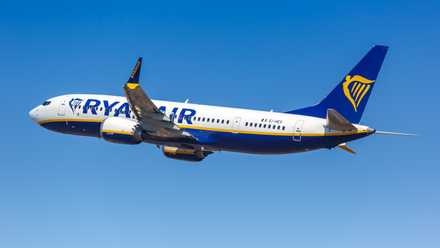
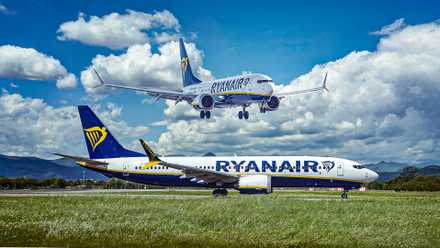
The delivery of this high-efficiency strategy relies entirely on total fleet standardization, a methodology pioneered by  Southwest Airlines in the US and executed to perfection across Europe by Ryanair. As of March 31, 2026, the airline’s operational fleet grew to 647 aircraft, driven by the successful integration of all 210 ordered Boeing 737-8200 Gamechanger models. Crucially, fleet uniformity allows for massive economies of scale in pilot training, maintenance licensing, and spare part procurement, which once again keeps costs lower.
The layout of the Gamechanger aircraft is a testament to the company’s focus on density and asset maximization. The Boeing 737-8200 incorporates an extra 4% more seats into the exact same cabin dimensions as previous models, compressing seat pitch down to 28 inches (71.12 centimeters) while simultaneously reducing fuel burn and carbon dioxide emissions by 16%. The aircraft is an engineering marvel designed to compress maximum human volume into a low-cost, hyperefficient container.
This single-type fleet strategy protects the carrier against supply chain disruptions and maintenance delays that frequently paralyze mixed-fleet operations. According to Air Data News, Spring 2027, is when the airline is scheduled to receive the first 15 units of a massive 300-aircraft order for the larger Boeing 737 MAX 10, which will deliver an additional 20% seat capacity. Continually upgrading to higher-density, more efficient platforms is giving Ryanair even more comfort room to retain its structural unit-cost advantage over its regional competitors, which will stay permanently intact if all goes to plan.
The Airline Of The People?

The aggressive execution of Ryanair’s operational strategy has historically generated intense public scrutiny, including European labor strikes over crew working conditions and regular regulatory pushback regarding hidden fee structures. Most recently, the airline’s FY2026 balance sheet was hit by a €255 million fine tied directly to an antitrust investigation by the Italian competition authority (AGCM). Yet, despite constant media criticism and passenger complaints on digital forums, the airline’s passenger volumes continue to climb, hitting a historic 208.4 million travelers in the newly closed fiscal year.
Ryanair has shown how consumer resilience highlights a fundamental reality of modern travel psychology: when evaluating short-haul European flights, the absolute price floor of the ticket overrides almost every other consumer metric. Travelers are entirely willing to tolerate a tighter seat pitch, a walk across the tarmac, and a complete lack of in-flight entertainment if it means crossing the continent for less than the cost of a regional train ticket. Ryanair understands that passenger complaints are completely detached from passenger purchasing habits, allowing it to ignore superficial optics in favor of raw structural efficiency.
Ultimately, Ryanair’s profitability demonstrates that, in a hyper-commoditized transport market, cost leadership is the ultimate corporate shield. By treating physical discomfort not as a flaw, but as a core operational strategy, the carrier has successfully built an unassailable financial fortress across European skies. As the company continues to expand its high-density fleet toward its target of 300 million annual passengers by 2034, the blue-and-yellow low-cost model will remain an enduring testament to the fact that absolute simplicity is often the shortest path to absolute profit.
