


DUBLIN — Federal Aviation Administration documents have provided new details about a SpaceX project to develop and test reentry vehicles that could be used to support in-space manufacturing projects.
The FAA on May 15 issued an environmental assessment for test flights of Starfall, an uncrewed reentry vehicle. The FAA also issued a record of decision approving those test flights, concluding that they would not have any significant environmental impacts. The agency did not publicize the findings until it sent out an “FAA Space Update” on May 29.
The documents provide insights into Starfall, which SpaceX has not publicly discussed. Bloomberg first reported on the project last July, describing it as an in-space manufacturing program using capsules that would perform microgravity research and development, then return to Earth.
The FAA documents describe Starfall as serving both in-space manufacturing and point-to-point cargo delivery. The capsules could serve as a “proliferated successor” to the International Space Station to support “a self-sustaining manufacturing economy in space,” the documents state.
“The purpose of SpaceX’s proposal is to (1) enable point-to-point delivery of critical cargo through space on rapid timelines and (2) create a self-sustaining commercial in-space manufacturing market by offering access to microgravity and vacuum, loiter on orbit, and safe return from orbit as a service at scale,” the record of decision states.
The FAA decision approves two reentries of Starfall capsules in the Pacific Ocean about 1,300 kilometers off the coasts of California and Mexico. The capsules would launch on either Falcon 9 or Starship vehicles, going into orbit before reentry or flying a direct suborbital trajectory to the landing zone.
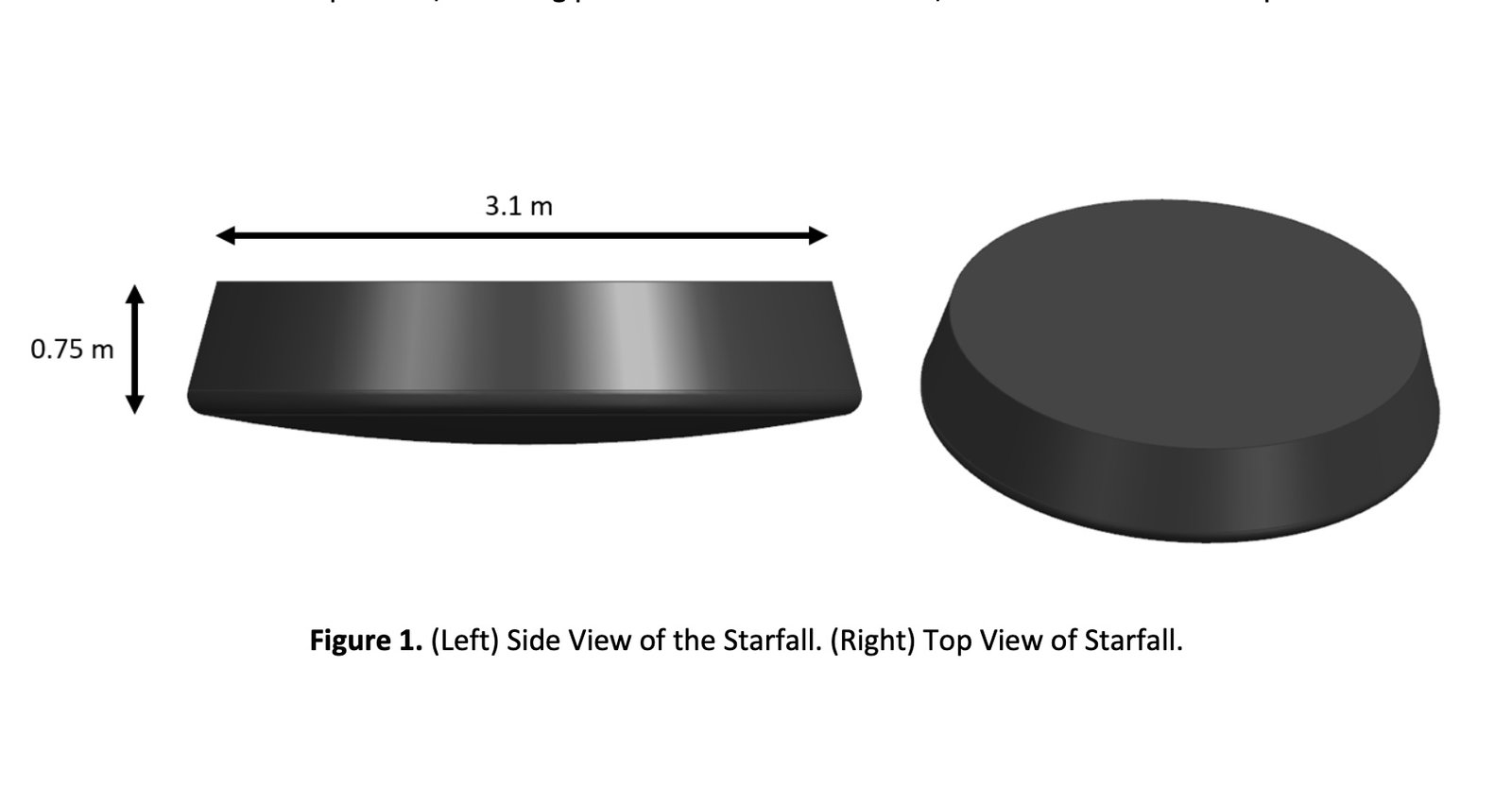
The capsules are disk-shaped, 0.75 meters tall and 3.1 meters in diameter at the top. The capsules have cold-gas attitude control thrusters but no other propulsion system and do not have the ability to deorbit on their own.
The vehicle consists of two parts: a top plate and a heat shield. The top plate is an aluminum structure partially wrapped in an unspecified thermal protection material and weighs 1,400 kilograms. The heat shield is a carbon-fiber structure covered in thermal protection material and also contains nitrogen gas bottles used for the thrusters and other systems. It weighs about 700 kilograms.
The vehicle would slow its descent using a single main parachute, along with pilot and drogue parachutes, with the heat shield jettisoned before splashdown. The FAA documents state that SpaceX will use boats to recover all elements of the spacecraft after splashdown.
The environmental assessment does not state when the test flights would take place and does not provide approvals for additional missions after the two test flights. However, the documents make clear SpaceX sees these as prototypes for spacecraft that would be built in large volumes.
SpaceX “plans to develop a mass producible reentry vehicle that can precisely deliver cargo from space to various locations on Earth, which would be able to launch on either Falcon 9 or Starship,” stated a document developed by contractor KBR that assessed sonic booms from Starfall reentries. That document also noted that Starfall will be able to carry up to 1,000 kilograms of payload in a volume measuring 2.5 by 1.5 by 0.5 meters inside the spacecraft.
Starfall would potentially put SpaceX into competition with companies that rely on SpaceX for launch services. Among them is Varda Space Industries, which has flown six of its W-series spacecraft on SpaceX rideshare missions, performing microgravity research and hypersonics testing with capsules that landed in Utah and Australia.
Inversion, another company developing reentry vehicles, flew its first spacecraft, Ray, on a SpaceX rideshare mission in 2025, but technical issues prevented the spacecraft from reentering as planned. Atmos Space Cargo, a European startup, flew its first reentry vehicle on a SpaceX rideshare mission in 2025 and plans to fly additional missions with SpaceX as well as on European small launch vehicles.
Several other companies, including Catalyx Space, Lux Aeterna and Reditus Space, have also announced plans for reusable spacecraft that would return to Earth and be recovered for reuse, with test flights planned through next year. They are also planning to rely in large part on SpaceX launches.
