


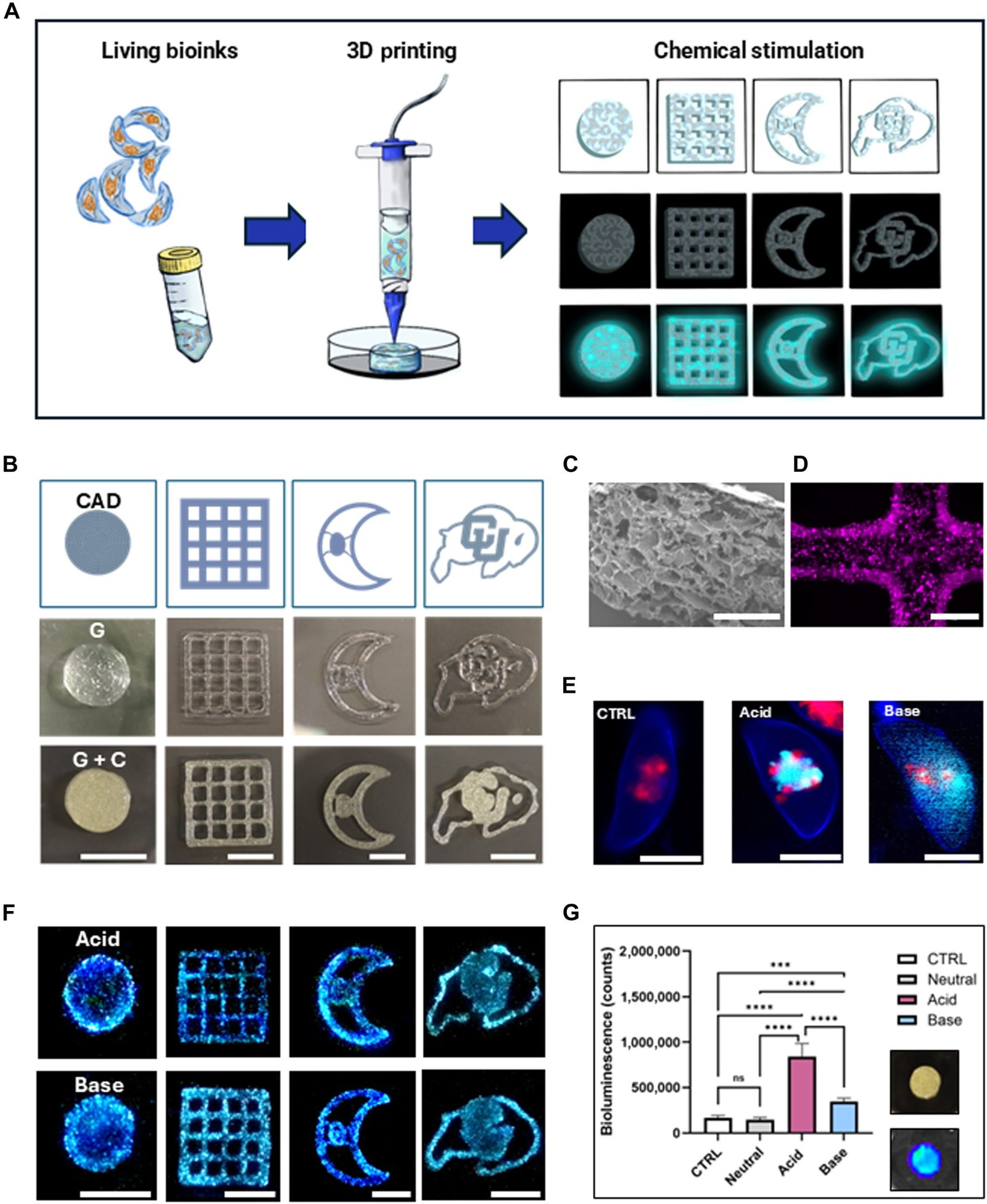
Researchers at the University of Colorado Boulder (CU Boulder) have built light-emitting living materials by embedding a marine microorganism inside 3D printed alginate scaffolds and activating its bioluminescence chemically.
Published in Science Advances, the constructs were made using the dinoflagellate Pyrocystis lunula, and maintained functional light output through four weekly stimulation cycles without structural breakdown. The result has direct implications for how long living light-emitting materials can remain reliably reusable.
P. lunula has long been attractive to materials researchers for its ability to flash light when physically agitated, a defense mechanism the organism evolved against predators in turbulent ocean water. The problem is durability. Mechanical stimulation degrades cellular structure, and most systems built around it lose function after a single use.
The CU Boulder team addressed this by shifting the activation mechanism entirely to chemistry. P. lunula bioluminescence is governed by pH-dependent cellular machinery: a drop in pH inside the cell’s scintillons triggers the luciferin-luciferase reaction that produces light. Rather than shaking the cells into response, the researchers exposed them to acidic (pH 4) and basic (pH 10) environments and measured what each produced.
From Cellular Micro-Signatures to Functional Inks
The two conditions yielded strikingly different signatures. Acid drove intense, spatially confined emission localized to discrete intracellular compartments, covering roughly 32% of cumulative total cell area across the measurement period. Base stimulation began similarly but rapidly spread into a diffuse, cell-wide luminescence, reaching 61% coverage by 60 seconds, a pattern the researchers attribute to progressive ionic imbalance and structural breakdown rather than controlled light output.
At the population scale, that distinction matters: acid stimulation produced a peak intensity of approximately 112,000 photon counts against roughly 43,000 for the base-treated group, with the acid signal holding stable over several minutes where the base signal was not.
To translate these free-swimming cells into a usable material, the team encapsulated P. lunula in 4 weight percent sodium alginate, ionically crosslinked into hydrogel beads of 1.6 millimeters in diameter. Scanning electron microscopy revealed a porous internal network that supports nutrient and gas exchange while physically retaining the cells.
Over 30 days, cells seeded at the lowest tested density of 150,000/ml showed a sixfold increase in metabolic viability signal, indicating active proliferation rather than mere survival inside the matrix. The same formulation was adapted for 3D printing by partially pre-crosslinking the alginate before extrusion, which tuned the material viscosity for shape retention without compromising cell viability. Printed constructs showed a 2.4-fold luminescence increase under acid relative to base at five minutes post-stimulation, consistent with results from suspension cultures.

Combined Stimulation Amplifies Long-Term Output
A separate set of experiments tested what happens when chemical and mechanical stimulation are combined. Rather than one canceling or replacing the other, acid preconditioning amplified the cells’ response to subsequent compression, with acid-primed constructs reaching 661 arbitrary units of cumulative luminescence against 305 for controls.
The researchers link this to pH-induced intracellular changes that sensitize scintillon-associated proton channels and calcium signaling pathways, effectively priming the cells to respond more forcefully to physical input.
The longevity data are where the two stimulation chemistries diverge most sharply. Acid-conditioned constructs held above 200,000 arbitrary units through all four weekly cycles, with a Kaplan-Meier analysis showing 75% luminescent activity at week four.
Base-treated constructs collapsed progressively, losing roughly 92% of signal by the third week and another 58% by the fourth, a 97% overall decrease that left them indistinguishable from unstimulated controls by the final cycle.
Most mechanically activated bioluminescent systems in the literature degrade after a single use. The ability to restimulate the same construct weekly across a month, without meaningful loss of output, moves living light materials into a range that environmental monitoring, embedded sensing, and soft robotics applications could plausibly act on.
The team has identified broader stimuli libraries and multiplexed inputs as the next phase of development.
Titled, “Chemical stimulation sustains bioluminescence of living light materials,” the study was conducted by Giulia Brachi, Jessica McKean, Cheng Pau Lee, Joy Edwin-Ezeh, and Wil V. Srubar, III.
3D Printing Industry is inviting speakers for its 2026 Additive Manufacturing Applications (AMA) series, covering Energy, Healthcare, Automotive and Mobility, Aerospace, Space and Defense, and Software. Each online event focuses on real production deployments, qualification, and supply chain integration. Practitioners interested in contributing can complete the call for speakers form here.
To stay up to date with the latest 3D printing news, don’t forget to subscribe to the 3D Printing Industry newsletter or follow us on LinkedIn.
Explore the full Future of 3D Printing and Executive Survey series from 3D Printing Industry, featuring perspectives from CEOs, engineers, and industry leaders on the industrialization of additive manufacturing, 3D printing industry trends 2026, qualification, supply chains, and additive manufacturing industry analysis.
Featured image shows 3D bioprinting of P. lunula-laden alginate bioinks enables spatially defined, chemically stimulated bioluminescence. Image via Giulia Brachi et al. Science Advances.
