


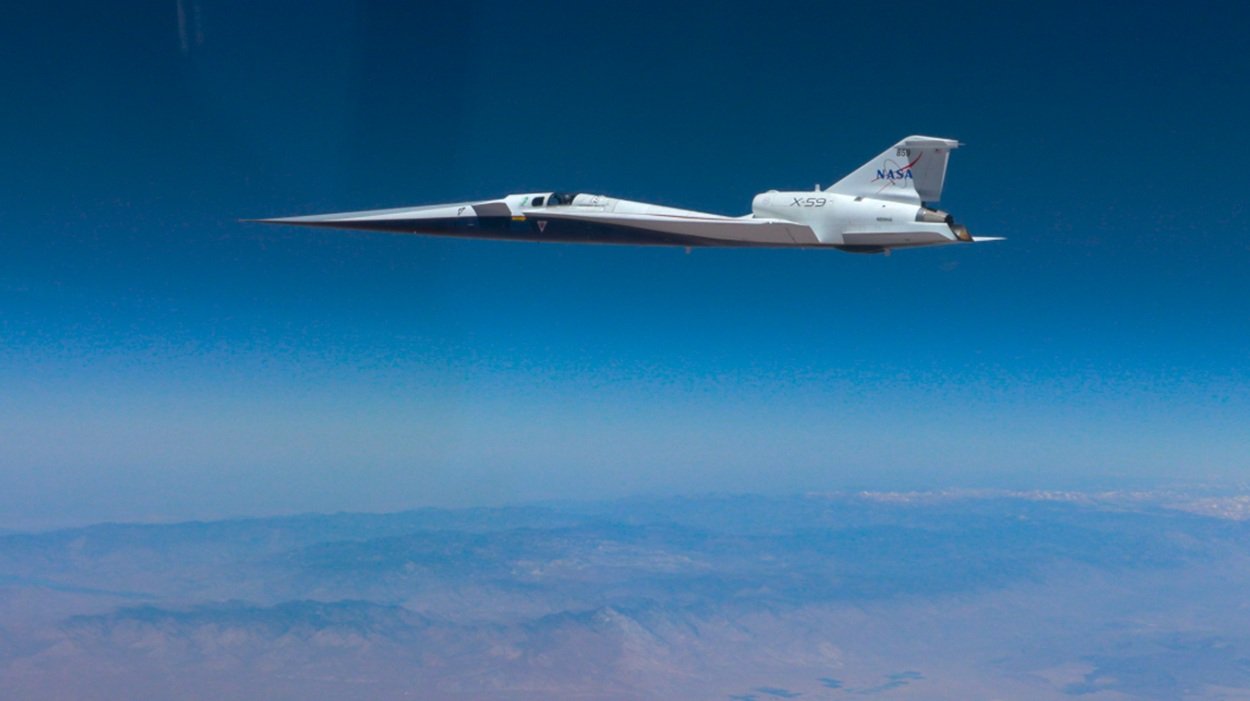
Commercial supersonic flight over land has been off the table in the U.S. for more than 50 years because of one problem: the sonic boom. On June 5, NASA’s answer to that problem broke the sound barrier for the first time as the X-59 went supersonic over the Mojave Desert. It was the most significant milestone yet in the agency’s quest for a quiet supersonic signature from the demonstrator. A clean run to Mach 1.1 The flight began at 11:08 a.m. local time and lasted 81 minutes, with the test team evaluating the aircraft’s handling at both subsonic and supersonic speeds. NASA says the X-59 reached approximately Mach 1.1 at 43,400 feet and performed as expected. That is a welcome change from March, when the program’s second flight ended after nine minutes because of a vehicle system warning in the cockpit. The warning turned out to be a false alarm, eventually traced to an incorrectly installed instrument. A NASA F-15 chase plane flew nearby to monitor the X-59, and the F-15’s own sonic booms masked whatever sound the X-59 produced, so the aural results will have to wait. The flight launched from Edwards Air Force Base in California, the X-59’s home since October 2025, when it made its first flight from Lockheed Martin’s Skunk Works in Palmdale to NASA’s Armstrong Flight Research Center at Edwards. NASA test pilot Jim “Clue” Less was at the controls, as he was for the March flight; fellow NASA test pilot Nils Larson flew the aircraft’s maiden trip. Target is the rulebook, not a speed record Supersonic flight is banned over land in the U.S. because of boom noise, and the X-59 exists to make that restriction obsolete. Its elongated nose and carefully shaped airframe are designed to keep shock waves from merging into the sharp crack of a sonic boom. Flown at the right speed and altitude, the aircraft should produce something closer to a quiet thump. The aircraft, built in partnership with Lockheed Martin, is the centerpiece of Quesst, NASA’s mission to gather the data that could allow quiet supersonic flight over communities. Flight testing is planned to accelerate through 2026, with the X-59 gradually flying faster and higher in the envelope expansion process that will demonstrate its airworthiness, performance. Next stop: Mach 1.4 at 55,000 feet NASA is now working toward a mission conditions flight at a cruise of Mach 1.4 and roughly 55,000 feet. That profile matters because it is the baseline for the program’s next phase: flights over U.S. communities to measure whether residents hear the thump at all, and how they react when they do. NASA will hand that data to U.S. and international regulators as the technical basis for noise standards that could replace today’s blanket speed limit. What happens next The regulatory machinery is already moving faster than the airplane (a rarity). A June 2025 executive order directed the FAA to begin replacing the overland ban with a noise-based standard. The House has also offered its support with the passing of legislation in March that would let civil aircraft fly supersonic over land as long as no boom reaches the ground. The bill still needs to pass the Senate. Boom Supersonic, the only company currently building toward a supersonic airliner, is taking a different technical approach: using Mach cutoff physics, demonstrated on its XB-1 last year, to keep the boom from reaching the ground rather than reshaping it. None of this puts supersonic seats on sale soon. The X-59 is a research aircraft, not a commercial prototype, and its community overflights are still at least a year of envelope expansion away. The data it produces feeds a rulemaking process measured in years, and the noise standards that come out of it will shape aircraft that have not been designed yet. Boom’s Overture is targeting passenger service around the end of the decade, and supersonic programs have a history of slipping. The realistic read: quiet supersonic flight over land is a 2030s business. What changed on June 5 is that the regulators need to be ready for a future that exists at Mach 1.1 and beyond.
Trending
- Australia clears JASSM-ER, LRASM for Super Hornets
- On this day in space! NASA astronaut Mae Jemison makes history as the 1st Black woman in space
- European E-SAF Startups Firm Supply Infrastructure Agreements
- Vietravel Airlines signs preliminary deal for 50 Airbus aircraft
- South Korea Selects Seoul For UAM Pilot Project
- How Ryanair Built Europe’s Most Profitable Airline By Making Flying As Uncomfortable As Possible
- DSV expands air cargo pharma product with Shanghai connection
- Canada picks six systems in drone push with Ukraine
