


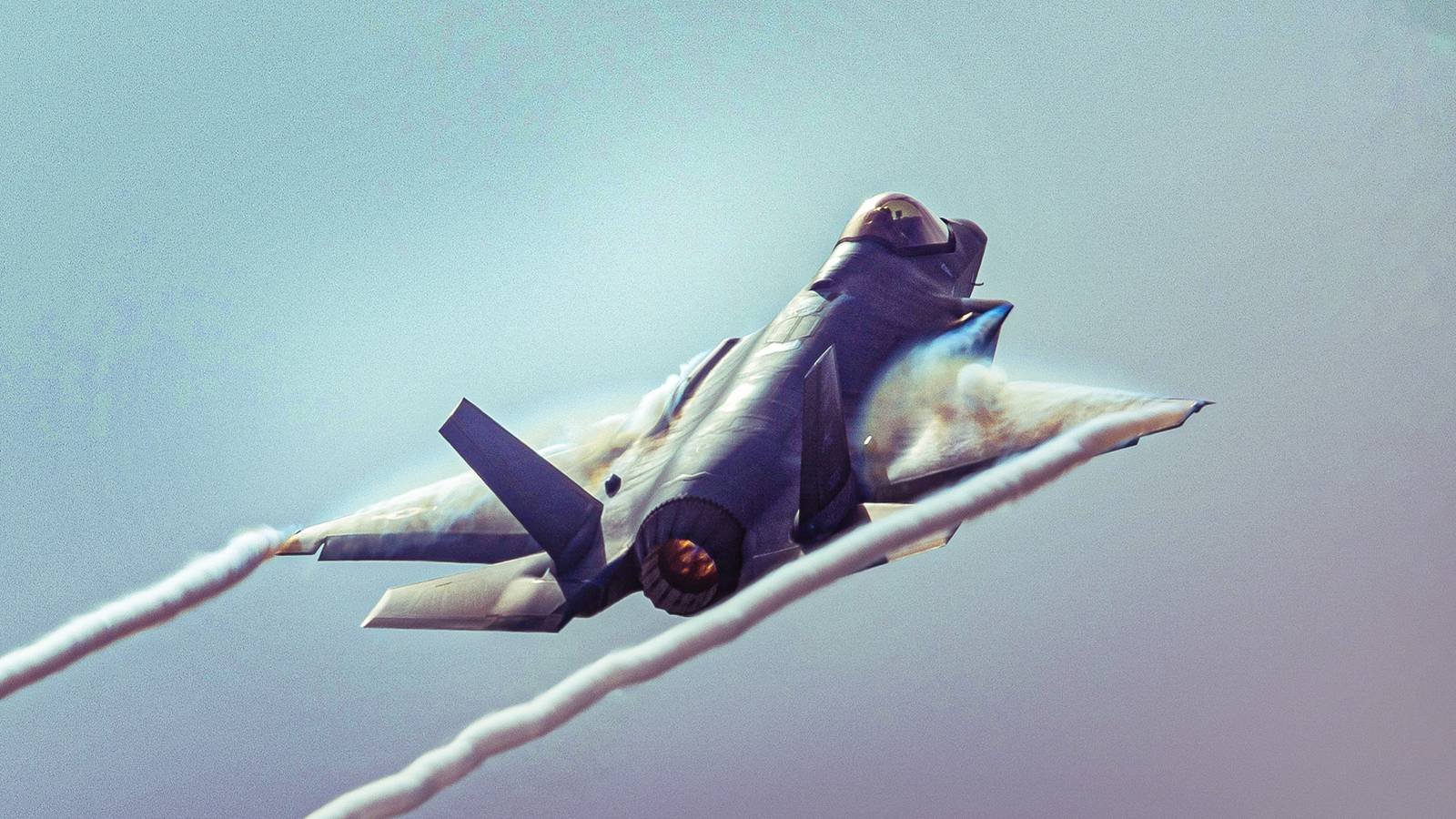
The latest generation of fighter jets around the world has reintroduced a debate over armament decisions in modern warplanes. Although the Lockheed Martin F-22 Raptor and F-35A Lightning II both have an internal gun, the F-35B Jump Jet and F-35C Carrier Variant do not. Similarly, virtually all sixth-generation fighter jets like the Boeing F-47 and BAE Tempest are expected to omit the internally mounted cannon. Next-gen fighters prioritize standoff tactics and maximize the advantages of stealth, meaning that getting close enough to a target to use a gun would already represent a tactical failure.
Instead, next-gens will rely heavily on advanced Beyond-Visual-Range missiles, Collaborative Combat Aircraft, and eventually Directed Energy Weapons, or lasers. Skeptics have drawn parallels to the McDonnell Douglas F-4 Phantom II, which was notorious in the Vietnam conflict for its losses in close-quarters dogfights. The jet was made without a gun as it was deemed unnecessary to the technological advancement of air-to-air missiles. Pilots suffered combat losses because the aircraft and its weapons fell short of expectations.
The Fifth-Generation Compromise: Joint Strike Fighter

As the world’s first fifth-generation fighter jet, the F-22 Raptor was purpose-built for air dominance. Its 20 mm M61A2 Vulcan Cannon was a core part of its design in order to provide it with close, high-G dogfighting lethality. As a simpler and less expensive successor, the USAF design philosophy still extended to the F-35A, requiring a gun for Close Air Support and emergency dogfight scenarios. On the other hand, the other variants of the JSF line can only carry an externally mounted gun on hardpoints under the fuselage.
Starting with the F-35B, as a Jump Jet, the Marine Corps variant has a massive vertical lift fan sitting precisely where the internal gun ammunition drum would otherwise be. This is necessary in order for it to achieve vertical takeoff and landing, its key characteristic that allows it to deploy to small forward airfields and amphibious assault ships. The Navy’s F-35C variant required heavy structural reinforcement, beefier landing gear, and arrestor hooks to survive catapult launches and carrier landings. To balance out this massive weight penalty, designers ditched the internal gun.
The external gun pods used by the F-35B and F-35C offer more ammunition than the F-35A’s internal gun and also have a higher rate of fire. All three variants utilize the exact same 25mm GAU-22/A Gatling gun, but the external pods inherently sacrifice the aircraft’s pristine stealth capabilities and aerodynamic efficiency. The gun pods are engineered with low-observable stealthy faceting and radar-absorbent coatings, but their surface area still increases the total aircraft radar cross-section.
Why NATO Countries Are Racing to Replace Their Ageing Fighter Fleets
The alliance’s rearmament for the future of air warfare.
The Sixth-Generation Difference: A System Of Systems

While it is more advanced than legacy airframes, the F-35 was still largely designed around its onboard weapons. In contrast, sixth-generation platforms are replacing the internal munitions carried by the airplane itself because the combined ecosystem of lasers, drones, and offboard networks destroys the fundamental requirements. These next-gen jets will never close the distance and point the nose of the jet at the target to accomplish their mission. Keeping a gun on a sixth-generation fighter means carrying hundreds of pounds of dead weight.
Sixth-generation warfare relies on combat cloud networking. Loyal Wingman, for collaborative combat aircraft, will be controlled by pilots inside next-gen fighter jets to strike targets, perform surveillance, and even act as a shield, like a ‘missile sponge.’ These advanced drones will be cheap enough to be acceptable sacrifices on the battlefield instead of allowing an exponentially more costly and strategically valuable crewed stealth fighter to be damaged or lost. By deploying these drones ahead of the main jet, they can radically expand their presence, absorb enemy fire, and project weapons into contested airspace.
Below is a side-by-side comparison of CCAs currently in development:
Specification | YFQ-42A | YFQ-44A | MQ-25 | MQ-28A |
|---|---|---|---|---|
Manufacturer | General Dynamics / General Atomics | Anduril Industries | Boeing Defense | Boeing Defence Australia |
Status (2026) | Flight Prototyping | Flight Prototyping | Fleet Integration | Operational Testing |
Max Speed | 760 miles per hour (1,225 km/h) | 720 miles per hour (1,160 km/h) | 610 miles per hour (980 km/h) | 645 miles per hour (1,040 km/h) |
Combat Radius | 1,120 miles (1800 km) | 745 miles (1200 km) | 575 miles (930 km) | 930 miles (1500 km) |
Max Altitude | 45,000 feet (13,700 meters) | 50,000 feet (15,200 meters) | 40,000 feet (12,200 meters) | 40,000 feet (12,200 meters) |
Max G-Load Limit | 9 G-force | 9 G-force | 4 G-force | 7 G-force |
Different global programs are actively building prototype drones to pair with their future fighters. The US Air Force recently entered the next day’s selection for its CCA program with General Atomics’ YFQ-42A, and Anduril Industries’ YFQ-44A is expected to deliver production-grade prototypes for testing this year. The Trilateral GCAP program is developing the ARMD-20X Drone with Mitsubishi Heavy Industries in the lead. Meanwhile, the Royal Australian Air Force is nearing operational status with its Boeing MQ-28A Ghost Bat.
How Many Drones Does The US Department Of Defense Operate?
The rapidly growing fleet of unmanned aircraft.
The Star Wars Arms Race

Pairing off-board drones for long ranges with speed-of-light lasers for short ranges allows next-gen fighters to create a nearly impervious, multi-layered defensive bubble that leaves a traditional kinetic gun with virtually zero tactical purpose. To use a 20mm or 25mm cannon in the sky, two brutal physical realities must happen. The range must be less than 1.5 miles (2.4 km), as bullets will lose their energy after that. The aircraft must also pursue its target nose-on, which greatly diminishes the advantage of stealth.
If an enemy fighter attempts to rush a sixth-generation jet, the pilot unleashes a swarm of jet-powered Loyal Wingmen. Because these drones do not contain human pilots, they don’t care about G-forces. A drone can pull an instantaneous 15-G maneuver that would burst a human pilot’s blood vessels. The drones intercept, dogfight, and fire high-agility missiles at the threat while the manned fighter safely watches from 50 miles (80 km) away.
Program Name | Program Leaders | Current Stage | Planned Entry | Key Partners |
|---|---|---|---|---|
NGAD (F-47) | US Air Force | Early Production; First flight expected 2028 | 2029–2030s | Boeing (Lead), Pratt & Whitney |
GCAP (Tempest) | UK, Italy, Japan | Formal Development; Demonstrator fly-off by 2027 | 2035 | Edgewing (BAE, Leonardo, MHI) |
FCAS / SCAF | France, Germany, Spain | Conceptual / Pre-Prototype; Demonstrator delayed | 2040+ | Dassault Aviation, Airbus, Indra |
F/A-XX | US Navy | Design Selection; Decision expected Aug 2026 | 2030s | Northrop Grumman, Boeing |
China 6th Gen (J-36 / J-50) | China | Flight Testing; Multiple prototypes observed | 2030–2035 | Chengdu, Shenyang |
By deleting the gun, engineers can use that critical internal space for more fuel and advanced cooling systems, significantly increasing the jet’s survival rate. Next-gen fighter engines generate massive megawatts of electricity to power onboard lasers. A laser travels at the speed of light with no bullet drop and zero target pursuit to aim perfectly.
Even if a hypersonic missile or a stealthy enemy fighter somehow slips past the drone shield and gets close, a gun is still useless compared to a Directed Energy Weapon. Lasers use small, rotating optical turrets embedded in the jet’s skin. The fighter can track a target sitting directly behind it, off to the side, or underneath, and instantly burn out its guidance sensors or melt its control surfaces. The pilot never has to turn the jet to aim, and the laser has an effectively infinite magazine as long as the jet’s engines are running.
The Pentagon Declared The F-35’s Most Critical Upgrade ‘Predominantly Unusable’
The problem with the Joint Strike Fighter.
The Phantom’s Legacy: Expect The Unexpected

Despite the massive ecosystem of technology in development for the next gen of fighter jets, the story of the F-4 Phantom II in Vietnam shows that overconfidence and technology can often lead to a human price when the proving ground is on the battlefield. Relying entirely on drones and lasers introduces specific blind spots that an enemy could exploit to force fighters into close-range, visual combat without a backup weapon.
Spotlighting this risk, at least one F-35A was confirmed to be damaged over Iran due to anti-aircraft fire while it was flying in a high-threat environment, shattering the illusion of its invulnerability already. Next-gen fighters carry a highly lethal but mathematically limited number of internal missiles to maintain their stealth profiles. An adversary could deploy massive swarms of cheap, decoy drones ahead of their main fighter fleet to intentionally absorb missile fire, as Iran has done in Operation Epic Fury.
The F-4 Phantom was also forced into dogfights because political mandates required pilots to visually identify targets before firing to avoid hitting friendly or civilian aircraft. Command could mandate visual verification before launching million-dollar hypersonic weapons. This eliminates the standoff advantage and exposes the plane to much more risk despite its design.
The ‘High-Low’ fleet mix, complemented by CCAs, is intended to solve this problem on a strategic level. Instead of a single aircraft trying to do everything, which made the F-4 Phantom vulnerable, tasks will be divided by cost, capability, and risk. Sixth-generation jets act as the ultra-expensive ‘High’ quarterbacks, and CCAs act as the cheap “Low” robotic shields. The 4.5 fighters, like the Boeing F-15EX Eagle II and fifth-generation jets, act as the heavy muscle that delivers the high volume of firepower once the airspace is sanitized.
