


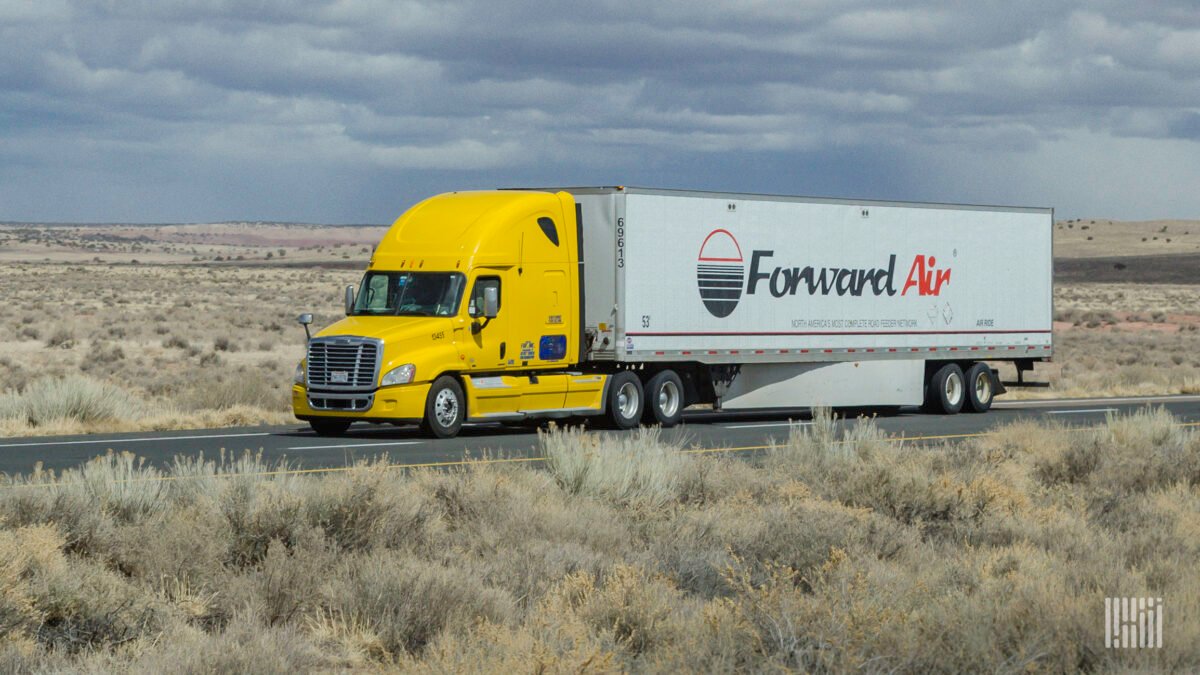
The fastest way for Amazon to add a premium expedited tier to its new national LTL network is to buy the one carrier already built for it — and already on the auction block
Amazon (NASDAQ: AMZN) opened its less-than-truckload network to all businesses this week, and the market reaction was muted. Shares of the publicly traded LTL carriers slipped about 5% on the day — a modest move for a group that has run more than 60% year to date — and the analyst notes that followed were, with one exception, reassuring to incumbents. The consensus read: this is a strong economy-tier offering, but not yet a hub-and-spoke carrier in the mold of Old Dominion (NASDAQ: ODFL) or FedEx Freight (NYSE: FDFX).
That consensus is right about where Amazon’s network stands today. It misses where Amazon could take it next. The launch gives Amazon a real national economy LTL platform; what it doesn’t yet include is a premium expedited tier on top. The fastest way to add one is a company that is mid-strategic review, trading at a depressed equity value, with a motivated seller: Forward Air (NASDAQ: FWRD).
Amazon’s new LTL service is purpose-built for one part of the market. The expanded offering covers shipments of one to six pallets — 150 to 15,000 pounds — picked up, transferred at a nearby terminal, and delivered intact at what Amazon pitches as a lower cost than legacy carriers. It runs on an asset-light model across roughly 30 terminals stitched into a package-delivery network, with real density in the Eastern U.S. and a growing set of Western metros. For the economy, cost-sensitive end of LTL, that’s a credible national entry on day one.
What it isn’t yet is a premium expedited network. A full national LTL carrier runs 200 to 300 service centers reaching nearly every U.S. ZIP code; FedEx Freight alone operates a 365-terminal network. Amazon’s 30-terminal footprint is the right size for where it’s competing today, and the analyst community read it that way. Deutsche Bank’s Richa Harnain told investors Amazon’s footprint isn’t yet that of a “formidable full-fledged nationwide asset-based operator,” and characterized the current service as more akin to what brokers offer. TD Cowen’s Jason Seidl, pointing to Amazon’s reliance on an intermodal container pool, argued the offering will mostly compete in the economy three-to-four-day sub-segment and take share “on the margins.” Those are observations about the entry point, not the ceiling.
One analyst dissented. Morgan Stanley’s Ravi Shanker warned that even an asset-light model could be a disruptor, because Amazon “has repeatedly demonstrated an ability to gain traction in transportation markets through a flexible and iterative operating model” — potentially capturing meaningful share even without best-in-class service, and striking at the real-estate-and-service “moat” that anchors the entire LTL bull thesis.
Shanker is right about the ambition and the iterative playbook. The question is just timing. Building the expedited tier organically — a national network of cross-dock terminals, a fleet with multiple truck and trailer types, and the dock-and-linehaul optimization that separates the best carriers from the rest — is a multiyear undertaking even for Amazon, because legacy carriers have spent decades reinvesting service into a flywheel: better service drives better yields, which fund better service. Amazon can build it. The faster move is to buy a flywheel that’s already spinning.
You don’t out-iterate a decades-long flywheel. You buy one.
Why expedited is the right tier — and why Forward Air owns it
The “Amazon won’t shake LTL — yet” framing misses a key point. Amazon doesn’t need to win the whole $60 billion LTL market. It needs to win the tier where its existing advantages — visibility, technology, reliability, density of demand — compound fastest. Amazon’s own pitch leans entirely on those attributes: real-time GPS tracking, automated appointment scheduling, electronic proof of delivery, a sensor-equipped fleet. Director of Amazon Freight Jim Ruiz framed the entire launch around closing the gap between LTL and the reliability and visibility shippers already get on full-truckload moves.
That is, almost word for word, the value proposition of expedited LTL — time-definite, high-intact-rate, premium-service freight. And the purest national expedited LTL franchise in the market is Forward Air.
Forward built its network airport-to-airport, serving the time-sensitive, high-value freight that brokers and economy carriers can’t reliably handle, and has spent years extending that backbone into a broader national LTL footprint. Its expedited segment is engineered around exactly the attributes Amazon is marketing: time-definite shipping, industry-leading intact delivery rates, late cutoffs, early recovery, cross-border reach into Canada and Mexico. Where Amazon’s network today is strongest in the East and built for the economy tier, Forward’s is national and premium-graded. The two are less competitors than complements — and, as the next section shows, they may physically connect at the hub.
The piece that completes the picture: a road feeder linehaul grid on airline bones
What makes Forward’s footprint so hard to replicate — and so valuable to Amazon specifically — is how it’s wired. Forward doesn’t run a conventional trucking network that happens to be national. It runs a road feeder network — scheduled linehaul trucks operating like flight legs, moving time-definite freight between terminals located at or near more than 80 major U.S. airports (with reach into Canada and Mexico), on a fixed, airline-style hub-and-spoke schedule. Freight is consolidated, run on a scheduled linehaul leg to a central sort or one of the regional hubs, reloaded in rapid fashion, and pushed back out on another leg — the same operating logic an airline uses to move passengers through a connecting hub, applied to pallets on the ground.
The single most important word in that description is scheduled. This is what separates Forward from the rest of LTL, and it’s the part that’s easy to miss. A conventional LTL carrier optimizes for density and yield: it holds freight at a terminal until it has enough volume to fill a trailer, because running a near-empty truck destroys the economics of the load. Forward runs to a cut-time schedule instead. Each leg has a published departure time, and when the cut time arrives the truck leaves — full or nearly empty — because the commitment is to the schedule, not to the yield on any individual run, exactly the way an airline departs on time whether or not every seat is sold. That discipline is the whole reason Forward can promise time-definite delivery and hit it: the freight moves when the schedule says it moves, not when the trailer happens to fill. Most carriers won’t operate that way because it’s expensive. Forward built its entire franchise on it — and it is precisely the operating posture a premium expedited tier requires. The whole design exists to move cargo across the country fast and on time, which is exactly the premium expedited capability that complements what Amazon launched this week.
That airport-centric architecture is the natural complement to Amazon’s parcel-derived terminal map — and it points to the cleanest physical synergy in the entire deal.
But there’s a second, subtler fit — one that turns Forward’s biggest structural weakness into Amazon’s most obvious contribution. Forward’s expedited network is fundamentally terminal-to-terminal, not door-to-door. Its scheduled linehaul moves freight airport-to-airport; the city-side pickup and delivery — getting a pallet from the origin shipper’s dock to the terminal, and from the destination terminal to the receiver’s door — has historically run through a network of agents and contracted cartage operators rather than Forward’s own people. That dependency is a real seam: it’s where service consistency frays, where margin leaks to third parties, and where a competitor can pry a customer loose by controlling the part of the move the shipper actually sees.
Amazon closes that seam natively. The single largest asset Amazon brings to logistics is a dense, national last-mile delivery network — Delivery Service Partner contractors and drivers already operating in virtually every U.S. metro. Because every Forward terminal sits at or near an airport, Amazon’s local contractors could handle the city legs directly: picking freight up at the airport terminal, running the door deliveries, and feeding shippers’ freight back into the terminal for the next scheduled linehaul. Forward supplies the premium scheduled middle mile; Amazon supplies the first and last mile it was renting from agents. The combination doesn’t just bolt two networks together — it backfills the exact capability Forward never owned, with the one network in America already built to provide it.
And there’s one more place the two networks physically lock together.
Forward’s central sort sits at Rickenbacker International (LCK) in the Columbus, Ohio area — its National Hub, and the historical heart of the network since its air-cargo origins. Amazon’s primary U.S. air hub is at Cincinnati/Northern Kentucky International (CVG), roughly 100 miles away and purpose-built as the backbone of Amazon Air. Two scheduled, hub-and-spoke networks engineered for time-definite freight, anchored at two air-cargo hubs in the same corner of Ohio. Folding Forward’s Columbus sort into Amazon’s existing Cincinnati operation is the kind of consolidation that takes cost out, eliminates a redundant central facility, and — more importantly — physically stitches Forward’s road feeder linehaul grid into Amazon Air’s network at the hub. The result isn’t two networks bolted together; it’s a single air-and-ground expedited system with a common hub, something neither Amazon nor any legacy LTL carrier can assemble from scratch.
Buying Forward Air would hand Amazon, in a single transaction:
- The national, airport-based road feeder linehaul network described above — and the scheduled, time-definite operating discipline behind it — giving Amazon a premium tier that complements its economy network rather than 30 parcel cross-docks doing the same job twice.
- A genuine premium service tier to sit above its economy three-to-four-day lane, giving Amazon a two-tier national carrier — economy and expedited — instead of one.
- Veteran LTL operating leadership and dock-and-linehaul expertise that Amazon would otherwise spend years developing — the human capital the analysts correctly flag as scarce.
- The first and last mile Forward never owned — Amazon’s national contractor network slotting directly into the door-to-door pickup and delivery Forward has long rented from agents.
- Cross-border North American capability that Amazon’s domestic parcel network does not natively provide.
The window is open right now
The strategic case is strong on its own. The timing is what makes it urgent.
Forward Air has been in a strategic review since January 2025 — a process that began under heavy investor pressure after its contested $2.1 billion acquisition of freight forwarder Omni Logistics, with shareholders citing misguided capital allocation and weak oversight. The company has repeatedly said the review is “nearing the conclusion,” but a full-enterprise sale has come to look unlikely: private-equity suitors including Clearlake Capital and Apollo Global Management stepped back from bids for the whole company, and Forward has instead leaned toward divesting non-core Omni assets to pay down debt and refocus on its expedited LTL core.
The result is a premium asset trading at a distressed price. Forward’s stock, which briefly ran above $30 last year on sale speculation, has fallen back toward $10, with a market capitalization in the $330–365 million range in early June 2026. Net debt of roughly $1.65 billion sits at about 5.5 times trailing EBITDA against a covenant that keeps stepping down — the equity is cheap, but the balance sheet is precisely the kind of problem a buyer with Amazon’s cost of capital can refinance or absorb. Enterprise value lands around $2 billion. For an acquirer with Amazon’s balance sheet — and analysts uniformly grant that Amazon has the resources to compete and win in the space — that is a modest price against the strategic value.
The timing is also competitive. J.P. Morgan’s Brian Ossenbeck had already warned that Amazon offering LTL to external customers in 2026 could introduce competition legacy carriers would struggle to match. That threat is now live. Meanwhile the rest of the field is consolidating around it: FedEx Freight just spun off as a standalone carrier with 500-plus dedicated sales reps chasing freight for its 365 terminals; Knight-Swift has been bolting on regional LTL carriers and Yellow’s old terminals since 2021; TFI is angling toward a pure-play LTL spin; and Walmart is upgrading its own LTL consolidation program. Amazon was itself rumored in early 2025 to be circling Old Dominion — the gold-standard national carrier — though ODFL’s management said it wasn’t in talks. Old Dominion would have been the trophy; Forward Air is the available, affordable, strategically cleaner fit, and it is on the block today in a way Old Dominion never was.
The counterargument
Skeptics will note that Forward’s recent results are soft: expedited revenue down 7% year over year in its latest annual figures, tonnage off double digits, the whole enterprise still posting net losses while it works through the Omni integration. Why buy a business in decline?
Because the decline is balance-sheet and integration-driven, not network-driven. The expedited franchise itself has been improving margins even as volumes softened — operating and EBITDA margins both expanded several hundred basis points year over year on cost discipline, and management has removed more than 300 positions and tens of millions in annualized cost from the system. What’s broken is the capital structure and the Omni overhang, not the LTL asset. An acquirer that wants the expedited network and can refinance or absorb the debt — and, ideally, sell the Omni forwarding operations to a different buyer — acquires the strong asset and resolves the weak one. That is precisely what Amazon is positioned to do.
The deeper objection is cultural: Amazon builds, it doesn’t buy networks. But Amazon’s air-cargo and middle-mile build-out shows it will acquire and absorb physical capacity when organic build is too slow, and nothing about LTL’s decades-long terminal flywheel rewards patience. The Morgan Stanley view points the same direction. If even the bull case for Amazon-as-disruptor rests on an iterative, asset-light grind, then the move that compresses years of that work into a quarter is the acquisition of a ready-made national premium network.
The bottom line
The analysts are right about one thing: Wednesday’s launch, on its own, won’t shake the LTL market. Thirty cross-docks built for parcels, running economy freight on three-to-four-day lanes, is not an extinction event for Old Dominion or FedEx Freight.
But that’s the launch, not the plan. The plan is a two-tier national carrier — economy on the bottom, expedited on top — running on Amazon’s technology, visibility, and demand. Amazon can spend five years and a fortune building the expedited tier from nothing, fighting a flywheel that veteran operators have been spinning for decades. Or it can buy the best expedited LTL network in the country while it’s in play, motivated, and cheap.
Forward Air is the gap in Amazon’s map. It’s the network everyone says Amazon can’t replicate — and it’s for sale right now. Amazon should buy it before another bidder does.
