


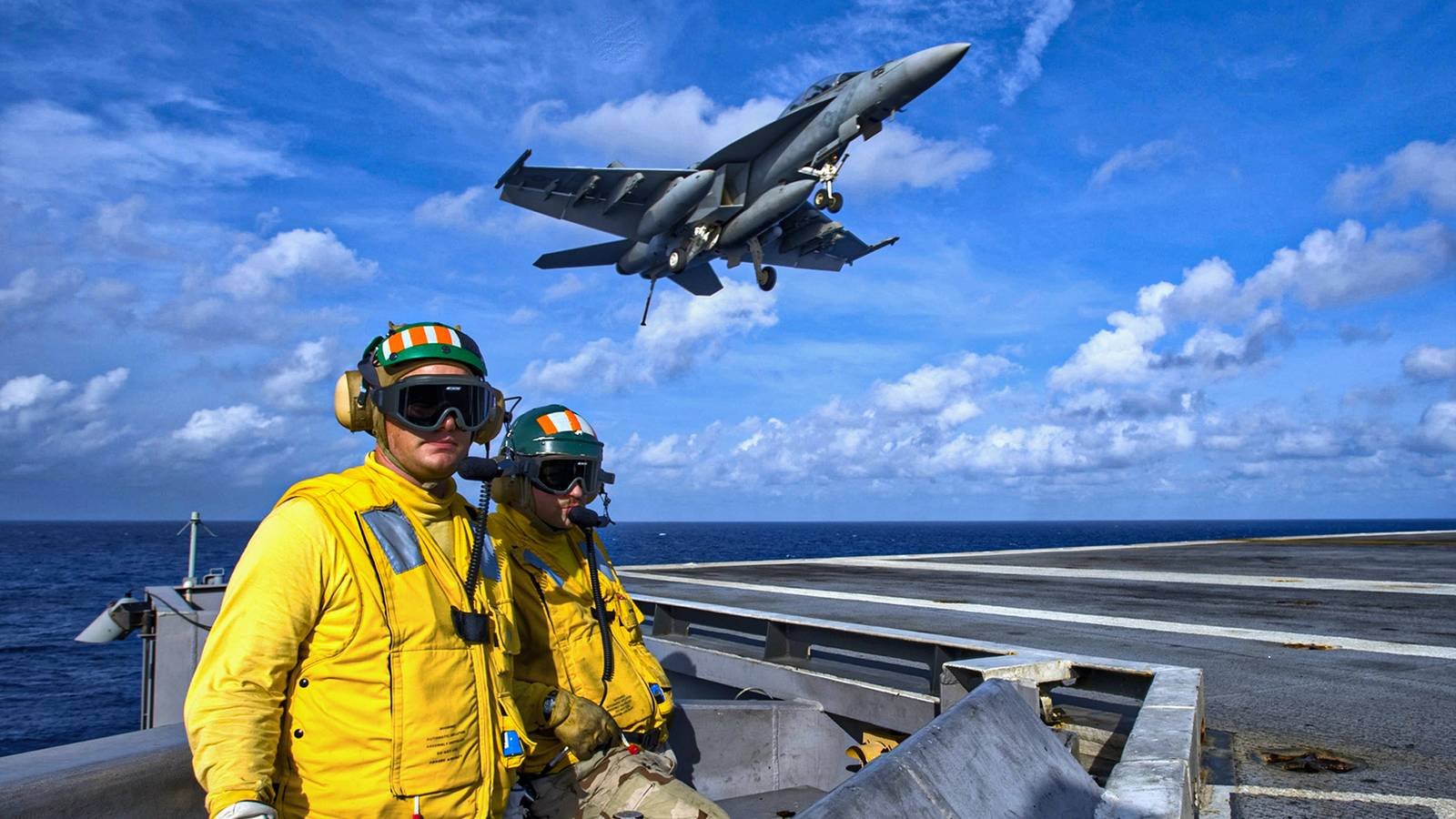
While all carrier-based fighter jets have high Angles of Attack (AoA) with nose-up approaches, the original McDonnell Douglas F/A-18 legacy Hornet is particularly famous for appearing the most dramatic. The eye-catching, highly angled landing is mostly a product of the physics of landing on a short flight deck while also needing to snag the arresting wire, and is also a product of its time, with less advanced flight control software than today’s F-35C. That said, the Hornet was advanced for its era.
Landing on aircraft carriers is dramatically more difficult for both flight crews and the aircraft itself relative to landing on conventional runways. For example, as a pilot touches down, they immediately advance the engines to 100% throttle so that if the tailhook fails to catch one of the arresting wires, the aircraft has enough power to fly off the angled flight deck and not tumble into the sea. Here is why the Hornet was designed with such a high angle of attack.
Carrier-Based Aircraft Need High Angles Of Attack
Carrier-based aircraft need to be able to execute a relatively high angle (nose-up) angle of attack on approach compared with conventional Air Force aircraft. This is true not only for the US Navy but also for other navies that require their jets to perform arrested landings since the dawn of the jet age. It has often been noted that conventional land-based jets are landed as finely and gently as possible, while Navy landings on carriers often resemble more controlled crashes.
To cope with the strain of these “controlled crashes,” carrier-based fighter jets receive structural and landing gear reinforcement. A trade-off is that they are heavier than their land-based counterparts would otherwise have been. The F/A-18 Hornet was designed to sustain carrier operations and was therefore equipped with robust landing gear and other adaptations. Notably, the land-based legacy Hornet variants in service in Canada, Finland, Spain, Switzerland, Kuwait, and formerly Australia (which still has Super Hornets) have been adapted for ground operations and have shed unnecessary weight.
One reason naval fighter jets are rarely sold as second-hand aircraft to other navies or air forces is that the strain of carrier-based operations tends to wear the airframes out. Salt-air exposure is another contributing factor to their shorter life cycles. Whereas retiring Danish, Norwegian, Dutch, and Belgian F-16s are looking forward to many more years of service with Ukraine, Romania, and Argentina, retiring US Navy and Marine Corps legacy Hornets and Super Hornets are sent to the boneyard.
Snagging The Arresting Wire

The key reasons for a high angle of attack include the need for the tailhook to snag the arresting wire, the controlled high descent rate (“Slam”), and pilot visibility. The Hornet was built from the ground up as a carrier-based fighter jet with an excellent angle of attack. The F/A-18 requires a high angle of attack (around 8°) and a relatively steep glide slope (around 3.5°) to ensure the tailhook catches the arresting wires.
The arresting wire is a key feature for rapidly slowing aircraft, as aircraft carrier flight decks are far shorter than the long runways used by air forces. When arresting wires fail, the aircraft can tumble into the sea, as happened with Russia’s seemingly cursed Admiral Khusanov aircraft carrier in 2016. US carriers have multiple arresting wires, although the F/A-18 typically snags the #3 wire.
Select carrier-based fighter jet types | Navies in service (per US Navy, etc.) |
|---|---|
F/A-18 legacy Hornet | US Marine Corps |
F/A-18 Super Hornet | US Navy |
F-35B | US Marines, Royal Navy, Italian Navy, Japanese Navy |
F-35C | US Navy, US Marines |
AV-8B Harrier II | US Marines (retiring), Italian Navy, Spanish Navy |
MiG-29K | Indian Navy, Russian Navy (no operational carrier) |
J-15 | Chinese PLANAF |
Rafale M | French Navy, Indian Navy (future) |
Because the Hornet’s weight changes due to fuel and munitions, a fixed angle of attack automatically gives the correct approach speed for that weight. The angle of attack remains constant while air speed changes. A high AoA allows the aircraft to fly slowly as it approaches the aircraft carrier while still generating lift.
A Closer Look At The US Navy’s 16 EA-18G Growler Squadrons
The EA-18G Growler Squadrons of the US Navy are fearsome weapons of electronic warfare, using cutting-edge systems to rule the EW battlespace.
Flight-Control Improvements Make Landings Easier

All carrier-based aircraft have relatively high AoA during landing. This is also true of the Navy’s carrier-based F-35Cwhich is also designed for catapult launches and arrested recoveries and then lands with a tailhook. That said, the F-35C’s landing often looks less impressive than the Hornet’s, as it has a larger wing, more internal lift, and extremely advanced flight-control software that helps to smooth the approach.
Catch what other flight trackers miss
Emergency squawks, holds, NOTAMs — live signals, no signup.
Open tracker
Catch what other flight trackers miss
Emergency squawks, holds, NOTAMs — live signals, no signup.
Open tracker
As a more modern and advanced fighter jet, the F-35C is optimized for more benign low-speed handling, reduced pilot workload, and stable carrier approaches. Initial McDonnell Douglas F-4 Phantom IIs were infamous for their high AoA and difficult low-speed landing. This was eased by the introduction of variable geometry wings. The old Grumman F-14 Tomcat had a more moderate AoA than the Hornets thanks to its large variable-sweep wings that generated a large amount of lift.
It is also worth noting that the original legacy Hornet was the first Navy fighter jet to enter service with digital fly-by-wire systems. The F-16 was the first operational fighter jet with fly-by-wire controls. Except for the appearance and then disappearance of variable-sweep wing aircraft, improving flight-control software has made carrier landings progressively easier.
Super Hornet Dampens AoA Somewhat

The AoA has changed over time. The original McDonnell Douglas F/A-18 Hornet had a dramatic nose-up carrier approach, with this being reduced somewhat by the Super Hornet upgrade. The F/A-18 Super Hornet has the same designation as the legacy Hornet, but it is in many ways a new aircraft. It was designed as a “good enough”, affordable, low-risk, and highly versatile replacement for the vulnerable F-14 Tomcat.
The Super Hornet comes with a larger wing and refined aerodynamics that allow it to be more stable on approach and a little less extreme visually in its AoA than the legacy Hornet. The US Navy’s EA-18G Growler electronic warfare fleet is also based on the Super Hornet and not the legacy Hornet.
The end is coming for the Hornet and its carrier-based operations. The US Navy retired the last of its legacy Hornets in 2019, although they remain in service with the Marine Corps. As of the time of writing (May 2026), the Marines are in the process of retiring the last of their AV-8B Harrier jump jets. This will leave them with a fleet of legacy Hornets and F-35Bs. As more F-35Bs enter service, the remaining legacy Hornets will be phased out.
Why The F-14 Tomcat’s Wings Had To Sweep Forward To Land On A Carrier
A closer look at the reasoning behind the plane’s iconic swing-wing mechanism.
How Carriers Reduce Ground Speed

Unlike ground airbases, the aircraft carrier can aid in reducing the aircraft’s ground speed by sailing at around 20 to 30 knots. In aviation, there is a key distinction between airspeed (the speed of the aircraft relative to the air) and ground speed (the speed relative to the carrier deck). The critical factor for lift generation is air speed, not ground speed (angle of attack also plays a role). This enables the carrier to sail into the wind and allows aircraft to generate more lift with a higher air speed, slowing down the ground speed.
Another factor is that airport runways can’t always point into the wind, even if they are designed to run into the predominant winds and are built with an angled runway. This means aircraft landing at airbases may have to contend with crosswinds. Carriers can sail into the wind. So a carrier sailing 30 knots into a 20-knot headwind generates 50 knots of wind over the flight deck. A fighter jet that needs 140 knots indicated airspeed to land safely may only have to deal with around 90 knots of actual speed relative to the flight deck.
This matters enormously as landing at 140 knots (relative to the deck) is vastly more difficult than landing at 90 knots. Not only is it more difficult for the pilot, but it also significantly increases the stress on the landing gear, the fatigue on the airframe, tire stress, stopping distance, and reduces safety margins. It is so important that carriers are often seen to obsess over “wind over deck,” to the point of planning flight operations around weather systems and changing course just for aviation needs.
STOVL Aircraft Are Different

There are still two STOVL and V/STOL aircraft in Western naval service, the F-35B and the AV-8B Harrier II. These are completely different from their carrier-based counterparts in their AoA during vertical landings. As F-35Bs transition to hover using their powerful LiftSystem, they don’t require high AoA. During these landings, the F-35B may appear flatter and slower and even like it’s hovering over the ship.
That said, when operating on larger aircraft carriers, like the Royal Navy’s Queen Elizabeth Class, they often conduct Shipborne Rolling Vertical Landing (SRVL), which is a semi-conventional rolling landing with some forward speed without a tailhook. This is common for aircraft landing with heavier loads. These landings use a higher AoA relative to typical land-based aircraft, but much less than the Hornet family.
The Harrier can also perform SRVLs, which has the benefit of causing less engine wear. As stated, the Harrier is now in its twilight years, with the type now retiring from Marine Corps service, and is expected to phase out of Italian Navy service by 2028 and finally from Spanish Navy service in the early 2030s. Meanwhile, the US Navy is the only operator of naval-variant Super Hornets. It is set to receive its final Super Hornets in 2027 and then operate them into the 2050s until they are phased out by the future F/A-XX in development.
