


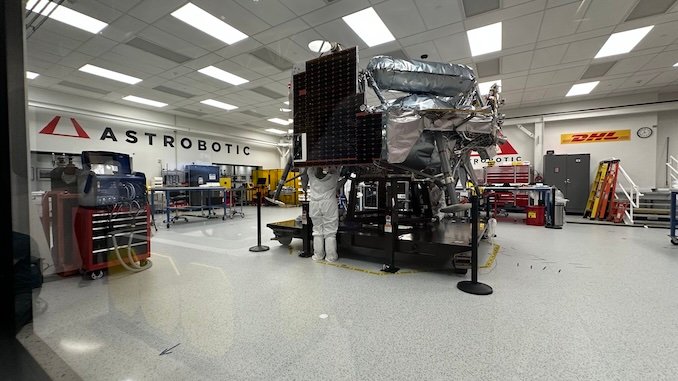
Astrobotic showed off its nearly completed lunar lander, named Griffin-1, as the vehicle prepares to head to NASA’s Jet Propulsion Laboratory in California for environmental testing later this month.
The robotic lander, which has a 650 kg payload capacity, has been integrated with multiple payloads so far. On exception is Astrolab’s FLIP (FLEX Lunar Innovation Platform) rover. FLIP will meet its lander down at Cape Canaveral for integration in the final weeks ahead of launch later this year.
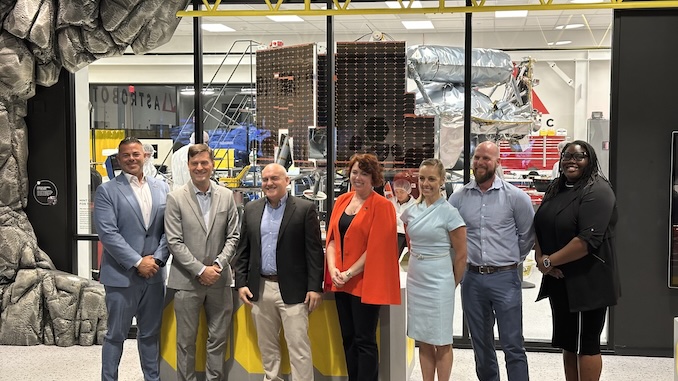
Dozens gathered on Monday at the Moonshot Museum in Pittsburgh, Pennsylvania, to mark the milestone. The site is adjacent to Astrobotic’s facilities and has a large window into the cleanroom, which allows for public viewing of the ongoing work.
“It’s fantastic to see the cross-section of Pittsburgh and Pennsylvania standing up, coming together, celebrating this big, big moment in space,” said John Thornton, Astrobotic’s CEO.
“Pittsburgh is in the space race. it’s not just a thing that happens in Houston or San Francisco or LA or Florida anymore. It happens right here in Pennsylvania and it’s in part do to the partnerships, the great people in this room that helped build this region up.”
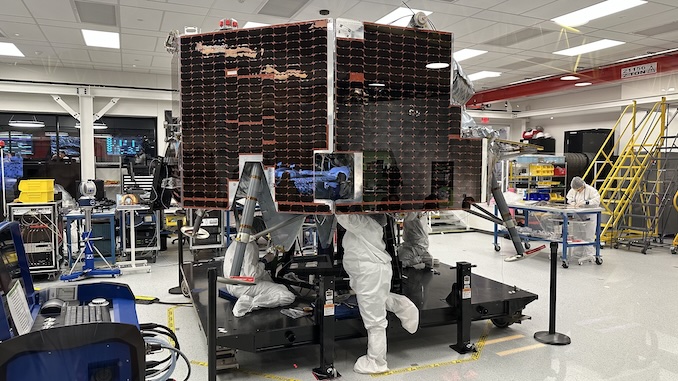
Thornton noted that the Griffin lander concept has been in the development chain going back nearly to the founding of Astrobotic almost two decades ago. The Griffin-1 mission is the follow up to the company’s first lunar landing attempt in January 2024, Peregrine-1.
That lander encountered a helium valve issue early in flight, which prevented a landing attempt. Thornton said their in-house avionics and other systems on the lander worked as expected on that flight and the post-anomaly review board worked through the fault tree and potential links to the future Griffin landers.
“The Griffin lander behind me has integrated all of those lessons learned. We did an exhaustive failure review board that did not just look at what we knew had failed, but also any other things that could have failed or any potential risks,” Thornton said.
“We’ve closed all of those loops with this lander behind me. This lander has a dual redundant valve system, two dissimilar valves that both have to fail to have the same outcome,” he added. “That will not happen. We are done with valve issues on our landers.”

Also present for Monday’s event was Carlos García-Galán, NASA’s Program Executive for the Moon Base. During a recent Moon Base event at NASA Headquarters in Washington D.C., he and NASA Administrator Jared Isaacman pointed to the Griffin-1 mission as a foundational flight for the program, dubbing it the Moon Base 2 mission.
During Monday’s event, García-Galán said the mission is a crucial stepping stone as the agency learns what will ultimately be needed for permanent infrastructure at the Moon’s south pole.
“It’s so critical that we get this going quickly, fast, and then it’s going to be one of the cornerstones of setting up the cadence we’re going to need to build this,” García-Galán said. “This mission, that this machine is part of, is more than about carrying payloads. It’s carrying new technologies that will help us understand how to do these things, like landing on the Moon successfully, reliably, and deploying rovers that would then give us the ground truth for deployment systems, and operating all at once: doing the operations, the communications, all of that stuff.”
Last week, Astrobotic announced that it was in the process of being acquired by Voyager Technologies, making it part of its lunar strategy. Matt Magaña, Voyager’s President of Defense & National Security, said Monday that the work Astrobotic is undertaking made a natural fit for Voyager’s deep space ambitions.
“Thank you, all of Astrobotic’s folks, for all the work you’ve done to get to this Griffin-1, but this is only the beginning,” Magaña said. “Super excited for the launch this year. Super excited for all the plans that we have to help scale this company, help scale this, and actually get a habitat on the lunar surface.”
The main payload on the Griffin-1 mission, FLIP, is also undergoing its own environmental tests and checkouts after completing its own payload integration. The rover is a pathfinder for technology that Astrolab will use on its lunar terrain vehicles: the Crewed Lunar Vehicle (CLV-1) and the Flexible Logistics and Exploration (FLEX).
The FLIP rover was designed and actualized in about 18 months after NASA temporarily cancelled its VIPER (Volatiles Investigating Polar Exploration Rover) mission in July 2024, leaving an opening on Griffin-1. Kelly Randell, Astrolab’s Business Development Manager, said they’re excited to be carrying NASA payloads on its own technology demonstration mission.
“We’re really honored to be part of this with NASA and Astrobotic. We’re also honored that the FLIP mission will hopefully really further technologies for our lunar terrain vehicle, which hopefully will have astronauts driving it in the very near future,” Randell said.
“So we think about all of the opportunities that this mission will bring, that it will really make a tangible impact on what we’re trying to build up on the surface, and really enable us to build a sustainable human prescreens off-planet, which I think is just incredible.”
The Griffin-1 mission is scheduled to launch onboard a SpaceX Falcon Heavy rocket in the fourth quarter of 2026. A specific launch date hasn’t been announced.
No tire shops on the moon.
These tires, built with strategic partner @Venturi Space, have been tested on 11 platforms, from NASA’s Glenn Research Center to Switzerland. They go on FLIP, CLV-1, and every FLEX rover we build.
The Moon doesn’t forgive untested assumptions. We test… pic.twitter.com/BGs8reRwvS
— Astrolab (@Astrolab_Space) June 4, 2026
