


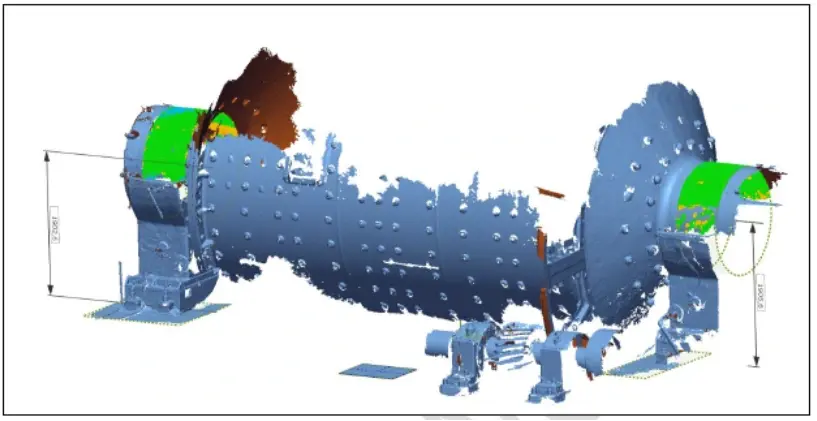
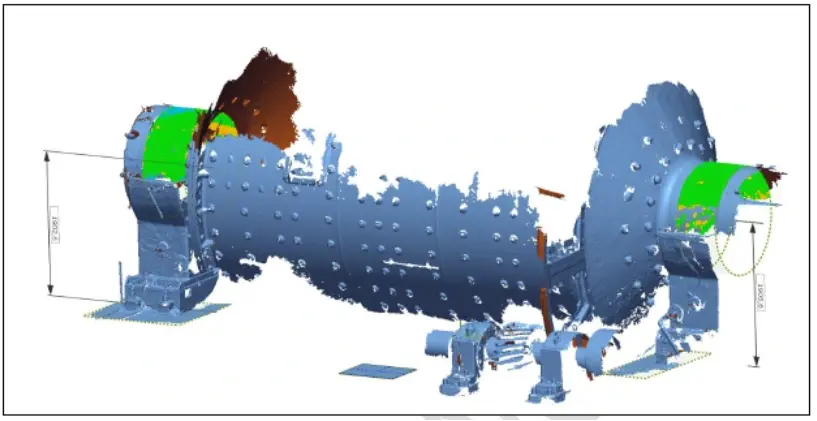
Talleres Artificio, a mechanical engineering firm based in Chile, has incorporated SHINING 3D‘s FreeScan Trak Nova into its inspection workflow for mining equipment, a move the company says has halved the time needed for certain ball mill inspections while improving the quality of the dimensional data its engineers work from.
The firm, which employs a team of more than fifteen people, designs, manufactures, and assembles mechanical systems for clients in mining, heavy industry, and advanced manufacturing. Its services routinely involve assessing the condition of large rotating equipment, where unplanned downtime carries a direct cost for mine operators.
The Limits of Manual Measurement
Until recently, the company’s inspectors depended on conventional hand-held instruments to take dimensional readings in the field. According to Talleres Artificio, this approach came with recurring drawbacks when applied to large, geometrically complex assets such as ball mills and their bearing systems. On-site measurement campaigns were slow, results varied with the skill of the individual operator, and certain features were simply out of reach. Verifying alignment and concentricity was difficult, wear patterns and deformation could go undetected, and gaps in the data occasionally fed through into design and fabrication errors downstream.
The team began looking for an alternative after seeing industrial 3D scanning demonstrated at technology exhibitions in Chile, where the possibility of capturing a complete digital representation of an asset, rather than a set of discrete measurements, stood out.
Following an evaluation of the options on the market, the company purchased the FreeScan Trak Nova, citing three deciding factors: the system’s ability to dynamically track point clouds over large areas using video photogrammetry (VPG), the use of certified measurement modules, and what it judged to be a favorable balance of capability and price. The firm also noted that its local distributor handled training and onboarding during implementation.
Scanning in the Field
In practice, engineers now capture point cloud data directly at the equipment, and the resulting digital models serve as the basis for engineering analysis, reverse engineering, maintenance planning, and quality control. The company highlights one capability in particular: the scanner can evaluate geometric characteristics, such as cylindricity, that conventional tooling struggles with. Where an internal micrometer requires physical access across a full 180-degree span, the optical system can reconstruct complete geometry even when that access does not exist.
In one ball mill project, the scan data allowed the team to quantify relative misalignment between the mill’s shafts and the degree of wear in the housings supporting its bearings, information that feeds directly into maintenance decisions.
Talleres Artificio reports that the switch has brought faster inspections, more dependable measurements, and greater confidence in the engineering conclusions drawn from them. For mine operators under pressure to keep availability high, the firm sees portable high-accuracy scanning as an increasingly standard part of maintenance engineering.
A Crowded Push Toward Portable Industrial Metrology
Talleres Artificio’s purchase reflects a strategy among service firms and scanner manufacturers alike: moving metrology-grade measurement out of the inspection room and onto the asset itself. SHINING 3D has been building its FreeScan line in this direction for several years, layering photogrammetry, wireless operation, and certified accuracy onto handheld devices so that large equipment can be digitized in situ rather than transported or measured piecemeal.
Other companies covered are pursuing the same problem from different angles. Artec 3D partnered with InnovMetric to integrate PolyWorks|Inspector into its software ecosystem, targeting the friction between scan capture and formal inspection, where data handoffs, manual alignment, and reformatting slow validation and introduce error. In addition, Artec launched Jet, a survey-grade mobile LiDAR scanner positioned explicitly for condition assessment, change detection, and inspection in mining, infrastructure, and underground environments, paired with software for processing large point cloud datasets.
The hardware race is equally active. SHINING 3D introduced the FreeProbe Series, a wireless probing add-on for its dynamic tracking platforms, including the Trak Nova, aimed at deep holes and obstructed features that scanning alone cannot reach.
The direction is consistent across vendors: faster setup, fewer markers, and inspection-ready data at the machine. For mining maintenance, the digital twin is becoming the starting point, not the afterthought.
3D Printing Industry is inviting speakers for its 2026 Additive Manufacturing Applications (AMA) series, covering Energy, Healthcare, Automotive and Mobility, Aerospace, Space and Defense, and Software. Each online event focuses on real production deployments, qualification, and supply chain integration. Practitioners interested in contributing can complete the call for speakers form here.
To stay up to date with the latest 3D printing news, don’t forget to subscribe to the 3D Printing Industry newsletter or follow us on LinkedIn.
Explore the full Future of 3D Printing and Executive Survey series from 3D Printing Industry, featuring perspectives from CEOs, engineers, and industry leaders on the industrialization of additive manufacturing, 3D printing industry trends 2026, qualification, supply chains, and additive manufacturing industry analysis.
Featured image shows Inspection data of the ball mill. Image via Talleres Artificio.
