


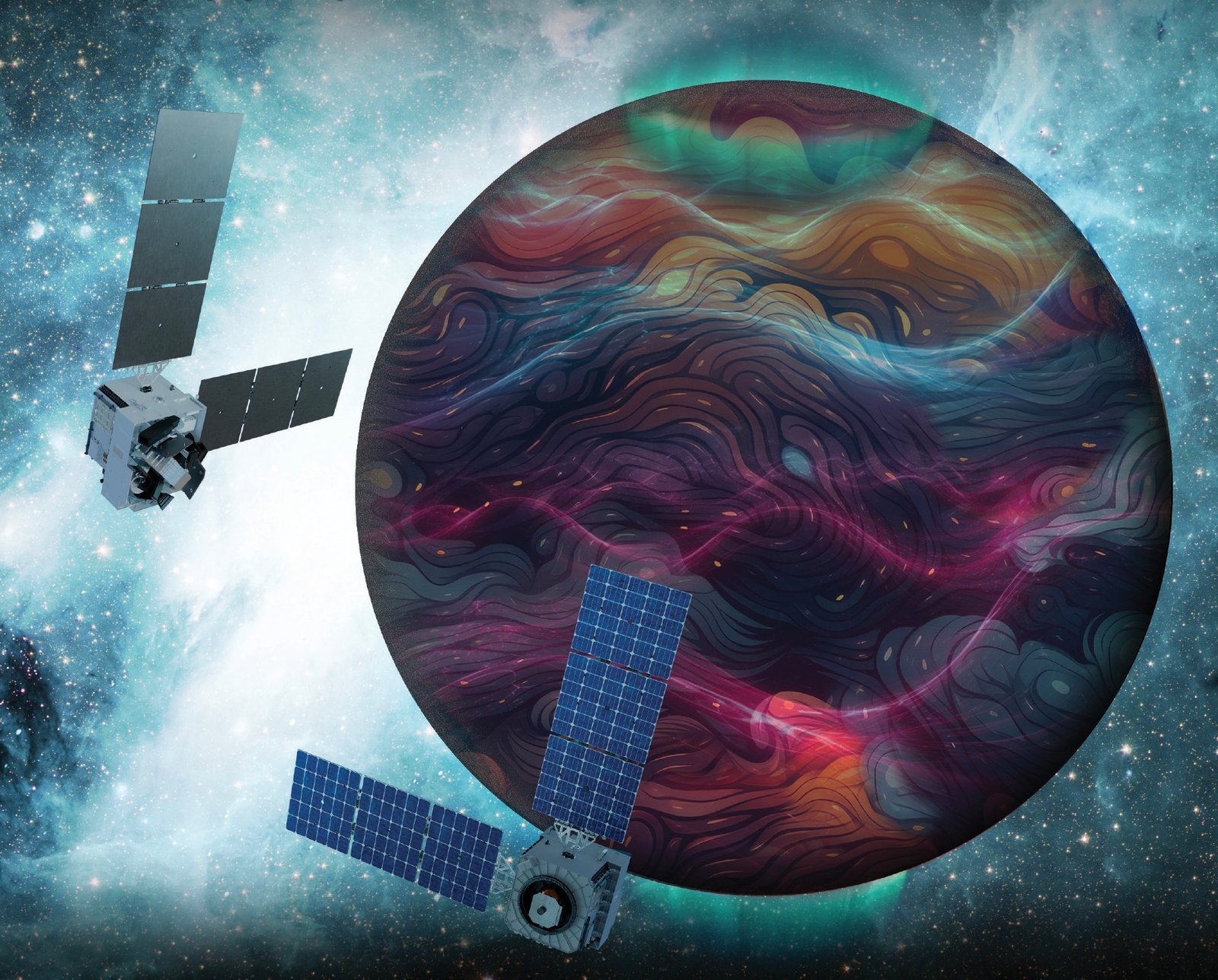
WASHINGTON — NASA has selected for development a space science mission that will study how space weather interacts with Earth’s atmosphere.
NASA announced June 18 that the Dynamic Atmosphere-Ionosphere Explorer, or DAPHNE, mission will proceed into the next phase of development, with a launch planned for no earlier than 2029.
DAPHNE was one of three concepts selected by NASA for study in 2024 for a mission concept called Dynamical Neutral Atmosphere-Ionosphere Coupling, or DYNAMIC, that was recommended by the heliophysics decadal survey in 2013 to examine the coupling between regions of the atmosphere and space weather.
DAPHNE will fly two identical satellites equipped with three instruments, dubbed MIGHTI, FUVI and PLATO. They will study conditions such as composition, temperature and winds in the thermosphere, a region of the upper atmosphere.
“Scientists have long studied how space weather affects Earth, but much less is known about how Earth’s lower atmosphere affects the upper atmosphere and space weather,” said Aimee Merkel, a researcher at the University of Colorado’s Laboratory for Atmospheric and Space Physics, or LASP, who is the principal investigator for the mission, in a statement. “DAPHNE will fill this major gap in scientific understanding and help answer long-standing questions about how Earth interacts with our sun.”
NASA did not disclose an estimated cost for DAPHNE but noted the DYNAMIC program has a cost cap of $250 million, excluding launch. A formal cost estimate will come at a confirmation review in 2027. Partnering with LASP on the mission are BAE Systems and the Naval Research Laboratory.
NASA bills the mission as part of a broader effort to understand space weather, with applications beyond Earth. “As NASA sends astronauts beyond Earth’s magnetic protection to the moon, Mars and beyond, DAPHNE will join the NASA science fleet strategically located across the solar system to provide data that will help mission planners predict and mitigate the effects of space weather for the benefit of all,” said Nicky Fox, NASA associate administrator for science, in a statement.
The selection of DAPHNE comes a month after NASA announced a revised strategy for its heliophysics division, one that puts a greater emphasis on the applications of research to society.
“We really want you to focus not only on the foundational science and the transformational science, on that critical innovation that only NASA can provide, but also connecting it to the applications, connecting it to the end users,” Joe Westlake, director of NASA’s heliophysics division, said at an online town hall meeting May 20.
“Can we clearly articulate how this discovery will eventually protect our power grid or our GPS or astronauts? Is the research applicable, or is it some niche science that only serves as sort of a single subdiscipline?” he said.
That shift, he said, involves going from research siloed in specific missions and disciplines to “strategic purpose themes” that he said will create “bigger, broader capabilities and science findings.” The division will also go from “curiosity-driven investigations” to “outcome-driven research.”
“We’re trying to push our researchers, push our science, into meaningful outcomes,” he said. “Instead of having randomly spread research across our activities, trying to drive it into a more strategic framework so that we can achieve the scientific outcomes that were asked for in the decadal survey.”
He and other division officials said that may affect how it solicits proposals for future missions, but they did not go into details during the town hall.
“Whether you’re somebody who embraces change or somebody who thrives in the routine, there is a shift that is coming,” Westlake said. “We have, as heliophysics, defined our community, but now we get to define what it means to everyone, what it means to society.”
