


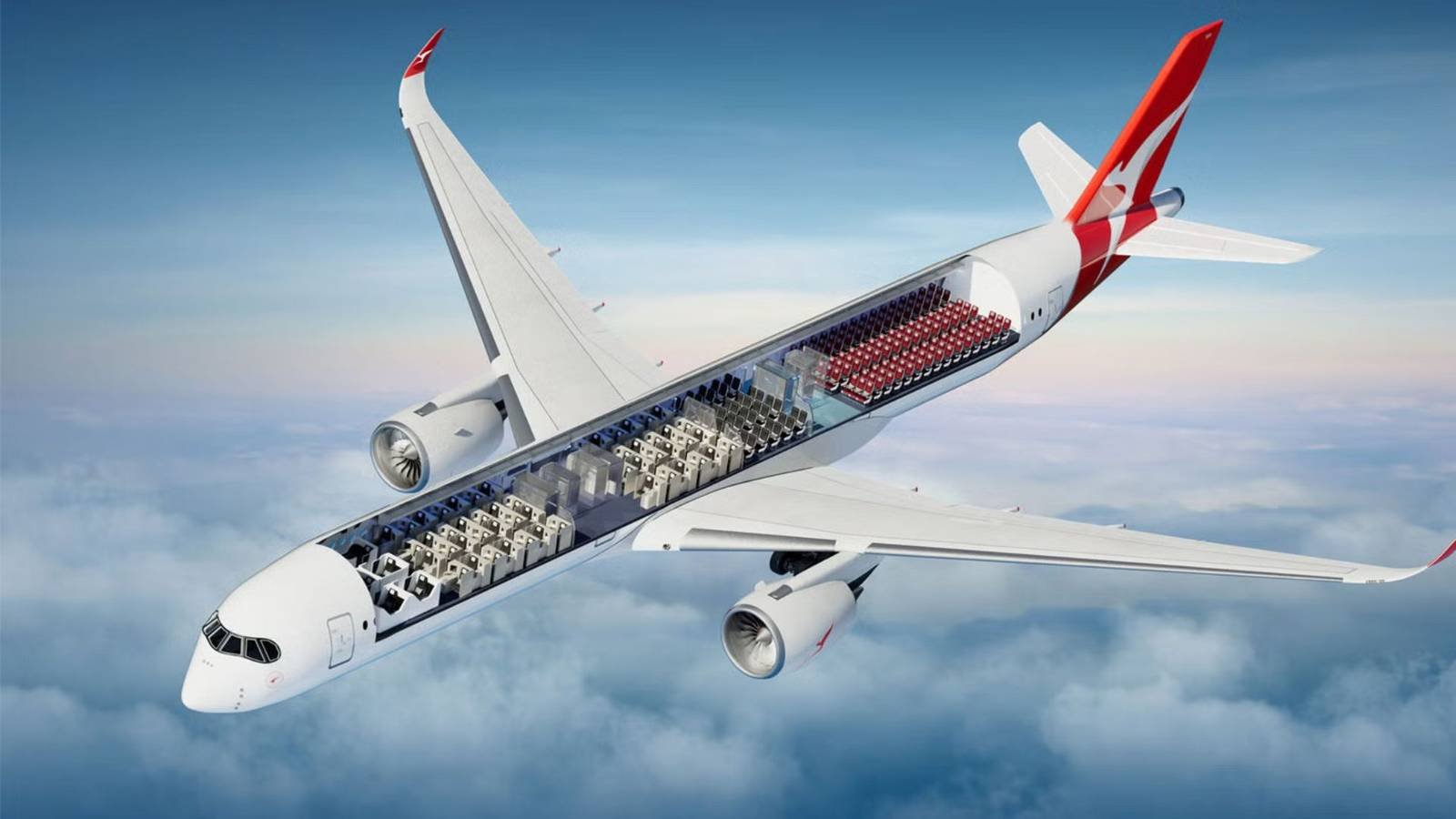
Project Sunrise has long been presented as one of the aviation industry’s most ambitious projects. Qantas intends to operate nonstop flights from Australia to destinations including London and New York, with journeys expected to last between 19 and 22 hours depending on winds and routing. The airline has now confirmed October 2027 as the target launch for the first Sydney Kingsford Smith Airport (SYD)–London Heathrow Airport (LHR) service, with tickets expected to go on sale earlier that year. The flights will be operated by one of 12 ordered Airbus A350-1000ULRs capable of flying up to 10,000 nautical miles (18,520 km), around 1,000 nautical miles (1,852 km) farther.
But as the launch date finally comes into view after years of delays, attention has shifted from route maps to seat maps. Project Sunrise was initially marketed around the idea that economy passengers would receive a generous 33-inch seat pitch throughout the cabin, significantly above the 31-inch pitch common on many long-haul aircraft. New cabin details reported by Executive Traveller suggest a more layered approach, with multiple economy seating categories and some passengers receiving less space than originally expected. The change has reopened discussion around whether Qantas has altered one of the project’s most talked-about selling points.
Project Sunrise: A Tiered Cabin Strategy
When Qantas first introduced Project Sunrise concepts, passenger comfort was repeatedly positioned as central to the program. The airline argued that traditional aircraft interiors needed to evolve if passengers were expected to spend nearly an entire day in the air. Research into sleep patterns, nutrition, movement, and fatigue became a key part of the aircraft design process.
The final A350-1000ULR layout remains unusual by industry standards. The aircraft will carry only 238 passengers, making it the lowest-density A350-1000 configuration currently planned anywhere in the world. By comparison, many airlines operate the same aircraft with more than 300 passengers, while high-capacity layouts can exceed 350 seats. Qantas’ aircraft will instead feature six first-class suites, 52 business suites, 40 premium economy seats, and 140 economy seats.
The economy cabin itself is now expected to include multiple seating categories. Economy plus seats will provide around 34 inches of pitch, standard rows will remain 33 inches, while some seats toward the rear of the aircraft will be reduced to 32 inches. Although a one-inch difference sounds modest, that represents 1 inch of personal space. Across a flight lasting almost 20 hours, small changes can become much more noticeable than on conventional long-haul journeys. Qantas CEO Cam Wallace discussed the change with Executive Traveller:
“So we’ve been able to manage the (layout) where they’ve got 34s, some 33s, and a small number of 32s,”
Why Qantas May Have Decided To Rework The Formula

The economics behind Project Sunrise are very different from a typical international route. Ultra long haul flights require additional fuel, modified aircraft systems, and operational flexibility that conventional long-haul routes do not face. Because fuel itself adds weight, aircraft on very long journeys effectively burn fuel simply to carry the remaining fuel needed later in the flight.
The aircraft also carries a large commercial trade-off. Limiting the cabin to only 238 seats means Qantas sacrifices significant capacity compared with conventional A350 operators. The airline will need to extract higher yields from each passenger to justify the investment. Qantas has previously pointed to its Perth Airport (PER)–London nonstop route, where it says passengers have accepted fares approximately 20% higher than one-stop alternatives in exchange for avoiding connections.
Catch what other flight trackers miss
Emergency squawks, holds, NOTAMs — live signals, no signup.
Open tracker
Catch what other flight trackers miss
Emergency squawks, holds, NOTAMs — live signals, no signup.
Open tracker
Creating economy plus seating may therefore represent an attempt to balance comfort and profitability simultaneously. Extra-legroom products have become an important source of ancillary revenue across the industry, and introducing a paid premium tier allows Qantas to monetize additional space without reducing seat numbers further.
Qantas Confirms Launch Month For 22-Hour Nonstop Sydney-London ‘Project Sunrise’ Flights
After a decade of planning, Qantas is finally set to begin its groundbreaking nonstop service between Sydney and London next year.
Project Sunrise Is Also A Scientific Experiment

Qantas has spent almost a decade working with researchers and sleep scientists in preparation for Project Sunrise. The airline partnered with specialists from the University of Sydney’s Charles Perkins Centre to study factors including lighting, meal timing, hydration, movement, and circadian rhythms.
The aircraft itself incorporates several features intended to reduce fatigue on flights that could remain airborne for almost an entire day. Passengers will have access to a dedicated Wellbeing Zone where they can stretch and move around during the journey. The cabin will also feature 14 different lighting scenarios designed to simulate natural light conditions and help align passengers’ body clocks with their destination time zone. Researchers involved in test flights reported improvements in alertness using modified meal and lighting schedules compared with conventional service patterns.
Ultimately, the challenge for Qantas extends beyond simply flying farther than any commercial airline has done before. The airline is attempting to convince passengers that eliminating stopovers is worth paying extra for, while simultaneously proving that spending nearly an entire day onboard can feel less exhausting than traditional travel. Project Sunrise may create the world’s longest flights, but its biggest test could be whether travelers believe the comfort promises still match the reality.
