


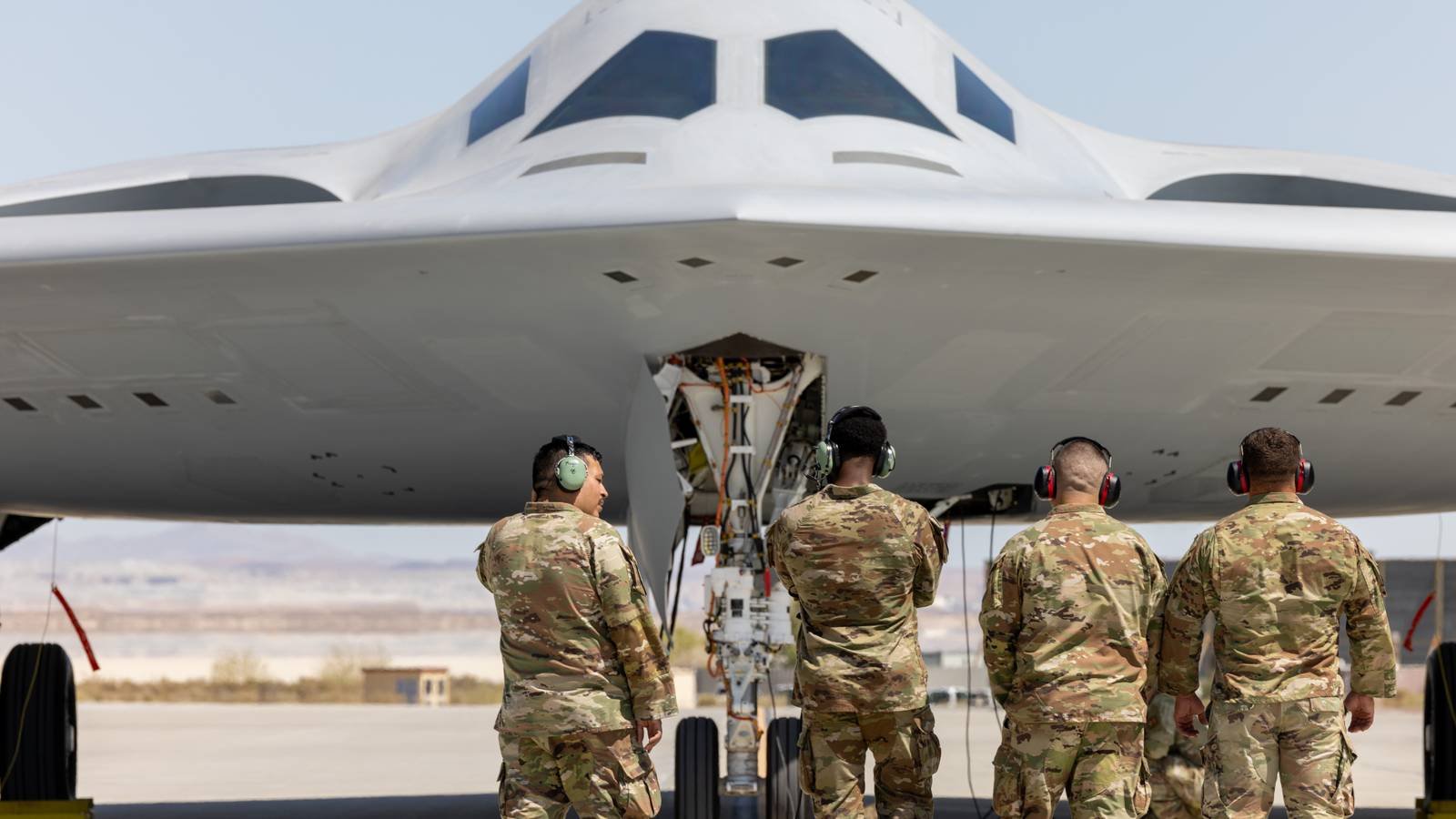
The Northrop Grumman B-21 Raider is currently in low-rate initial production (LRIP), and Washington is investing billions to boost production by 25%. Doubling production in the medium or long term is almost certainly possible with sufficient sustained investment, but it is not likely to be possible in the short term. For now, the United States Air Force appears to be planning for Northrop to deliver them at a rate of ten per year after the aircraft moves from low-rate production into full serial-rate production.
Currently, the B-21 is likely to be produced at a rate of around 1–2 aircraft a year as a pre-serial production test aircraft. While countless other ambitious aerospace programs are years behind schedule and considerably over budget, the B-21 appears to be an example of one largely on time and on budget. Here is what to know about why the Air Force can’t just double the B-21 Raider production in the short term, while also noting that the program’s actual bottlenecks and issues remain classified.
The Air Force Has Perhaps Three Test B-21s
The first Raider flew in 2023, and the type is expected to enter service in 2027. The first B-21 was delivered to the Air Force in early 2024 for flight testing at Edwards Air Force Base in California. The Air Force announced it had received the second aircraft in September 2025. Both of these aircraft are prototypes and are used for testing. In 2026, the US Air Force released images of the B-21 conducting in-air refueling for the first time.
During a 2026 earnings call, Northrop Grumman announced it had sold one of its prototype test B-21s to the USAF. Northrop’s Chief Financial Officer, John Green, said, “To support the acceleration of aircraft deliveries, we agreed to sell an aircraft to the Air Force that was previously planned to be utilized as a company-owned test asset.” It is unclear when the aircraft will be/was transferred to the Air Force, but it could mean it now has three B-21s in operation.
These B-21s are prototypes for testing. The Air Force is expecting to receive its first combat B-21 in 2027. Considering the type first flew in 2023, that is an incredibly short turnaround. The B-21 Raider now accounts for around 10% of Northrop’s revenue, with the LGM-35 Sentinel intercontinental ballistic missile accounting for another 6–7%. Other programs like the E-2D, Integrated Battle Command System (IBCS), and F-35 are also significant.

How Northrop Grumman Helps JetZero’s Blended Wing Aircraft Take Off
Northrop Grumman is leveraging decades of expertise in developing advanced military aircraft to make JetZero’s BWB a reality.
Expanding B-21 Raider Production

Prior to 2025, the US Air Force had operated under the baseline assumption that Northrop Grumman would be able to deliver around seven to eight B-21s annually (estimated, as the number is classified) once the program gears up and enters full serial production. However, developments in China and the return of Great Power Competition make the B-21 more urgent. This has likely been aided by the seemingly remarkable success in the aircraft’s development and capabilities, and by the program’s tracking, which has remained mostly on time and on budget.
FY2025 reconciliation funding (One Big Beautiful Bill) provided another $4.5 billion in funding to boost annual production capacity by 25%. Adding in other funding, this means the US allocated around $10.3 billion for the Raider program that year. The Air Force stated in February 2026, “This agreement accelerates the approved acquisition profile by increasing annual production capacity by 25%, compressing delivery timelines while preserving cost and performance discipline.”
Northrop Grumman B-21 Raider (per Northrop) | |
|---|---|
First flight | 2023 |
Number in service | Up to 3 (prototype, testing) |
Entry into service | 2027 (planned) |
Number planned | At least 100 (perhaps 145) |
Notable subcontractors | BAE Systems, Spirit Aerospace, Pratt & Whitney, GKN, Collins |
Assuming baseline deliveries of seven to eight per year, Northrop should be able to deliver nine to ten aircraft annually. It should be noted that these numbers are estimates, and the exact post-boost figures are classified. For now, the Air Force’s target remains at least 100 Raiders, although there is discussion of increasing it to 145 and perhaps eventually even 200.
Northrop Grumman, The Prime Contractor

All the Northrop B-21s are built at Air Force Plant 42 in Palmdale, California (including adjacent facilities), which is the same place where the Northrop B-2 Spirit was built in the 1990s. There doesn’t appear to be any effort to build new production sites. Rather, the funding boost focuses on expanding capacity at Palmdale and the supplier base.
Northrop Grumman has been able to develop the B-21 comparatively rapidly for various reasons. One is that, after it built the B-2 and the secretive RQ-180, the flying-wing stealth aircraft is now a somewhat mature design. Another important aspect is that Northrop has developed advanced manufacturing processes, including digital and augmented reality tools. This allows technicians to visualize tasks and solve problems before touching the airplane. This digital environment has allowed for effective flight test planning and real-time data analysis that has increased test cadence and efficiency.
Northrop Grumman is responsible for the overall design, stealth integration, and final assembly of the aircraft, although it only makes a minority of the software and physical components overall. It should be noted that Northrop is also one of the two (along with BAE Systems) contractors for the F-35 program under Lockheed Martin.
The Raider’s Subcontractors

When discussing production capacity, it is often more a matter of supply chains and subcontractor constraints than of Northrop’s ability to bolt them together. Many of the subcontractors are classified. However, in 2016, the Air Force announced major Tier 1 suppliers were BAE Systems in Nashua, New Hampshire; Collins Aerospace in Cedar Rapids, Iowa; GKN Aerospace in St. Louis, Missouri; Janicki Industries in Sedro-Woolley, Washington, and Spirit AeroSystems (Boeing) in Wichita, Kansas.
Additionally, RTX’s Pratt & Whitney division makes the B-21’s engines, which are non-afterburning derivatives of the PW1500 / F135 engine. Those engines are built at Pratt & Whitney’s facility in East Hartford, Connecticut. Collins is known to supply core avionics, flight controls, and mission software. BAE Systems is responsible for defense electronics, electronic warfare suites, and various mission systems components.
Spirit AeroSystems (re-absorbed by Boeing) manufactures major structural elements and composite airframe assemblies. GKN Aerospace produces structures and complex composite assemblies. Janicki Industries makes large-scale composite tooling and more. These companies are typically coy about the details of their B-21 participation. For example, Spirit says, “Spirit AeroSystems is proud to be a member of the B-21 Raider industry team—a program vital to national security.”
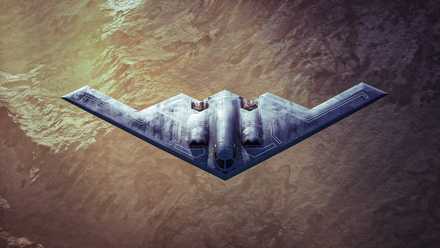
From 19 B-2 Spirits To 145 B-21 Raiders: How Much Bigger America’s Stealth Bomber Fleet Is About To Get
A $4.5 billion production deal signal the Air Force’s commitment to building its next-generation bomber
The Supply Chain Bottleneck

Doubling B-21 production to 15–20 aircraft a year would likely be difficult and may be a problem that throwing more money at the problem may struggle to solve. The issue will be felt most in the supply chain and a limited skilled workforce. Training an increased, specialized workforce with clearance takes time. One potential bottleneck would be the production of sufficient specialized materials, coatings, and edge treatments required for its low-observable design. It could also reduce bottlenecks in the supply chain (e.g., at Tier 2 and Tier 3 suppliers).
Tier 1 suppliers need to provide avionics, power systems, engines, sensors, and specialized electronics, etc. Historically, complex defense programs frequently encountered lower-level supply bottlenecks, which were tiny subcontractors that made seemingly minor components, limiting whole production lines. In the commercial sector, this is being seen where Airbus and Boeing can build new commercial airframes (e.g., 737s, 787s, A320s, A350s) faster than engine manufacturers (Rolls-Royce, GE Aerospace, CFM) can deliver the engines. Those companies, in turn, complain about bottlenecks in specific components holding up the entire engine.
Significantly increasing production is almost always possible. The issue is not whether it can be done; it’s a matter of how much time it takes to get there. Long-lead items cannot be acquired overnight, no matter how much more funding becomes available. This takes time; increased funding may reduce the time, but it still takes time. This has been famously true of warships for hundreds of years.
The Production Shortcut

The B-21 Raider is heavily classified, so identifying the likely bottlenecks is the domain of speculation or at least educated guesses. Industry strains are often broadly known (e.g., an engine manufacturer’s ability to produce specific engines), but not the specifics in relation to the B-21. One way to somewhat work around production bottlenecks is to deliver aircraft lacking full capabilities and systems. This has plenty of precedent, although it comes with caveats.
For example, if Pratt & Whitney can’t deliver the engine, then it’s not much of an airplane. In 2026, there is a report that the US Air Force is taking delivery of F-35s lacking AESA AN/APG-85 radars, as Northrop Grumman is having issues with supply chains with its subcontractors. According to the reports, these will be retrofitted as the radars become available, and the military can fly them, but not use them in the interim.
Other examples include long-running efforts to resolve F-35A gun accuracy and targeting issues, as well as delays associated with TR-3 software and hardware integration. Examples can be found across most advanced fighter jets (e.g., Su-57s, Rafales, Eurofighters). But there are tradeoffs to delivering aircraft without full capabilities. Famously, early F-35s experienced concurrency, which resulted in expensive retrofits later on.
