


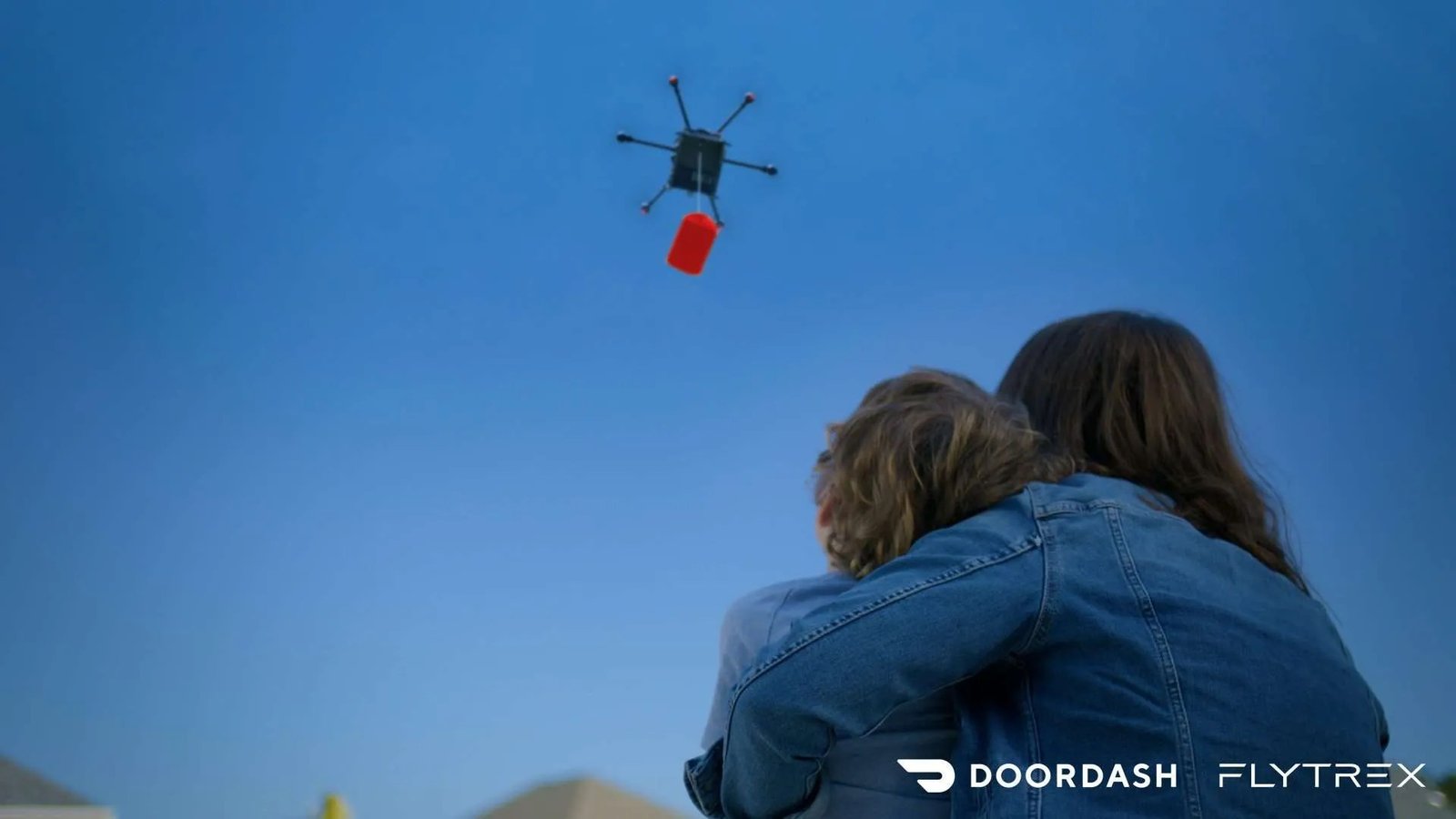
As the drone delivery industry eagerly awaits the FAA’s finalized Part 108 rules for Beyond Visual Line of Sight (BVLOS) flights, a massive proof-of-concept is scaling in the skies over North Texas.
Flytrex and Wing (the drone delivery arm of Alphabet, the company formerly known as Google) recently crossed a major Unmanned Traffic Management (UTM) milestone. Together, they’ve executed approximately 8,000 overlapping delivery flights across Little Elm and Wylie, Texas, and they say there have been zero airspace conflicts. Their projects operate just 1.36 miles apart with over 10 hours of daily flight overlap, proving an example of two rival operators sharing the skies.
To dig into the mechanics of how this automated air traffic control actually functions—and what it means for the future of drone regulation—I spoke with Shai Karassikov, Product Manager at Flytrex and Co-Chair of the U.S. UTM Tech Committee.
Here’s how it works.
Inside the tech: How automation stops conflicts before takeoff
The Dallas framework relies on the ASTM F3548-21 standard for USS (UAS Service Supplier) interoperability. Instead of a centralized government controller, the drones’ cloud systems talk to each other to map out paths.
According to Karassikov, conflict resolution is a proactive process where the goal is to stop collisions before a drone even spins its props.
“When the system identifies that a planned flight route and time would conflict with another operator’s approved flight, it prevents the conflicting operation from being approved,” Karassikov said.
Once a conflict is flagged, the automation handles the recalculation behind the scenes.
“The system then determines how to resolve the conflict, typically by adjusting the flight route or timing and resubmitting the plan for reapproval,” Karassikov said. “The updated operational intent is shared through the network and checked again.”
What about in-flight emergencies
While the software is highly sophisticated at mapping out paths before takeoff, it is not yet a real-time, mid-air emergency broadcaster. If a drone experiences a critical battery drop or a lost link, it still relies on internal safety protocols rather than telling its neighbors.
“An active operational intent can be updated, including its geographic area or timing, and accepted updates are shared through the network,” Karassikov said, meaning that planned path shifts are broadcasted. “With that said, the current shared UTM service is focused on strategic coordination and does not yet broadcast a dedicated in-flight emergency or contingency state between operators. Each operator currently manages immediate contingency and emergency landing procedures under its own FAA approvals and safety procedures.”
What about other drone delivery players like Zipline and Amazon?
While Flytrex and Wing are dominating the headlines for this specific Dallas milestone, the system certainly wasn’t built as a closed sandbox for two companies. In fact, the FAA’s UTM Operational Evaluation program has expanded to 17 providers and operators, and the architecture is intentionally built to scale. That includes big names like Zipline and Amazon Prime Air.
“The framework was designed from the start to support additional operators as shared-airspace needs grow, using the same standards-based approach for exchanging flight intent and identifying potential conflicts,” Karassikov said.
The tech to inform the regulation
Perhaps the most critical outcome of the Dallas framework isn’t the technology itself, but the political argument it proves to regulators. Historically, some models suggested that the FAA might need to segment low-altitude airspace, giving exclusive geographic “blocks” or corridors to specific commercial drone companies.
The 8,000 successful, conflict-free flights from this evaluation offer a loud counterargument that a ‘shared sky’ is entirely possible.
“It does not by itself determine what the final regulatory model should be, but it provides strong operational evidence that low-altitude airspace does not need to be permanently divided by operator,” Karassikov said. “The results show that multiple operators using their own systems can share overlapping airspace through a common, standards-based framework.”
“The evidence from this effort reaches the FAA through ongoing participation, reporting, and review rather than through a single dataset handoff,” Karassikov said. “FAA representatives attend recurring Operations Committee and Technical Committee meetings as observers, review technical documents and test results, and provide feedback on the work.”
Ultimately, Karassikov believes the data compiled over the last few months gives regulators the exact real-world proof they need to build a flexible framework for Part 108.
“We believe that this gives the FAA practical evidence that shared and coordinated access can work as an alternative to assigning exclusive geographic areas to individual companies. The final policy decision rests with the FAA, but we do believe that the operational record strongly supports the shared-airspace approach.”
Related
Discover more from The Drone Girl
Subscribe to get the latest posts sent to your email.
