


Haarlem’s 3D Print Gallery is preparing to open its fourth exhibition this July, titled “An Ocean of Possibilities for Sustainability.” The show, running from 1 July for three months at De Koepel brings together four designers whose practice sits at the intersection of digital fabrication, natural systems and circular thinking.
The exhibition is an initiative by MTL | More Than Layers, and frames digital fabrication as a path toward more responsible making. The materials on show range from recycled PETG and reclaimed ocean waste such as discarded fishing nets to natural ceramics and biomaterials capable of returning to the earth at the end of their use. The gallery describes the shared thread between the designers as follows: “What connects them is a shared approach: digital fabrication not only as a means of production, but as a design language in itself, and as a path towards a more circular way of making.”
Four Designers, One Shared Direction
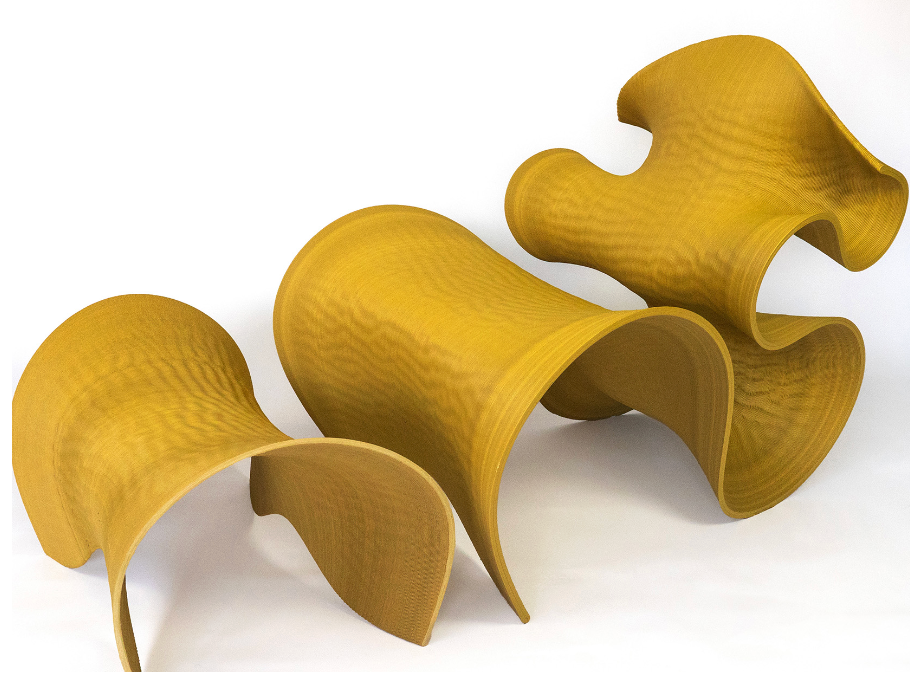
Danish designer Mikkel Huse contributes the Nori Chair, a large-format 3D printed piece modelled in virtual reality and shaped by the movement of seaweed in shifting tides. The chair is produced using Large Format Additive Manufacturing and, despite being made from a rigid material, carries a quality of fluidity in its form.
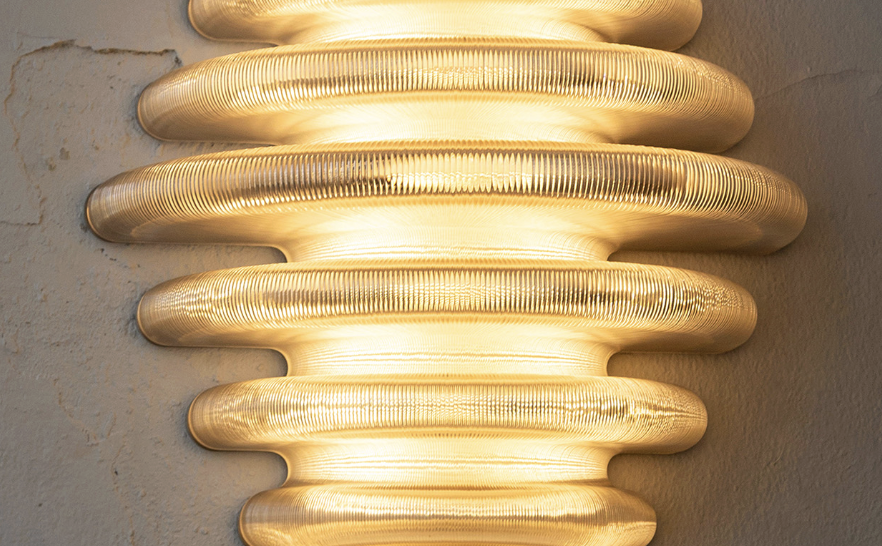
Dutch product designer Lilian van Daal presents Heliodiscus, a modular light sculpture drawn from the geometry of radiolaria, microscopic marine organisms with intricate mineral skeletons. Printed in transparent resin, the modules diffuse light in soft, scattered patterns. The piece functions both as a lighting object and as an exercise in translating natural complexity into reproducible, 3D printed form.
Also featured is the Hive Wall Lamp by Rotterdam-based designer Stijn van Aardenne, developed through an investigation into layer orientation in additive manufacturing. Rather than building horizontally layer by layer, van Aardenne developed a rotating printing system that allows layers to follow the geometry of the object itself. The resulting surface makes the production process visible, treating fabrication as part of the design rather than something to be concealed.
The fourth contribution comes from IOUS Studio, an architecture and design practice, working in collaboration with Barcelona-based LAMÁQUINA. Their series of 3D printed ceramic tiles translates computational design into a scalable cladding system, operable at scales from interior surfaces to full building façades.
3D Printing as a Tool for Sustainable Expression
The 3D Print Gallery’s exhibition joins a growing body of work where artists and designers are using additive manufacturing not just to make objects, but to make arguments about materials, cycles and the relationship between production and the natural world.
Italian 3D printing company WASP partnered with Milan’s Rossana Orlandi gallery to showcase Gaia, a 3D printed eco-house constructed from raw soil and sustainable natural materials, as part of the “We Are Nature” exhibition at the Leonardo da Vinci National Museum of Science and Technology. The gallery requested WASP’s research specifically to advocate for new forms of sustainable living and raise awareness of alternatives to plastic-heavy, carbon-intensive construction.
Similarly, Dassault Systèmes and architect Arthur Mamou-Mani showcased their AURORA installation, made from recycled 3D printed PLA panels that underwent full life cycle assessments, fused art, science and industry to demonstrate the possibilities of sustainable design.
Where WASP and Mamou-Mani used the gallery to argue for sustainable materials in construction and manufacturing, the 3D Print Gallery turns to the ocean as its framework, a system the four designers draw on not just for formal inspiration but for how materials might move through cycles.
3D Printing Industry is inviting speakers for its 2026 Additive Manufacturing Applications (AMA) series, covering Energy, Healthcare, Automotive and Mobility, Aerospace, Space and Defense, and Software. Each online event focuses on real production deployments, qualification, and supply chain integration. Practitioners interested in contributing can complete the call for speakers form here.
To stay up to date with the latest 3D printing news, don’t forget to subscribe to the 3D Printing Industry newsletter or follow us on LinkedIn.
Explore the full Future of 3D Printing and Executive Survey series from 3D Printing Industry, featuring perspectives from CEOs, engineers, and industry leaders on the industrialization of additive manufacturing, 3D printing industry trends 2026, qualification, supply chains, and additive manufacturing industry analysis.
Featured image shows Nori Chair. Photo via Haarlem’s 3D Print Gallery.
