


Performance gains
So what does this all deliver in practice? We’ve already discussed the improvements to be found in life extension and inspection reductions compared with the original equipment.
The service life of the Van Horn rotor is 4,800 hours. This compares with 4,000 hours for the OEM version.
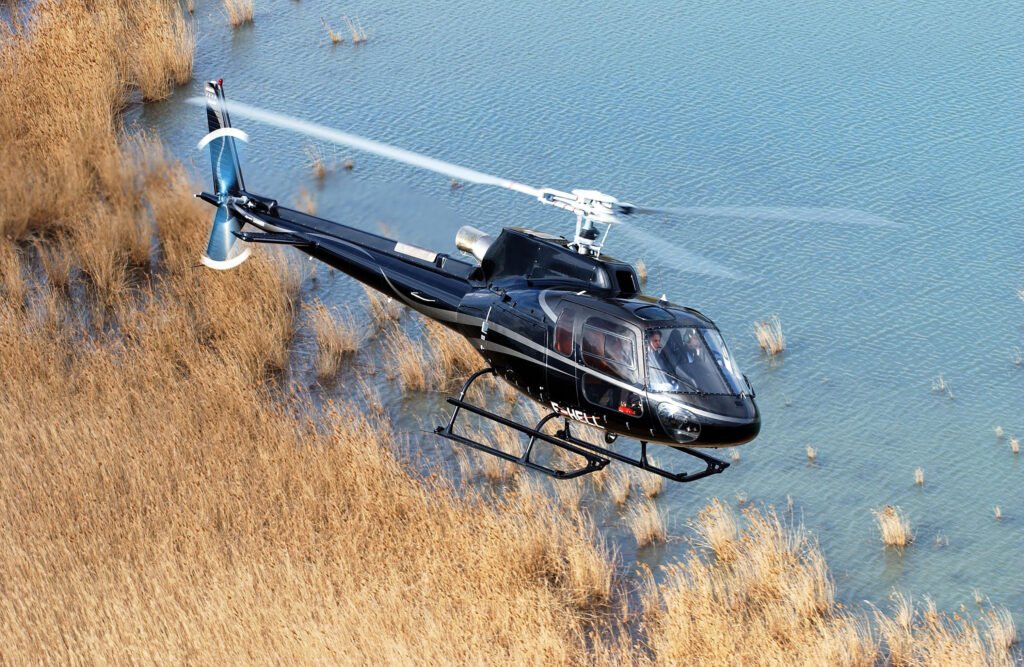
Moving on to performance, the proof is as always in the pudding, and I was able to have a sortie in the Van Horn test aircraft in the company of Chief Test Pilot, Terry Tyner.
It’s important to keep in mind that I don’t have enough time in AS350s to make a value judgement of the tail rotor authority improvements of the Van Horn tail rotor versus the original, but the response was certainly crisp even in the higher density altitudes found in the Arizona summer.
I was assured by Tyner that to the experienced AS350 pilot the difference is immediately noticeable and invariably remarked on early in a demonstration flight.
Reviewing the data from the flight test programme leading to the STCs, which encompassed 150 test points – including aggressive pedal turns, sideways flight, speed sweeps in turns, pedal pulses and autorotations at a number of altitudes – it was clear that critical factors like tail rotor shaft torques were lower than the original equipment. Likewise, boom bending loads were also clearly and consistently lower.
Another performance gain was hover performance with an aircraft ballasted to maximum gross weight (MGW), where gains were made especially at higher density altitude (9,400 feet).
A key data point that underscores Van Horn’s claims for wear reduction is to be found in the pitch link loads, which show significant reductions in both hover and forward flight manoeuvring.
An unexpected although always welcome improvement was in noise reduction.
The obvious conclusion is that, thanks to the rake of the swept tips, the energy of the tip vortices is reduced, thereby delivering the improvement in emissions.
Setting aside my amateur aerodynamics, the net result is that with the aircraft ballasted to its test weight of 5,140 pounds, the noise produced by the Van Horn tail rotor was 0.9 dB(A) lower than that of the original equipment – boosting the margin versus the Stage 2 limit of 86.5 dB(A).
