


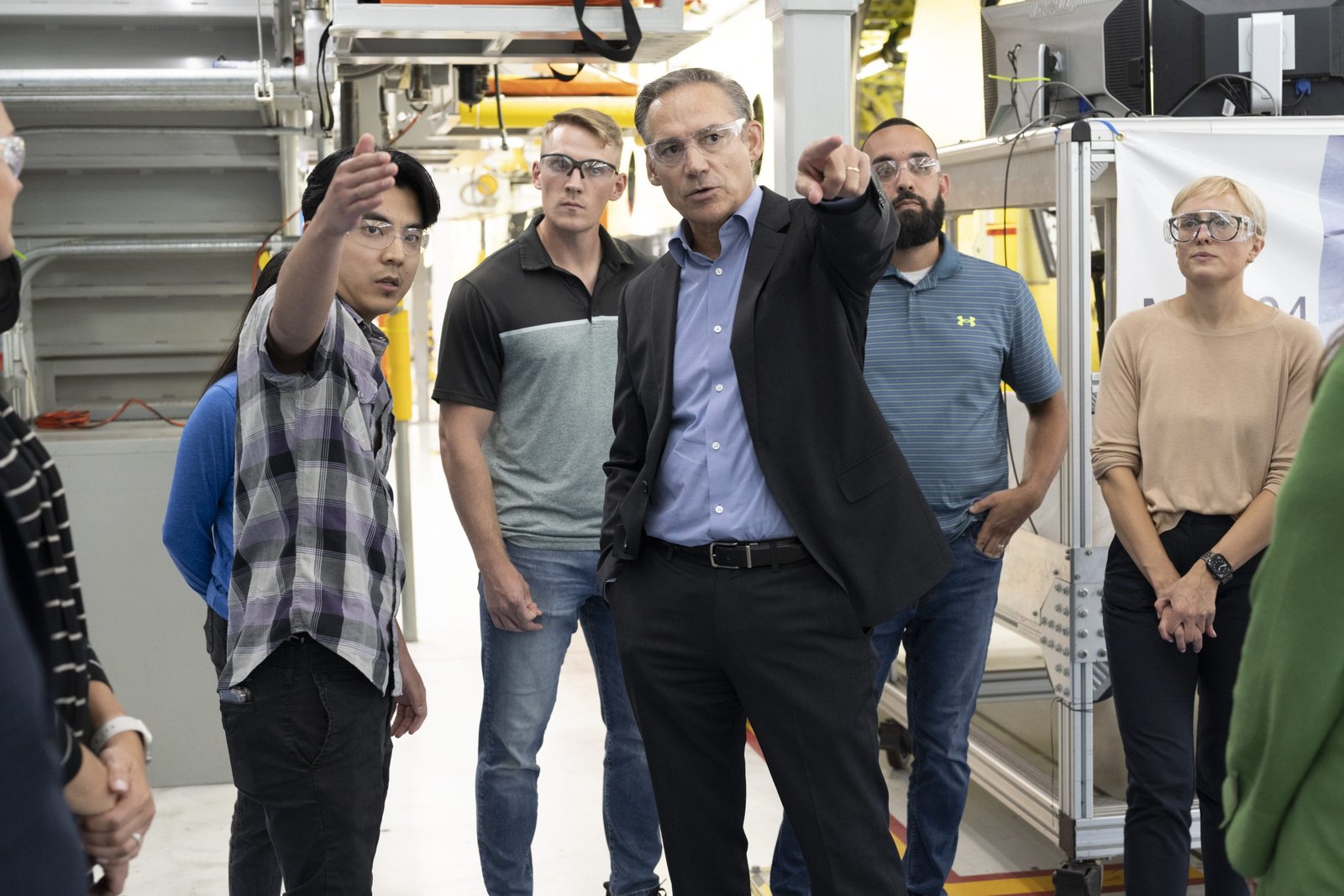
The project involves studying perceptions of the brand and whether it reflects Boeing’s post-crisis turnaround.
Boeing has launched an internal and external review of its corporate brand, seeking to understand how people perceive it and evaluate how well the brand represents Boeing’s recent recovery following several years of upheaval.
The company is launching the project now in light of its ongoing turnaround, and also because much time has passed since the last such review, a source familiar with the matter says.
Through the project, Boeing aims to better understand what its existing brand, which took a hit in recent years, represents, and to determine if and how the brand could be improved to better reflect the company’s recent successes.
The review involves work with an external provider and evaluation of all aspects of Boeing’s brand, the source says. Boeing chief executive Kelly Ortberg on 26 June sent some employees a message asking them to participate.
“Over the next few weeks, we’re holding a series of online panels and listening sessions across the company to hear your perspective on the Boeing brand,” Ortberg writes. “Boeing is conducting this assessment to evaluate how our company’s messaging and visual elements resonate with employees and other key stakeholders.”
“It is also important to assess whether our current company identity needs to evolve [to] reflect Boeing’s ongoing transformation, innovation and global growth,” it says.
At this stage, the review involves only research, the source says, adding that Boeing has no plans yet to modify its corporate logo or any aspects of its brand.
Boeing sent Ortberg’s message to a “diverse range” of randomly selected employees in manufacturing, engineering and corporate roles. They will be asked to complete a confidential survey, responses from which will inform “a comprehensive report that highlights key themes and recommendations”.
“It’s common for companies to periodically conduct brand research to understand what’s working and where we can improve,” his message says.
Boeing had long been a shining example of American ingenuity and engineering excellence, but that reputation took a hit after two 737 Max 8s crashed in 2018 and 2019, which investigators attributed partly to flight-control software issues.
Boeing then suffered operational struggles that included quality problems affecting many of its aircraft models. An Alaska Airlines 737 Max 9’s mid-cabin door plug blew out during a January 2024 flight. The jet landed safely. But investigators attributed the incident to Boeing workers failing to install fasteners.
Boeing is also years late in achieving certifications for its 737 Max 7, Max 10 and 777-9.
RECOVERY PROGRESSING
But things are looking up.
For starters, Boeing insists the Max 7 and 10 certifications will happen this year – goals it is widely expected to achieve and that have been confirmed by Federal Aviation Administration chief Bryan Bedford. Boeing aims to begin delivering 777-9s next year.
The company has also significantly ramped production in the last year.
In May, Ortberg said Boeing had moved 737 output from 42 to 47 jets monthly, advancing to a rate comparable to that at which Boeing produced the jets before the crashes.
Boeing also this year hiked 787 output to eight jets monthly and is working to hit rate 10.
It is close to opening a third 737 Max production line in Everett and is building a second 787 production site adjacent to its existing facility in North Charleston, South Carolina.
Additionally, the company has enjoyed wide sales success in the last year, padding its backlog with orders for 1,499 jets since January 2025.
“Whether your feedback affirms our direction, gives us new ideas or falls somewhere in between, we are listening because the Boeing brand belongs to all of us,” Ortberg’s message says.
Subscribe to gain access to all news
Already have a subscription? Log in.
Choose your subscription
Considering a corporate subscription? Contact us to find out more.
