


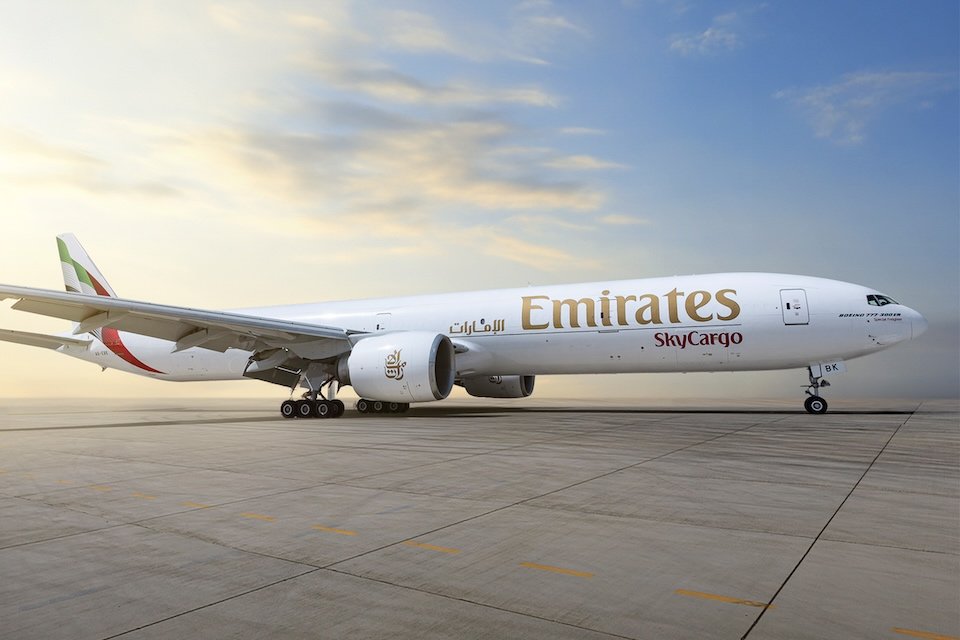
Emirates SkyCargo has continued to rapidly expand its cargo fleet with the arrival of its first converted Boeing 777 freighter.
The carrier took delivery of the first of 10 converted Boeing 777-300ERSF freighters two weeks ago and will today deploy the aircraft (A6-EBK) on its first commercial flight from Dubai to Hong Kong carrying 100 tonnes of cargo.
The aircraft are being converted by Israel Aerospace Industries (IAI) and offer 100 tonnes of payload capacity and 811 cu m of cargo volume, which is claimed to be a 25% increase over the production freighter. The model also offers 47 pallet positions, an additional 10 positions compared with the production model.
This makes it ideal for transporting volumetric cargo such as e-commerce goods, which currently constitute around 20% of global air cargo tonnage, with further growth projected in the next few years, the airline said.
With the delivery, Emirates becomes the first combination carrier to deploy a converted 777 freighter.
The airline has now added a total of six 777F freighters to its fleet since March of this year. Nadeem Sultan senior vice president, cargo planning and freighters, told Air Cargo News that another converted freighter is due to be delivered this year and the carrier will then receive three more next year.
Emirates’ all-cargo fleet currently stands at 18 777Fs and four wet-leased Boeing 747Fs. Sultan said that in total five more 777Fs are due to be delivered this year, meaning by the end of the year the carrier’s freighter fleet will reach 23 Boeing 777Fs (21 production and two converted) and the four wet-leased 747Fs.
Sultan explained that the additional capacity is needed to meet growing demand and to continue to expand the airline’s freighter network in line with the expansion of passenger operations.
Badr Abbas, Emirates SkyCargo’s divisional senior vice president, said that the airline had expanded its freighter destinations from 40 in February to 62 destinations.
It is understood there are plans to soon launch a round-the-world service, which will be the carrier’s first transpacific operation.
Sultan added that the carrier has been adding longer flights to its network, which also take up capacity due to the longer sectors.
“Even with all of this capacity going in, we are already thinking ahead to 2027 and beyond around what we need to do in terms of adding more freighter capacity,” he said.
“The demand levels are very strong from every region, and we are doing a lot of longer flying into North and South America.
“The average sector length that we used to operate is increasing quite a bit, so that is driving a lot of demand at our end. South America and North America are key in terms of growth over the coming years.”
He also pointed out that Dubai is building a new airport that will be operational around 2032, which will become the world’s largest airport.
In line with the opening of the new airport, Emirates is aiming to grow its cargo volumes from around 2.4m tonnes currently to 5m tonnes.
Emirates SkyCargo first announced plans to convert four of its 777-300ERSF passenger planes to freighters with IAI in 2021 and later extended this to 10 units.
Conversions were hampered by delays in securing the Supplemental Type Certificate (STC) for the conversion
