


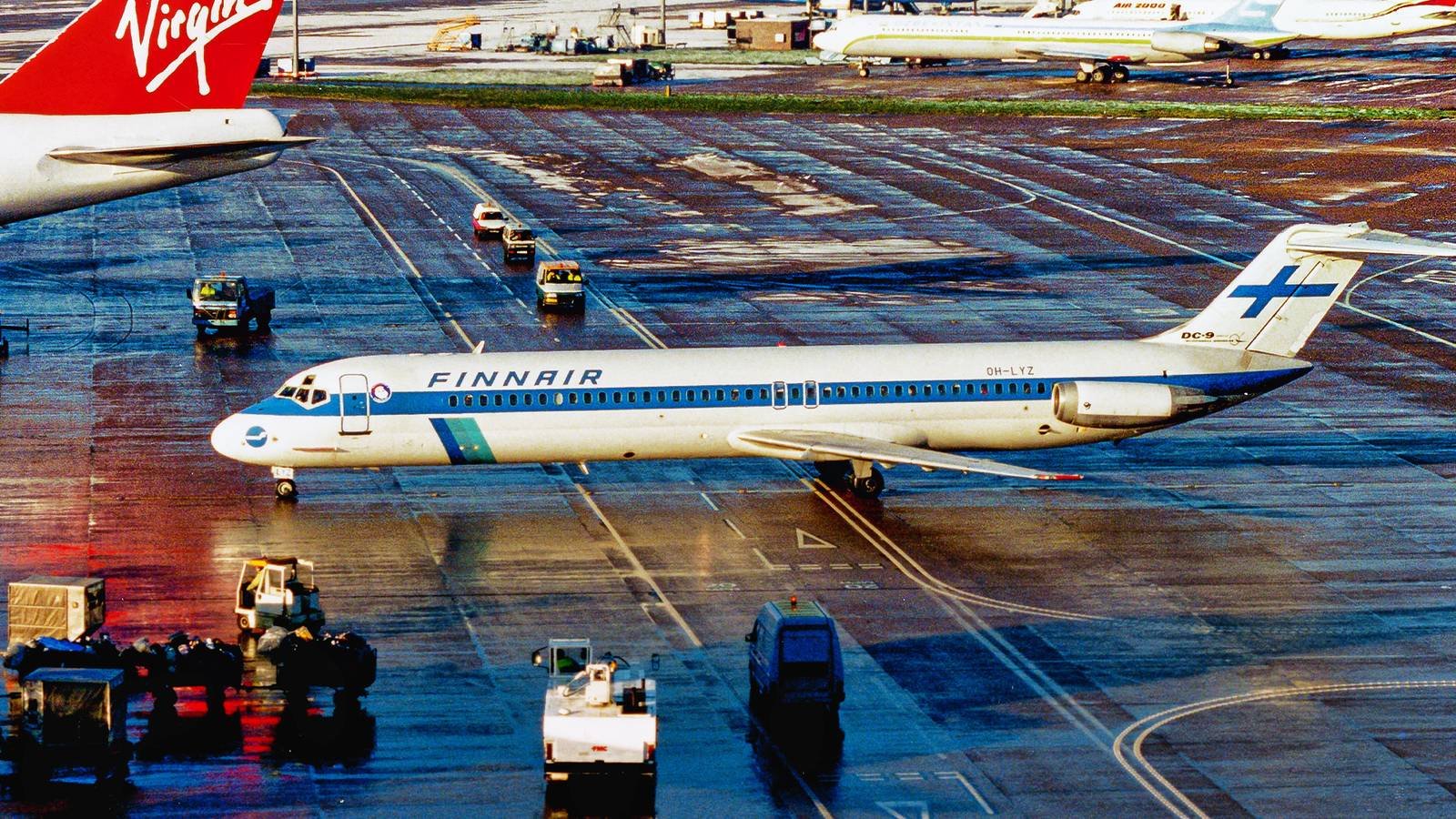
Newer aircraft types are universally expected to render their predecessors obsolete through superior fuel burn, advanced flight deck automation, and reduced maintenance profiles. Despite this, there are some notable outliers, like the McDonnell Douglas T-tail family, which delivered a striking anomaly. The original, 1960s-era DC-9structurally and economically outlasted the very aircraft built to replace it, the MD-90.
When market dynamics shifted and corporate consolidations rearranged the manufacturing landscape, airlines discovered that technological sophistication could quickly become a multi-million-dollar liability. The DC-9 epitomizes this, sticking around far longer than even its own manufacturer expected, cementing its place in aviation history as an aircraft that truly defied the odds.
Hard-Wearing And Long-Lasting
The structural durability of the original DC-9 comes directly from an era before digital stress modeling allowed manufacturers to shave excess aluminum in the name of weight optimization. In the early 1960s, engineers at Douglas Aircraft Company relied on conservative mechanical equations and thick-gauge metal to guarantee structural survival. This approach resulted in a narrowbody airframe built with a massive structural safety margin, creating a commercial jet with the structural resilience of military transport.
At the core of this rugged architecture is a heavy wing box and an exceptionally thick fuselage skin designed to endure the constant, violent pressurization cycles of short-haul regional flights. Unlike modern composite or thin-alloy structures optimized for long-distance cruising, the DC-9 pressure hull was built to absorb severe punishment from frequent takeoffs and landings on unrefined runways. Mainline operators running multi-stop daily schedules found that the metal resisted micro-cracking and structural fatigue far better than subsequent designs.
This metallurgical stubbornness allowed individual aircraft to breeze past original engineering expectations, with multiple airframes logging more than 60,000 flight cycles over four decades of continuous operation. Newer models began showing signs of economic or physical wear after 20 years, whereas the vintage twin-jet remained structurally pristine.
Its Unsuccessful Successor

Launched in 1995, the MD-90 was marketed as the modern, ultra-quiet solution that would naturally inherit the short-haul market from older T-tail models. Engineers stretched the fuselage by nearly 30 feet (9.1 m) compared to the DC-9 and added an advanced electronic flight instrument system to lower operating costs. However, this high-tech successor ran headfirst into the chaotic corporate consolidation of the McDonnell Douglas and  Boeing merger, stalling its commercial momentum before it could establish a stable market presence.
The aircraft ultimately became a logistical trap for operators due to a microscopic production run of just 116 units. Manufacturing lines were abruptly shut down following the Boeing acquisition, leaving the global fleet lacking the critical mass required to build a healthy third-party logistics market. Airlines quickly discovered that acquiring specialized components for a tiny fleet of orphaned airframes wiped out any marginal fuel savings achieved by the newer design, putting many carriers off the idea of operating the type.
Program Metric | McDonnell Douglas DC-9 | McDonnell Douglas MD-80 | McDonnell Douglas MD-90 |
Total Production Run | 976 airframes | 1,191 airframes | 116 airframes |
Entry Into Service | 1965 | 1980 | 1995 |
Primary Fuselage Engineering | Heavy-gauge aluminum alloy | Extended light-alloy build | Stretched frame, composite accents |
The severe lack of parts liquidity turned the MD-90 into an expensive financial liability long before its structural lifespan was exhausted. When major operators encountered unique component failures, the absence of widespread donor airframes led them to purchase expensive, custom-manufactured parts directly from the primary supplier. Faced with these lopsided maintenance economics, carriers began sending 15-year-old MD-90s to the desert scrap heaps while continuing to fly their reliable, deeply amortized DC-9 fleets.
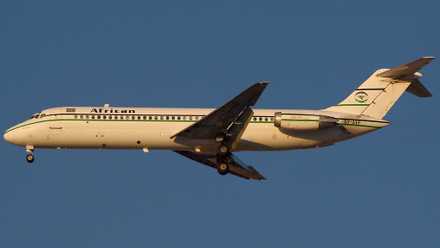
59 Years Since Its First Flight: Who Still Operates The DC-9?
16 original DC-9 aircraft remain in service, mostly in cargo and military use.
A Brilliant Engine Partner

The economic survival of any commercial airliner depends entirely on the long-term cost of keeping its engines spinning. For the original DC-9, that survival was sustained by the primitive but ubiquitous Pratt & Whitney JT8D low-bypass turbofan. The engine itself was undeniably noisy and thirsty compared to modern powerplants, though its massive global footprint created a highly liquid market for maintenance, field service, and second-hand spares.
In contrast, the MD-90 relied on a highly specific, low-volume variant of the International Aero Engines turbofan, designated as the V2500-D5. This specific configuration was never widely adopted across other high-volume narrowbody aircraft programs, mainly because spare parts were notoriously rare and expensive. A single engine overhaul for an MD-90 could easily eclipse the total asset value of the entire airplane, completely destroying its operational utility for mid-tier carriers.
Engine Characteristic | Pratt & Whitney JT8D (DC-9) | Pratt & Whitney JT8D-200 (MD-80) | IAE V2500-D5 (MD-90) |
Bypass Ratio | 1.7 to 1 (Low-bypass) | 2.0 to 1 (Low-bypass) | 4.7 to 1 (High-bypass) |
Global Engine Inventory | Thousands of active units | Thousands of active units | Limited low-volume production run |
Maintenance Ecosystem | Independent overhaul shops | Independent overhaul shops | Restrictive proprietary networks |
The original DC-9 fleet capitalized on this engine abundance, allowing discount operators to harvest cheap components from retired cargo and passenger jets worldwide. Independent repair stations could overhaul a JT8D quickly and cheaply, ensuring that engine maintenance costs remained locked at a fraction of modern rates. Having such a massive supply pool allowed the primitive grandfather jet to out-compete its sophisticated successor on pure, unvarnished operating economics.
The Big Test

The true test of airframe longevity can be found in dense regional networks where short flights subject a fuselage to continuous pressurization cycles. The domestic market in Japan became a prime proving ground for the McDonnell Douglas T-tail family, as carriers struggled to balance high passenger capacity with extreme structural wear. Fleet planners found that operating short trunk lines under 400 miles (643 km) required the aircraft to handle repeated takeoffs and landings without developing structural cracks.
Japan Air System and later Japan Airlines deployed both the classic T-tail models and the advanced MD-90 across high-frequency corridors. The quiet cabin environment of the newer high-bypass model was highly favored for noise-restricted airports like  Tokyo Haneda(HND), where evening curfews penalized loud aircraft. However, the intense utilization rates quickly exposed the logistical vulnerabilities of the smaller production series when parts shortages delayed daily schedules.
The newer platform offered an improved passenger experience, but the underlying engineering complexity required specialized maintenance equipment that was scarce outside major hubs. In contrast, older variants relied on simple mechanical linkages that technicians could inspect and repair during brief turnarounds. It meant that despite burning more fuel, the classic mechanical designs maintained higher dispatch reliability during peak domestic travel seasons.
Old Is Gold

When analyzing fleet profitability, the monthly cost of owning or leasing an aircraft often outweighs raw fuel efficiency metrics. An older jet that has completely paid off its initial manufacturing debt is a zero-capital weapon in an airline’s arsenal. Having an asset like this provides financial flexibility that alters the calculation of operational profitability, as a paid-off classic airframe can generate profit at lower passenger yields compared to a brand-new model.
Operators can weather seasonal drops in passenger demand without burning through cash reserves to meet fixed lease obligations when using these paid-off jets. If a newer aircraft sits idle on the tarmac, it continues to accumulate steep ownership costs that can rapidly deplete airline capital. In the case of the DC-9, it could remain parked during off-peak periods and fly only when demand guaranteed a profitable load factor, thereby avoiding the financial penalties of low utilization.
Independent maintenance facilities further extended this economic advantage by capitalizing on the massive surplus of discarded parts. Technicians could swap out a major component for a fraction of the cost of a new proprietary part, keeping direct maintenance costs remarkably flat.
The Common Final Job

The final chapter of the DC-9, like many jets over their lifetime, is written in the demanding environment of the overnight freight market. When passenger configurations lose their market appeal due to cabin layout or seating constraints, a rugged cargo conversion can grant an airplane a second career that lasts for decades. Cargo carriers prioritize structural toughness and low acquisition costs over aerodynamic refinement because their aircraft spend far fewer hours in the sky each day.
The heavy-gauge metal hull of the original DC-9 design allowed freight modifiers to cut large cargo doors into the forward fuselage without needing any extensive structural reinforcement. These converted freighters could easily haul 25,000 pounds (11,339 kg) of payload across regional supply chains, easily handling rough nocturnal flights. The newer variant, with its thinner skin and complex fly-by-wire engine controls, proved far less adaptable and far more costly to modify for cargo roles.
Ultimately, the structural survival of the classic platform over its high-tech successor highlights a fundamental truth in aerospace engineering. While advanced aerodynamics and quiet powerplants provide clear benefits on paper, long-term fleet survival is determined by supply chain depth and structural simplicity. The old DC-9 outlasted its replacement primarily because it was built with a level of resilience that the modern aviation industry may never duplicate again.
