


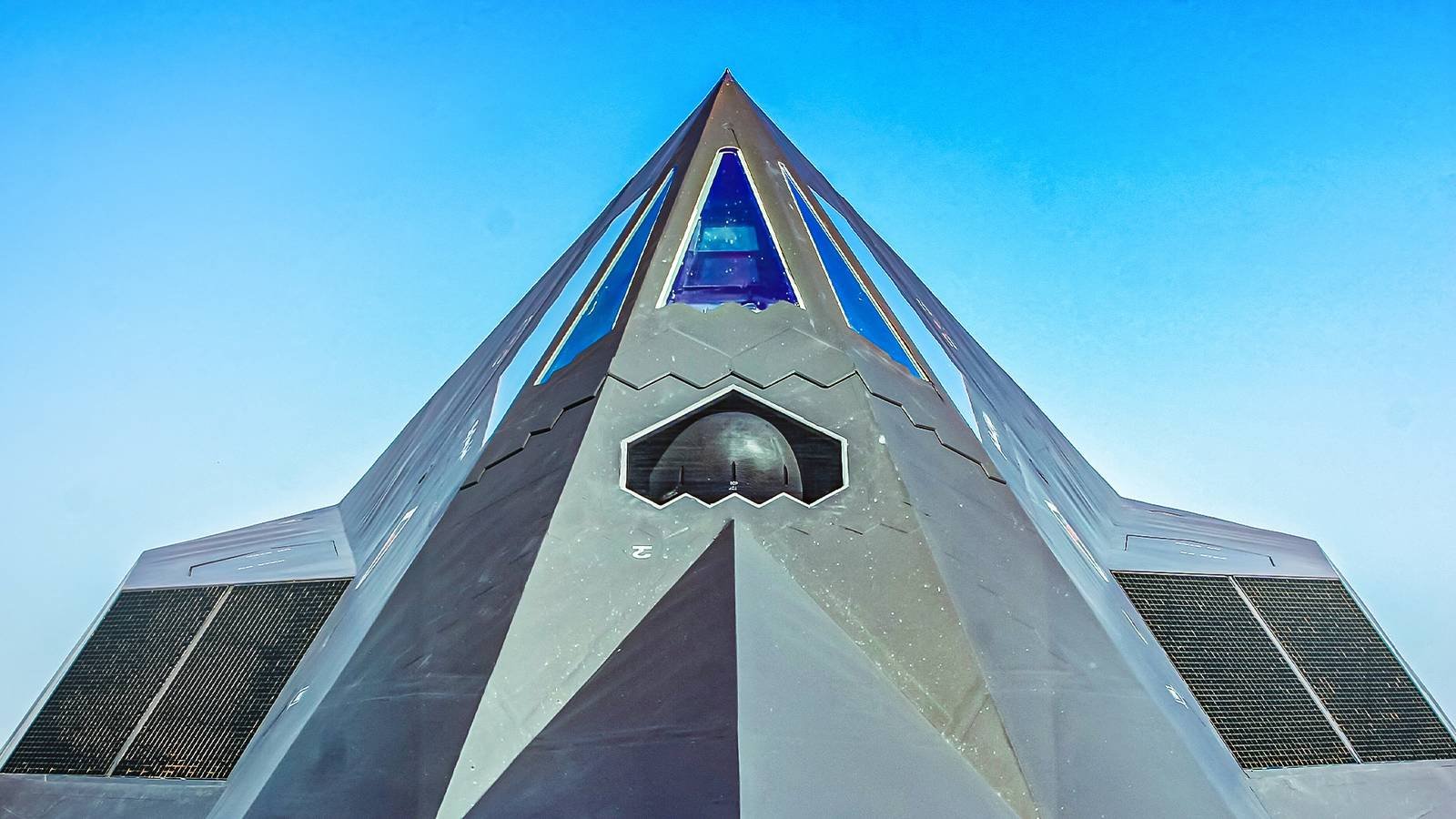
Although far from a true air-to-air combatant, the Lockheed F-117 Nighthawk was the world’s first stealth fighter, and after displaying its incredible capabilities over multiple conflicts across the span of 25 years, it was officially retired in 2008. Yet these distinctively angular black jets with their faceted fuselages continued to be seen flying over USAF’s Tonopah Test Range at the Nevada Test and Training Range. Although they may no longer serve on the front line, Uncle Sam is far from finished with these incredibly unique pioneers of stealth flight.
The reason the planes have been pulled back into service is to serve as ‘red air’ or aggressor aircraft for training exercises in stealth on stealth hunting scenarios for Air Force pilots of modern jets like the Lockheed Martin F-35 Lightning II or F-22 Raptor. The Nighthawk is the only surplus stealth plane in the inventory of the American military with the ability to perform such a niche role. These planes are also a cost-effective way of providing high-quality training platforms as they are much cheaper to fly than more modern fifth-generation fighter jets.
The Nighthawk Reborn: Tonopah’s Stealth Fighters
The F-117s have been seen performing testing and flying to and from air bases focused on advanced technology in addition to their red air job. The Nighthawk’s ongoing post-retirement operations are structured around highly classified, high-end joint training exercises and electronic warfare research. In a notable development, an F-117 was caught on camera performing air-to-air refueling operations with a modern KC-46A Pegasus tanker. Nighthawks have also been seen flying to and from Edwards Air Force Base in California, which is a major center of testing programs for the US military.
Nighthawks have been spotted at the Northern Edge exercises held in Alaska, where they appear to be performing the same counter-air role as they do in Nevada for Red Flag exercises, according to the Aviationist. There have also been sightings of the F-117 deployed to Savannah Air National Guard Base in Georgia for the Century Savannah drill alongside fourth and fifth-generation fighter jets. Sources like Defense Magazine propose that it is likely providing a platform representative of emerging near-peer threats, such as the Chinese Air Force, which operates stealth aircraft in littoral environments and open ocean airspace.
The F-117 provides a highly valuable training aid for the US Air Force and the American military as it pivots to the Pacific. The USAF, Navy, and Marine Corps are reorganizing force structures and optimizing equipment for agile combat employment across the first and second island chains. The F-35A, B, and C variants will all be present in the Pacific theater to work jointly both among US military branches and coalition allies in the region. Simultaneously, the F-22 Raptor is being upgraded with features uniquely tailored to counter the People’s Liberation Army Air Force and PLA Navy stealth aircraft. The F-117 does not appear to be a permanent airframe at any one base but rather a floating asset that is used to enhance training quality for many operational air units in the Department of Defense.
F-117: A Stealthy Stand In

The US military can craft very meticulous training exercises thanks to the enormous wealth of data it has on the F-117 as the precursor to the aircraft the Nighthawk is going up against in simulated air warfare. Because the exact radar cross section of the F-117 is meticulously documented, it is used as a flying target to baseline and calibrate new active electronically scanned array radars mounted on newer fighters and naval vessels. Thanks to the F-117’s radar-defeating qualities being a known quantity for US forces, realistic training scenarios can be evaluated for effectiveness with great fidelity.
The jet’s unique flat, rectangular exhaust system is lined with heat-absorbing tiles specifically designed to minimize its thermal signature. The military uses this to test the locking and tracking thresholds of next-generation infrared search and track sensors and ground-based anti-air optical tracking mounts. This is a crucial element of modern stealth on stealth hunting tactics for fighter pilots in the F-35 and F-22 that will be ‘flying dark’ with their radar off and using IRST as the primary search sensor against threats like the Chengdu J-20 Mighty Dragon of the PLAAF.
Catch what other flight trackers miss
Emergency squawks, holds, NOTAMs — live signals, no signup.
Open tracker
Catch what other flight trackers miss
Emergency squawks, holds, NOTAMs — live signals, no signup.
Open tracker
While the Chinese military has made great progress in the development of stealth aircraft, it is widely speculated that the RCS of the J-20 is far inferior to American-made stealth fighters like the F-35 and F-22. Because the F-117 is an older generation of technology, it makes a good analog as a stand-in, given the limitations of the technology in the 1980s for radar absorbent material, electronic warfare, and thermal signature masking. Additionally, because the F-117 does not need to be deployed to a combat zone, it can also be modified to better represent the training target of the day.

From 76 F-22 Raptors To 200 Next-Gen Fighters: How Much Larger America’s Air Superiority Fleet Could Get
A closer look at the future of air power in the US Armed Forces.
Wobbly Goblin: A Unique Testbed

The Nighthawk earned a unique moniker for unusual handling characteristics in flight, the ‘wobbly Goblin,’ as its geometric surfaces give it unusual aerodynamics compared to virtually every other airplane ever made. Although it may be a less refined stealth aircraft than modern examples, its lower level of technology also makes it a good test bed to evaluate measurable results for modernization. Retrofitting new RAM coatings, thermal shielding, or anti-EW equipment can provide valuable test data thanks to the same archive of operational records that makes it a good training adversary. The War Zone reported that Nighthawks have even been spotted in a mirror-like, multispectral stealth coating that is speculated to be in development for the F-22 or possibly the Next Generation Air Dominance Boeing F-47.
The US Air Force awarded Boeing the contract for the first sixth-generation stealth fighter in early 2025 after videos of two Chinese airworthy prototypes were leaked over social media, immediately igniting urgency in the Western defense industry. The NGAD has since been designated as the F-47, and it will introduce all aspects of stealth technology, or ‘Stealth Plus.’ This technology is expected to surpass even that which is being featured on the Northrop Grumman B-21 Raider stealth bomber, succeeding the B-2 Spirit.
The F-47, however, is many years from taking flight, and although some technology demonstrators have been spotted over Area 51, the first representative example is not expected to take off until 2028. In the meantime, the US Air Force is investing in the F-22 Raptor 2.0 modernization program that will make the Nighthawk successor even more lethal than it has been in the past to act as a bridge until 2037 when large numbers of the NGAD can be introduced to operational fighter squadrons. This makes the probability of F-117 being a technology test bed highly likely as part of these research and development efforts.
Why The US Air Force Just Cut Its 2026 F-35A Order Nearly In Half
Fifth-generation fighters still struggling to live up to the hype.
The Cost Of Doing Business

Saving the most ‘exquisite’ fifth-generation fighter jets from wear and tear is another highly valuable aspect of using the surplus fleet of Nighthawks to support the operational testing and training of frontline fighter squadrons. The aging fleet of F-22 Raptors suffers massive maintenance hours for every flight hour, and even though the F-35 is newer by decades, the jets are plagued by software issues that keep them grounded more than many older airplanes.
Government Accountability Office audits and defense data highlight a stark contrast between America’s frontline fighters and the legacy Nighthawk. Every hour an F-22 Raptor or F-35 Lightning II spends acting as a generic target for training or a ‘guinea pig’ for paint tests is an hour shaved off its operational combat lifespan. By absorbing these high-stress flight hours, the F-117 acts as a cheap operational buffer. According to Military Machine, a single flying hour in the F-22 can run over $80,000 in associated maintenance costs, and the F-35 can similarly be $30,000 to $40,000, while the F-117 is estimated to cost $20,000 or less.
The Pentagon Declared The F-35’s Most Critical Upgrade ‘Predominantly Unusable’
The problem with the Joint Strike Fighter.
A Troubled Transition: The F-35 Issue

Last year, the F-35 fleet’s overall mission-capable rate dropped to 44%, while the full-mission-capable rate plummeted to a staggering 25%, according to Air & Space Forces Magazine. If a wing of F-35As has only 10 out of 24 jets fully cleared to fight on any given day, commanders cannot afford to waste those airframes playing the enemy in training drills. Flying the F-117 as the adversary allows the fully mission-capable F-35s and F-22s to focus entirely on blue-air combat tactics rather than burning up airframe life.
The F-117 is mechanically simple by comparison to both of these ‘exquisite’ fighters. As such, it provides a highly reliable, low-observable radar profile that allows developers to test how future systems distinguish between friendly stealth assets and legacy low-observable targets. Engineers can slap a new experimental RAM skin onto its flat, geometric panels and fly it almost immediately relative to the newer jets.
That also makes them a far more budget-friendly alternative for validating advanced tech for the incoming F-47. It is more reliable, lower risk, and cheaper to fly every time a contractor needs to check performance in flight. Aside from simply saving money, a higher readiness level of the Nighthawk fleet also makes the development timeline for the NGAD faster, as it doesn’t suffer from the chronic mechanical issues of the F-22 or software bugs of the F-35. Given its newfound value in once again advancing American defense and aerospace, we may yet see the F-117 fly for many more years.
