


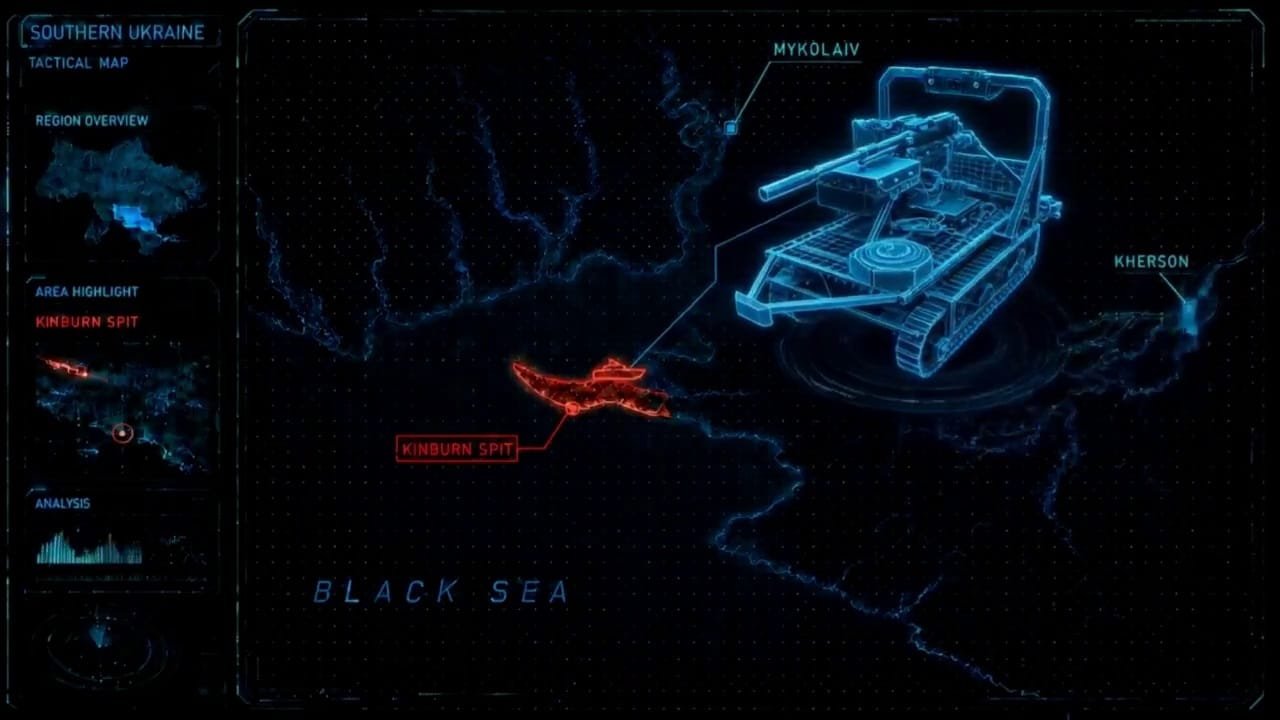
Footage reveals Ukraine’s 123rd Territorial Defence Brigade using an Unmanned Surface Vehicle (USV) to deploy a Roboneers Rys UGV on the Russian-held Kinburn Split, marking a breakthrough in automated cross-domain naval operations.
The Ukrainian armed forces have reportedly conducted a groundbreaking amphibious raid against Russian-held positions at the Kinburn Split. Executed entirely by unmanned vehicles operating across the sea, land, and air domains, the operation marks the first completely automated amphibious assault in military history conducted under wartime conditions.
The raid, reportedly conducted by Ukraine’s 123rd Territorial Defence brigade, was done by delivering a unmanned ground vehicle (UGV) on a beach at the Kinburn Split by means of an Unmanned Surface Vehicle (USV). Once delivered on the beach, the UGV took op position and allegedly engaged an enemy position located further on the waterfront. The results of the amphibious raid was however not reported.
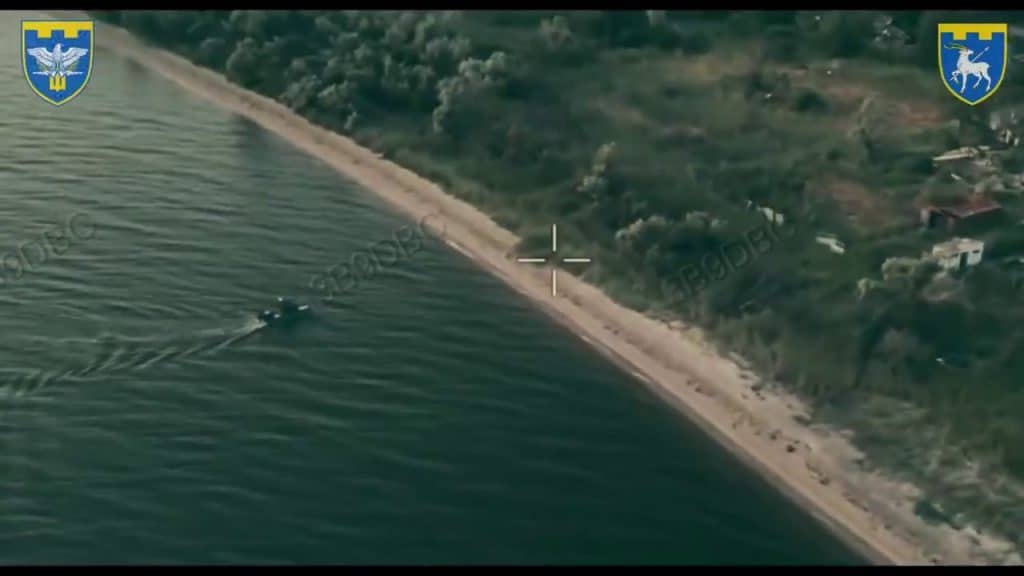
Footage of the amphibious raid was provided by an unmanned aerial vehicle (UAV) flying overhead to monitor the deployment. The UAV films how a USV is transporting a UGV, most likely an Ukrainian-made Rys UGV developed by Roboneers and equipped with a 7.62mm PKT machine gun. Once the ramps of the USV are lowered, the UGV proceeded to roll off the USV and quickly take up position in the nearby vegetation. Once the UGV is in cover, the USV departs the area.
In the next shot of the video, the UGV is show deployed at the water edge looking over the beach and firing at a target in the distance. A close up of the position shows the UGV firing at least three rounds at the target with two rounds hitting the sand in front of the target. The last round appears to be a tracer round showing the round flying in an arc indicating that the UGV is possibly firing at its maximum range, which could explain the limited accuracy.
No footage was released showing the UGV being picked up again by an USV though the absence of such footage doesn’t exclude that a recovery mission wasn’t undertaken. It is also unknown if the target in question was occupied by Russian forces at that point in time or if the amphibious raid was a demonstration to pave the way for similar future operations.
The operation appears to be the first completely automated amphibious raid under wartime conditions in history executed by unmanned vehicles operating in all three domains, sea for transportation, ground for the assault, and air for observation and follow up. Tensions on the Kinburn Split in Southern Ukraine have been rising in recent weeks with Russian war bloggers anticipating an Ukrainian amphibious operation in the near future as a result of deteriorating Russian logistics in this region. Ukrainian forces have previously planted an Ukrainian flag at the Kinburn Split on June 25th, most likely by use of a UAV. The video showing the Ukrainian flag also included footage of airstrikes at the Kinburn Split, indicating that Ukraine is pressuring the Russian positions for a while now.
Ukraine’s mid-range drone strikes in recent weeks have been targeting Russian logistics in Southern Ukraine and the Crimea with drones striking the overland routes between Mariupol and the Crimea. These mid-range drones target Russian military trucks transporting among other things fuel and ammunition to and from the frontlines. Russian forces have reportedly suffered significant losses, undermining its capabilities to keep frontline troops adequately supplied.
Ukrainian partisan movement ATESH has recently reported that Russian forces garrisoned on the Kinburn Split withdrew as they could no longer be supplied which. According to ATESH, units of Russia’s 337th Regiment withdrew from the northern and western parts of the Kinburn Split due to the absence of food, ammunition, and fuel deliveries.
If true, this would make the Kinburn Split vulnerable for an amphibious invasion by Ukrainian forces.
Footage of the operation shows the Rys UGV being deployed near a village. Though no geolocation was provided, the terrain shown in the video resembles to terrain west of Pokrovske with the Rys UGV firing at a feature that might correspond to a location identified as “Pokrovsʹki Khutory”
The recent amphibious raid by the 123rd Territorial Defence Brigade could be seen as the first steps in assessing if the Kinburn Split could be retaken. By sending out UGVs, Ukraine can assess how well the Kinburn Split is still defended by Russian forces while also put pressure on Russian positions and attempt to neutralize them. Taking the Kinburn Split would be a first step for Ukraine to try and reopen the maritime entrance to the Dnipro river and the port of Mykolaiv.
Analysis – Wider future implications
Ukraine’s amphibious raid with the Rys UGV has most likely started a new chapter on how amphibious operations will be undertaken in the future. The presence of unmanned combat systems, most notable in the use of USV and FPV drones, has made amphibious operations more risky than they already were. Unmanned systems allow the defender to observe and strike large littoral areas without the need of spreading troops out. Given the success of recent Ukrainian USV strikes in the Black Sea and UAV strikes both on land and in the Sea of Azov, it isn’t hard to imagine that conventional amphibious operations are in severe risk of becoming no longer an option on a modern battlefield.
USV and FPV drones would be able to pick off the slow moving amphibious landing ships as they move to their designated landing zones or while they are gathered offshore supporting an actual landing. Once ashore, marines risk being targeted by FPV drones before a beachhead can be secured. Even if marines would be able to hold a beachhead, they would be exposed to constant FPV drone strikes causing mounting casualties and equipment losses.
Ukraine however appears to be demonstrating that unmanned combat systems could revive amphibious operations by using these unmanned systems for reconnaissance, raids, suppression of known enemy positions, and create an initial assault force that paves the way for regular amphibious troops to land. This concept is however still under development and it remains to be seen if Ukraine can leverage this new concept and scale it up by deploying more UGVs simultaneously in potential future follow up raids. Given the importance of the Kinburn Split and the reported weakness of Russian forces in this area, it is possible the future amphibious operations in this area will continue to take place.
