


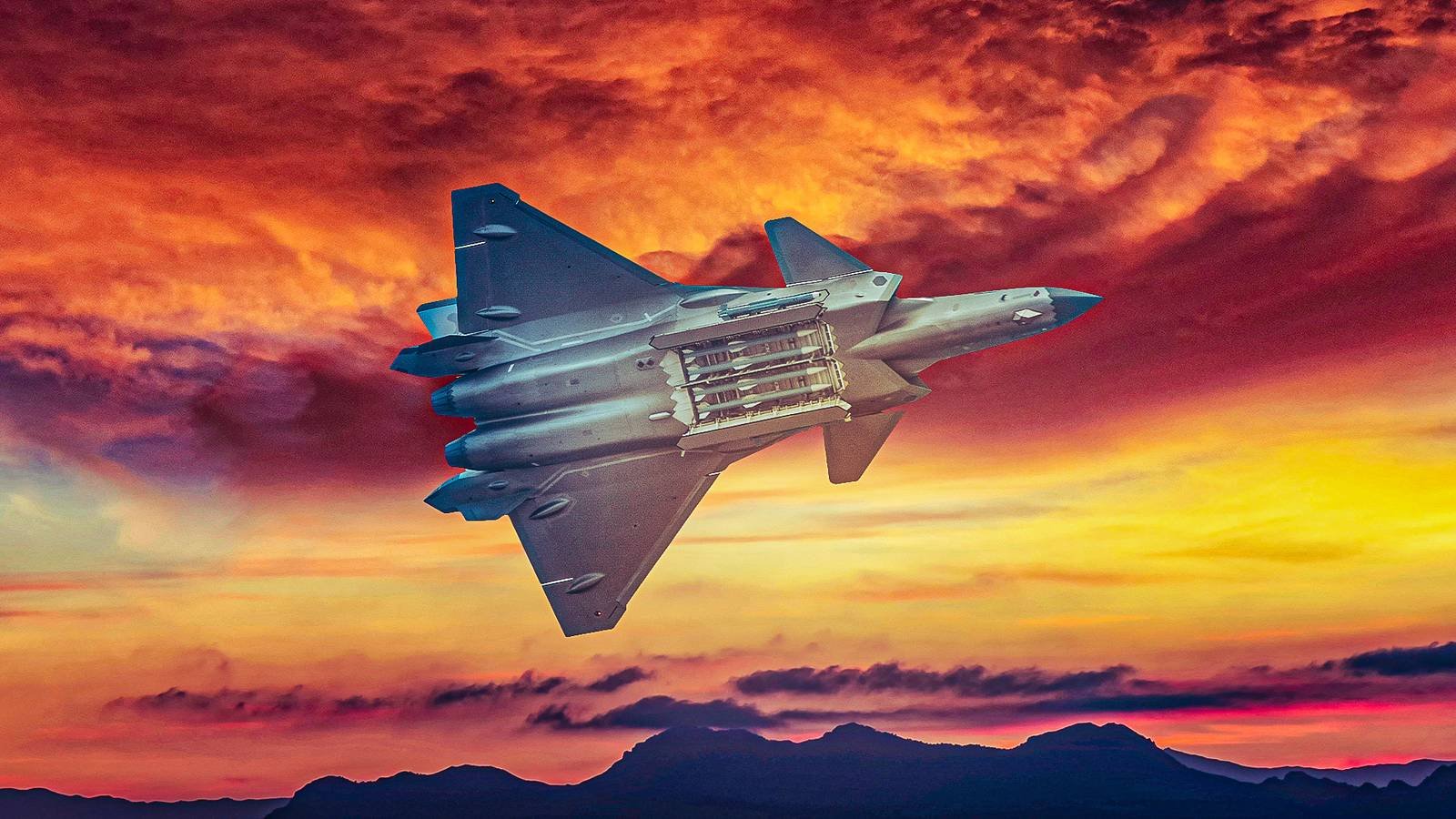
The Lockheed Martin Lightning II fighter jet is the world’s most advanced fighter and is taking its place as the second-most in-service fighter jet in the world (depending on how the numbers are counted). At the same time, the Air Force is planning to double the number of F-15EXs it is procuring to 267. Importantly, this is not so much increasing its F-15 fleet as it is intended to recapitalize the aging F-15E fleet as they age out and retire.
As the F-35 fleet grows, the Air Force sees a role for around 267 upgraded Eagles to carry out policing, drone hunting, and missile truck roles well into the century. Part of the motive may also be industrial to keep the production line humming. Here is what to know about how the F-15EX and its large payload complement the F-35 and its stealth mode.
The Stealthy Internal Bay
One useful way to think of the F-35 is as part flying computer and sensor, and part fighter jet. In some ways, the F-35 has more in common with a flying smartphone than it does a legacy Cold War fighter jet. The F-35 is designed as a stealth fighter capable of penetrating enemy air defense and taking out high-value targets. It is intended to be one of the first effectors to take out enemy air defense systems on the first day of operations through SEAD (suppression of enemy air defense) and DEAD (destruction of enemy air defense).
The F-35’s ability to take down higher-end air defense systems was on display in 2024 when Israel damaged an Iranian high-end S-300 system in a symbolic attack. This was followed up in 2025, with Israeli F-35s dismantling much of Iran’s air defense network (along with other effectors like drone teams on the ground). F-35s contributed to Israeli and American jets securing air superiority over much of Iran in short order.
During the campaign, one US F-35 seems to have been hit by a low-end shoulder-launched missile (likely MANPADS). While many of the details are opaque, it seems the aircraft was flying low and slow. No stealth aircraft is invisible; if flown low and slow, they can be hit by flak fire just like any other aircraft from any period. To some degree, if a stealthy F-35 flies like an A-10, it can be hit like an A-10. Notably, none appear to have been hit by mid- to high-end air defense systems. But while the F-35 appears to have excelled in its counter-air defense role, it needs to do much more than that.
Pairing With 4th-Gen Fighter Jets

The F-35 excels at penetrating enemy air defense and kicking in the door, but it is limited by its internal bay storage. In modern operations, there is a need for high-end exquisite munitions to take out highly sensitive targets. But there is also the need to deliver massed fires to take out many, many other targets. This is one area where the F-35 becomes particularly effective when paired with 4th-generation fighter jets.
Most large and medium-sized air forces are pairing the F-35 with 4th-generation fighters. This allows the F-35 to act as a quarterback, providing targeting and other information to 4th-generation fighters. Telling nicknames are given in the RAF, where the F-35 is dubbed the “assassin”, while the Eurofighter Typhoon is called the “thug.” The F-35 is (or will be) paired with the Eurofighter in the UK, Germany, and Italy.
The F-35 is (will be) paired with the F-16 in the USAF, Israel, Poland, and Japan, and is paired with variants of the F-15 in the USAF, Israel, South Korea, and Japan. Uniquely, it is paired with the Super Hornet in Australia. Air forces like those of Finland, Norway, Denmark, the Netherlands, and Belgium are exclusively operating the F-35, in part because it is logistically difficult to operate multiple types of fighter jets.
F-15EX Functioning As A Missile Truck

The F-15 Eagle was originally developed as an air superiority fighter jet, although that role has largely been supplanted by the F-22 Raptor. The F-15EX is the latest version of the Eagle, and while the airframe is superficially similar, it is essentially a new aircraft with modern avionics and systems. Initially, the US Air Force had intended to acquire around 100 (later 124) of them as a stopgap following the termination of the Raptor program.
The idea was originally for these F-15EXs to be assigned to Air National Guard units, with an emphasis on patrols and homeland defense. However, the large size and lack of stealth requirements have led to the F-15EX being seen as a ‘missile truck’ that can be paired with the F-35. In early 2026 the USAF announced it wants to double its planned purchase to 267 examples.
US Air Force | F-35A (per Lockheed Martin) | F-15EX (per Boeing) |
|---|---|---|
Number planned | 1,763 | 267 |
Payload (total) | 18,000 lbs (8,160 kg) | 29,500 lbs (13,380 kg) |
Internal bay payload | 5,700 lbs (2,585 kg) | None |
Entered service | 2016 | 2024 |
267 is a huge number for almost any other air force, but it should be put into perspective. The USAF has a program of record for 1,763 F-35As (over 500 of which have been delivered). So, while a large number of F-15EX’s will be procured, the F-35A will remain decisively the backbone. Additionally, the F-35 can be paired with other off-board platforms like the F-16. Importantly, the USAF is rapidly developing Collaborative Combat Aircraft (CCAs) or loyal wingman drones, which are intended to be the primary off-board effector for the F-35.
Pairing The F-15EX With F-35A

The F-15EX is able to carry 12 air-to-air missiles, much more than the F-35A can carry in its internal bay. The Air Force is working to shrink the missiles down and stuff more missiles in the internal bay, but that is a work in progress and outside the scope of this article. China is currently producing around the same number of fighter jets as the United States, and retaining more when the fact that many of the US-built jets are exported is accounted for. Together, the US and China accounted for around 85% of all frontline fighter jets produced in 2025.
Catch what other flight trackers miss
Emergency squawks, holds, NOTAMs — live signals, no signup.
Open tracker
Catch what other flight trackers miss
Emergency squawks, holds, NOTAMs — live signals, no signup.
Open tracker
While the US (with the Marines and Navy) will likely continue to have considerably more stealthy fighter jets than China, especially when allies are added in, China may have a local numerical advantage. This means the USAF can’t just look to match China on a one-for-one basis. The USAF is increasingly pursuing a high-low mix in which stealth aircraft penetrate defended airspace, engage targets, and provide targeting data.
4th-gen aircraft like the F-15EX stay further away from contested airspace and launch large numbers of long-range missiles. This allows the F-15EX to operate as a missile truck, with much of the cueing provided by the F-35. Just four F-15EXs could theoretically fire 48 air-to-air missiles directed by F-35s further forward. The F-15EX is also well-suited to drone hunting and intercepting barrages of cruise missiles.
The F-35A’s Beast Mode

It should be noted that the payload gap between the F-35A and the F-15EX significantly shrinks if the F-35A carries its ordnance externally, aka in ‘beast mode.‘ However, beast mode sacrifices much of the aircraft’s stealth. Internally, the F-35A can carry four to six internal air-to-air missiles (e.g., 4x AIM-120 AMRAAM + 2x AIM-9X), although upgrades will allow it to carry six internal AIM-120s. Its internal-only payload is limited to around 5,700 lbs (2,585 kg).
With external pylons, the F-35A is able to carry a total of 14 to over 16 air-to-air missiles. Its total payload jumps to around 18,000 lbs (8,160 kg). For comparison, the F-15EX can carry up to 12 AIM-120 AMRAAMs, but this increases to 22 air-to-air missiles with expanded racks and a mixed load. It has a maximum total payload of 29,500 lbs (13,380 kg).
The F-35A is an 18,000-lbs payload aircraft, not a 5,700-lbs payload aircraft in theory, but in practice it is more of the latter. The F-35A first entered service in 2015, and ten years later, in 2025, The War Zone reported, “Israel has confirmed that its F-35 stealth fighters have flown airstrikes using external ordnance. The F-35’s so-called ‘beast mode,’ featuring heavier loads on underwing pylons, is familiar by now, but as far as is known, it has not been called upon operationally by any other countries.” Put another way, in the first eight or so years of service and tens of thousands of combat hours, the F-35 was not known to be used in beast mode.
The Bigger Picture

The F-15EX is set to provide a supporting role for the F-35A, especially in the Eastern Pacific theater. The Air Force is also looking to CCAs as the primary off-board platform. In 2026, the Air Force awarded contracts to General Atomics for the FQ-42 and Anduril for the FQ-44. These will enter service with the F-22 starting in 2029, followed by the F-35.
It is also worth noting that this discussion is not limited to fighter jets but also includes bombers. The Air Force is testing its new B-21 Raider and preparing to bring it into service in 2027. Somewhat like the F-35, it is designed to penetrate contested airspace, but is constrained by its internal weapons bay. Consequently, the USAF is working to upgrade the B-52 fleet as a “missile truck” while also developing CCAs for it.
No matter what off-board platforms are used, the size of the internal weapons bay is limiting. The UK, Japan, and Italy are jointly developing the next-generation GCAP/Tempest fighter jet, for which around 75% of the structural weight of the demonstrator is now complete. The Aviation Week recently saw its internal bays, writing, “Their size suggests the demonstrator could potentially carry around twice the internal weapons volume of the F-35’s relatively shallow bays, and potentially could be capable of accommodating larger-diameter stores.”
