


Executives detail redesigns of the 737 Max’s engine anti-ice and angle-of-attack systems, alongside flight-test headway with new widebody-twin.
Ahead of this year’s signature aviation event in Farnborough, Boeing has more wind at its back than at any time in recent memory.
The company has hiked production to rates not seen in years, finalised two 737 Max system updates and is close to securing the Max 7’s long-delayed certification, with approval for the Max 10 to follow.
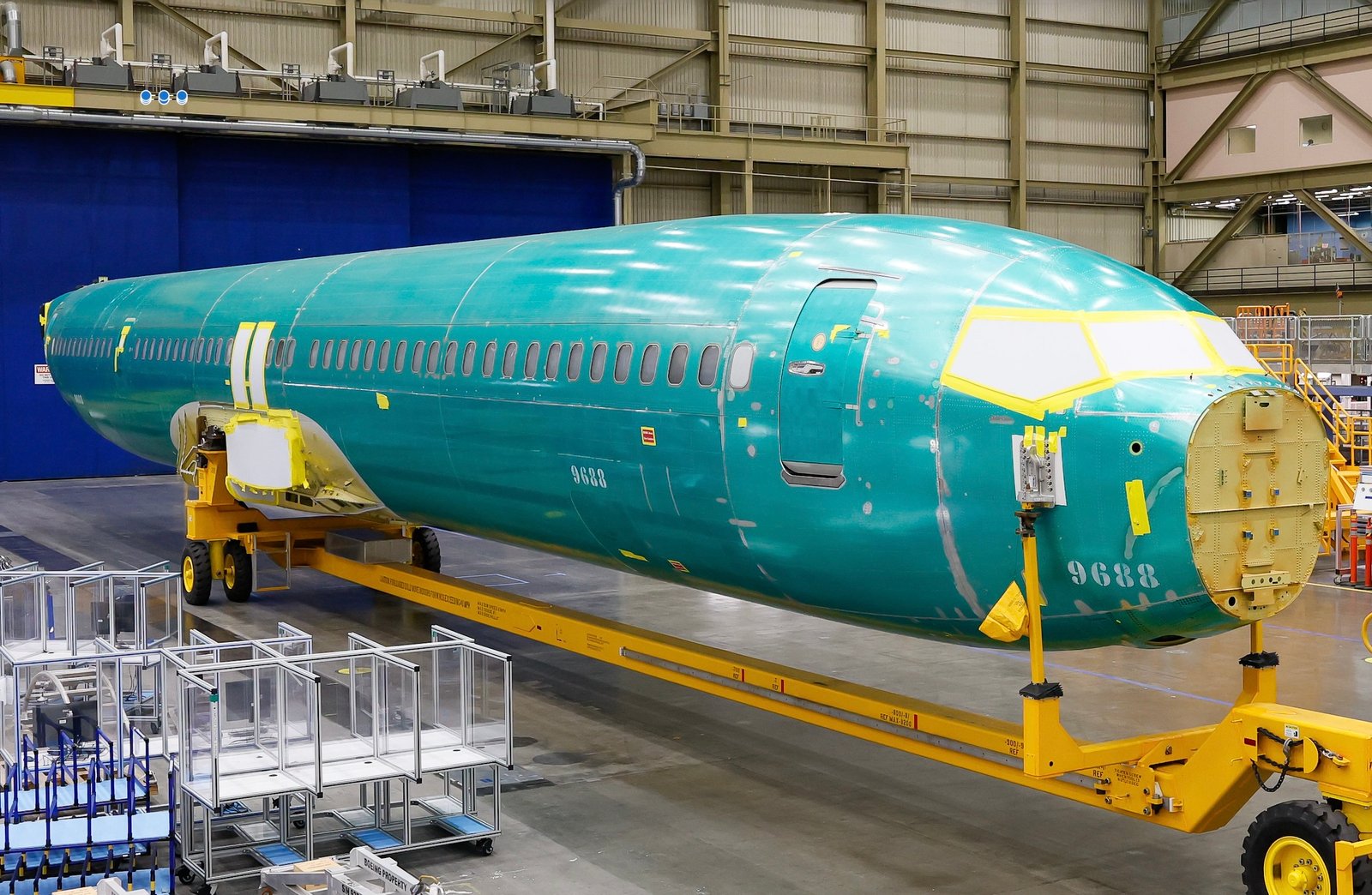
Boeing also just opened a new 737 production line in Everett and is ticking off regulatory boxes for certification of its delayed 777-9.
Executives have disclosed more about those programmes in recent days, while insisting the airframer has made progress addressing quality and cultural issues.
Boeing has said it expects the Federal Aviation Administration will certificate the Max 7 this summer, although on 9 July The Wall Street Journal reported that the approval could come as early as this month.
Boeing vice-president of 737 development Chris Payne says the company has now completed all Max 7 certification flight tests and 95% of “certification deliverables” due to the Federal Aviation Administration (FAA).
Anti-Ice Redesign
He also detailed the redesign of the 737 Max’s engine anti-ice system, a change required because the existing system in certain circumstances can cause engine inlet inner barrels to overheat.
The changes notably involve installing “turbulators” on the forward fan case that sits ahead of the Max’s twin CFM International Leap-1B engine.
The turbulators are “literally a washer and fastener that go through the inlet in a circumferential row around the engine”, says Payne. Their purpose is to make air entering the engine swirl, which draws in colder air and reduces the temperature “at the critical point” by 93°C (200°F).
“It does a fantastic job of really taking care of the temperature conditions,” Payne says. “It’s a highly integrated solution for the aircraft and the engine.”
The redesign also includes replacing the forward fan case, which has “acoustic perforations” intended to reduce noise, with a perforation-free “hard-walled” case.
Contrary to expectations, those perforations did not reduce noise; the hard-walled case is actually quieter and the change ensures sufficient “fan-flutter margin”, says Boeing senior vice-president of development programmes Mike Sinnett.
The anti-ice redesign also includes a new “flow restrictor”, limiting how much hot air strikes critical components, insulation blankets around inlet ducts, circuit breakers, wiring, a “fault redundancy” pressure switch and an integrated air systems controller for the engine anti-ice valve.
“We have done all of the [anti-ice] certification testing. We’ve done all the analysis, all the flying, all the lab testing,” Payne says. “We’ve submitted almost all of the deliverables for it. We’re just in the last throes of getting certified.”
Payne says Boeing has meanwhile completed 98% of the Max 10’s flight-test programme. It has two planned flight tests remaining and should complete those this quarter, putting the company on track to achieve certification for the variant before year-end.
Payne also says that last quarter Boeing completed level 3 of the Max 10’s “development assurance” work – the regulatory framework used to demonstrate adherence to processes. It has also finished 60% of Development Assurance Level 4 (the final level), and expects to be done this quarter.
Additionally, Boeing has submitted 30% of required documents for the Max 10’s system safety analysis, Payne adds.
With the Max 10, Boeing is introducing another change, to the angle of attack (AoA) system. It undertook that project because two Max 8 crashes, in 2018 and 2019, revealed that failure of one of the Max’s two external AoA sensors can trigger the Maneuvering Characteristics Augmentation System (MCAS), which trims the aircraft nose-down and is supposed only to activate to counteract excessive nose-up pitch.
That sequence preceded both Max crashes, putting those jets into dives from which the pilots did not recover. In addition to MCAS issues, investigators cited pilot workload as contributing to the accidents.
That is because AoA failures can activate the stall-warning stick shaker even if the aircraft is not stalling and prompt “five different” cockpit warnings, including false alarms, says Boeing 737 deputy chief test pilot Bill Quashnock.
For that reason, Boeing developed its “enhanced AoA” for the 10.
The redesign simplifies “flight deck effects” by identifying AoA faults, inhibiting stick shake and displaying a simple message to pilots: “AoA Fault”.
“Our engineers have run all the simulations, showing that for pretty much every conceivable error that we know, the monitors will catch it,” Quashnock says. As a backup, Boeing’s enhanced AoA system includes a cockpit switch for pilots to deactivate the stick shaker.
Following Max 10 certification, Boeing will deliver other Max models with the improved system, and within two years retrofit in-service jets.
Boeing has for two years been delivering Max with “provisions” enabling technicians to complete the updates in as little as 2h. Some 1,200 jets, about half of the in-service fleet, have those provisions. Updates to other aircraft will take several days, Boeing says.

Perhaps the most visible sign of Boeing’s upswing lies within Everett hangar space that until several years ago housed 787 assembly (a jet now built entirely in South Carolina).
On 6 July, Boeing began operating a 737 Max assembly line in that space, adding to three lines in Renton. The company says the extra space will allow it to ramp 737 output from 47 to 52 jets monthly, with additional rate hikes to follow.
“Long term, we really want to use the space to support the [Max] 10,” says Boeing Commercial Airplanes chief executive Stephanie Pope.
Though the 777-9’s approval is seven years behind Boeing’s original schedule, executives insist the project is progressing, noting the company has completed half planned 777-9 certification flight tests. It aims to start delivering 777-9s next year.
Boeing 777-9 vice-president Terry Beezhold notes many certification flight tests require the aircraft be in its final configuration. Boeing has made several updates to the jet in recent years, contributing to delays.
“We’ve had a number of lay-ups throughout our test programme, updating the aircraft from its original build,” he says. “We are in the final phases of completing those lay-ups.”
Two 777-9 test aircraft (WH001 and WH002) are now in the “final certification configuration”. WH001 is ready to begin certification flight tests and WH002 will come online in “a couple of weeks”, Beezhold says.
Boeing is now working through the final step, stage 5, of the 777-9’s Type Inspection Authorization (TIA) – the document confirming an aircraft meets certification requirements and approving certification flight tests.
Historically the FAA approves TIAs in their entirety but has been approving the 777-9’s authorisation in stages.
When all primary 777-9 certification work is complete, Boeing will turn its focus to securing 180min ETOPS (extended twin-engined operations) approval for the type. It may later work with airlines to receive longer-duration approvals, Beezhold says.
GE Aerospace is also redesigning mid-seals in the 777-9’s GE9X turbofans, though Boeing insists the issue will not further hold up certification. Mid-seals balance pressure and temperature between turbine stages.
Boeing has also been subjecting a 777-9 fuselage and wings to fatigue testing using a towering steel rig at the far north end of the Everett campus. There, 190 actuation systems – composed of weights, hydraulics and pulleys – lift, pull and twist the aircraft, simulating as many as 160 “ground-air-ground” cycles every 24h, says Boeing vice-president and chief 777-9 project engineer Tresha Lacaux.
“We test for all types of… conditions, and the entire operating envelope that we expect the aircraft [will see] while it’s in service,” Lacaux says. “It enables us to accelerate years and years of service… so we can identify any durability issues.”

Boeing has already subjected the fuselage to 63,000 cycles – double the type’s expected 36,000-cycle life. “Everything has been within our expectations,” says Lacaux.
Meanwhile, across the USA in North Charleston, South Carolina, Boeing’s 787 programme is by most measures flying high. The company landed 250 787 orders in the last year, thanks partly to US President Donald Trump, who promoted Boeing jets as part of tariff negotiations. The airframer has some 1,100 787s in its backlog.
The company recently hiked production to eight 787s monthly and aims to hit rate 10 this year, though getting there has not been as smooth as hoped.
CEO Kelly Ortberg has cited shortages of the 787’s GEnx turbofans.
“We’ve fallen behind in delivery on engines in the first quarter,” the CEO said in June. “We’ve got a recovery plan that we’re working with GE on. We’ll need to see the engine recovery plan come to fruition before we can get to rate 10.”
Also, slow certifications of complex business-class seats have held up deliveries.
“Customers always use the front of the cabin to differentiate their experience. We’re also seeing, especially in the US, carriers expanding how much premium cabin that they have. So, the complexity of that differentiation is certainly growing,” Pope says.
Though the South Carolina assembly site will be maxed out at rate 10, the company is constructing a second adjacent facility that will double capacity. Boeing aims to have the site operating in 2028.

Through it all, Boeing is stressing steps taken to improve quality and mend cultural issues.
On 9 July, four employees chosen by Boeing from various business segments described that culture and how it has changed, speaking on condition of anonymity. They were among workers who partook in a “cultural working group” charged with creating a list of “core values”. They did so with feedback from a company survey and 500 smaller focus groups.
“We had a lack of communication… [and] follow through,” one employee says of Boeing’s prior atmosphere years ago when she joined the firm. “It seemed we never got the full story… Now it’s definitely different.”
The employees describe previously feeling pressured to keep aircraft moving down the line and being fearful of raising concerns, hesitant to speak up and sometimes unsupported.
“I remember being told once by a senior employee, ‘Why are you doing all that work?… There’s no growth. There’s no opportunity,’” an employee says.
But the workers insist the atmosphere has improved. They say they now better understand the company’s direction, feel more supported and see advancement opportunities.
“I have seen significant changes… They’re just hard to miss now,” an employee says, citing “a huge jump in… communication and accountability”.
“It’s a change in mindset for everyone,” another employee says. “It’s not just me, it’s my team.”
Additional reporting by Edward Russell.
Subscribe to gain access to all news
Already have a subscription? Log in.
Choose your subscription
Considering a corporate subscription? Contact us to find out more.
