


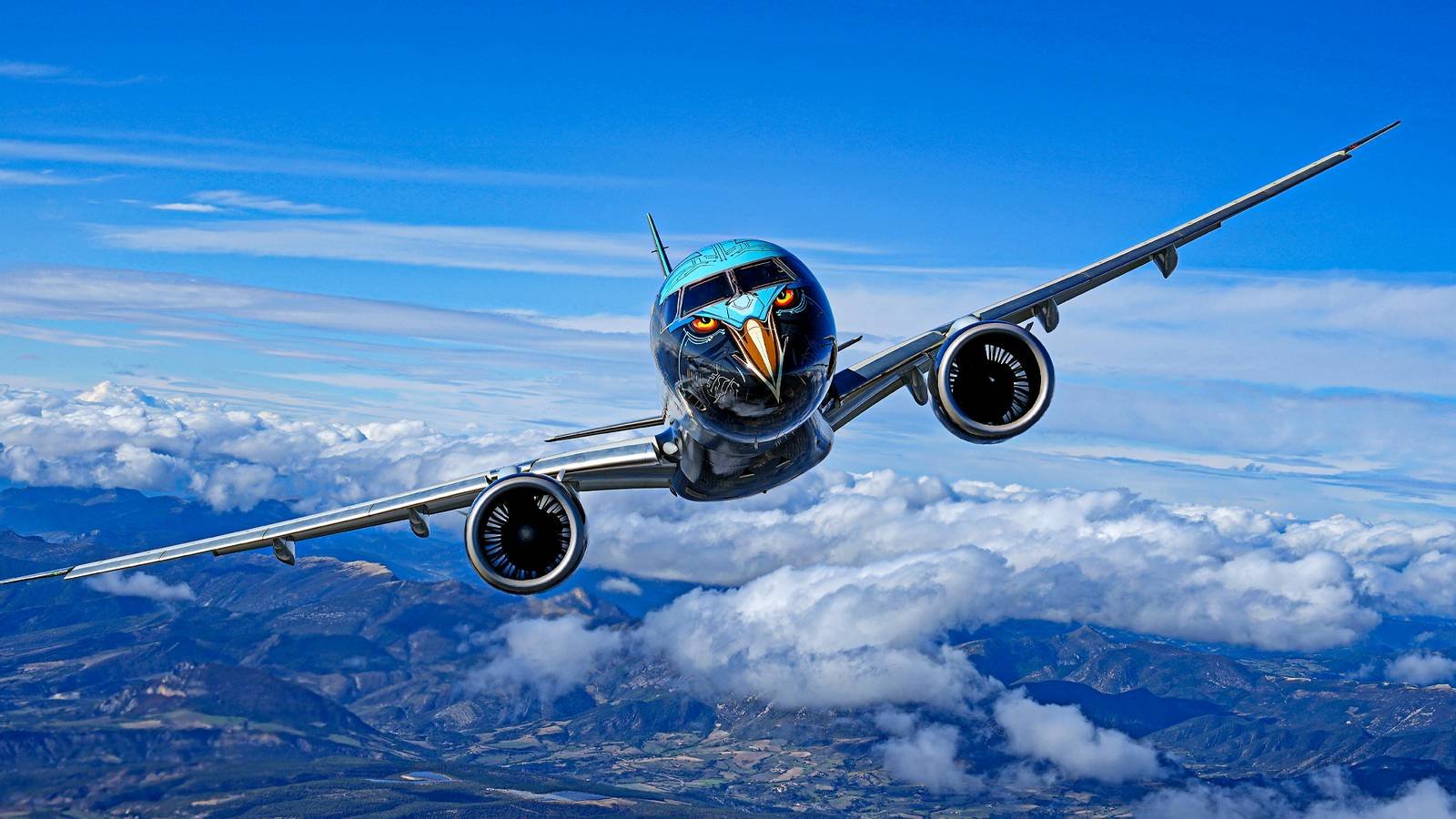
The market for small narrowbodies has traditionally been smaller than the one for mainline aircraft, but it’s still a space with significant demand. Embraer has long been a dominant player, with its E-Jet family having received nearly 2,000 orders since its launch. Still, the company’s refreshed E2 family has sold in relatively low numbers, as the Airbus A220 (formerly the Bombardier C Series) has been grabbing market share.
However, while the A220 remains the market leader, the Embraer E2 is more than holding its own. 2025 was the E2 program’s best sales year ever, with 154 orders booked, and the E2 has recently proven popular in its home continent of South America. Indeed, within the past 12 months, the E2 has received 44 combined orders from two South American customers, which also builds upon an order by Azul early in the E2 program’s life. Notably, despite the A220’s overall sales success, it has only been ordered by one South American carrier, and the E2 is making its presence clear as a legitimate threat to the adopted Airbus.
Where The E2 Is Winning & Losing
On July 21, Colombia-based Abra Group ordered 20 Embraer E195-E2s, in addition to ten purchase options and 15 purchase rights. Abra Group currently owns Avianca and GOL, while holding an investment in Wamos and a minority ownership interest in Sky. This follows an order in September 2025 by LATAM for 24 E195-E2s with 50 options. Together with Azul’s 2015 order for the E195-E2, Embraer has sold well over 100 E195-E2s in South America, with the total approaching 200 on the continent when including all options. Embraer’s sales success here is particularly notable because the competing Airbus A220’s only South American customer is FlyBondi, with an order for 15 and options for five more. Worldwide, however, the E2 has not been nearly as popular as the A220, only receiving about half as many orders.
However, the E2 has scored some major wins, having received orders for 18 E195-E2s from Finnair earlier in 2026. Meanwhile, the E2 received orders from SAS, All Nippon Airways, and Avelo Airlines in 2025, in addition to the LATAM sale. While the A220 has been more popular than the Embraer E2 program as a whole, the actual competition between the two is more nuanced. Of the two variants in the A220 family, the A220-300 has been far more popular, with the A220-100 receiving just over 100 orders. Meanwhile, the E195-E2 is comparable in size to the A220-100 and has received over 400 orders, while the smaller E190-E2 has sold only 68 units. Given the size and design differences between the two, a sales competition between the two depends heavily on an airline’s overall strategy rather than simply on attributes.
What The Embraer E2 Offers

While it’s based on the prior E-Jet family, the Embraer E2 is positioned very differently from its predecessor. The E-Jet was initially produced as the E170 regional jet, while the slightly larger E175 model was by far the most popular E-Jet variant and is still in production. Embraer also produced the larger E190, which was commonly used as a large regional jet by some airlines and as a small mainline aircraft by others.
Meanwhile, the slightly larger E195 received only 172 orders, the least of any E-Jet variant. Embraer did market an E175-E2 during development, but the aircraft’s gross weight exceeded the maximum figure established by pilot scope clauses in the United States, the E175’s largest customer base.
Embraer E-Jet Variants | Sales | Embraer E2 Sales | Sales |
|---|---|---|---|
E170 | 191 | E190-E2 | 68 |
E175 | 1,003 | E195-E2 | 464 |
E190 | 568 | Total | 532 |
E195 | 172 | ||
Total | 1,934 |
As such, the E175-E2 has no market and development is currently on pause, with Embraer still selling the first-generation E175 in its place. Meanwhile, the E190-E2 is the same length as the E190, while the E195-E2 is stretched from the E195. Embraer is competing directly in the large regional jet and small mainline market.
The E2 features a redesigned wing with raked wingtips, along with new Pratt & Whitney PW1900G high-bypass geared turbofans. In addition, the E2 includes a new landing gear, horizontal stabilizer, fly-by-wire system, and other technological improvements. Notably, the E2’s wing is not constructed out of composites, as it was considered too expensive for the weight savings that it would offer, given the small size of the aircraft. Maintenance intervals and costs were also lowered from the original E-Jet series.
The Advantage Of The E2

The Airbus A220 is an excellent aircraft, but it’s also an expensive plane that’s booked for years. While the A220 is more capable and can take off from a shorter distance, the E2 can be had much sooner than its competitor and is cheaper to acquire. As such, it’s often more cost-effective for airlines that don’t need the full capabilities of the A220, but rather just need a large regional jet. Availability is also a major selling point given current delivery delays in the industry, especially regarding engines.
On shorter routes, the E2 is more than competitive with the A220, translating into compelling operating costs. The E2 also has crew and parts commonality with the tremendously popular E-Jet series, improving the economics of adding the E2 to existing fleets, whereas the A220 has essentially no commonality with any Bombardier or Airbus product. For E-Jet operators that aren’t pushing the limits of their aircraft, the E2 is often the easier, cheaper choice.
These attributes don’t always swing a competition in favor of the E2: LOT Polish Airlines ordered up to 84 A220s to replace its entire E-Jet fleet, but generally, the two aircraft work best on different missions. When flying missions within the E2’s strength, it can often better justify its place in an airline’s fleet than the A220, while performing just as well or better than its clean-sheet opponent. Of course, pricing plays the biggest factor and can sway an order in either one’s favor, though as previously mentioned, the E2 is often less expensive.
How The E2 Is Used Compared To The A220

While the Embraer E195-E2 and Airbus A220-100 are similarly sized, the E190-E2 is much smaller than either (with the same fuselage length as the E190), while the A220-300 is sized equivalently to the Airbus A319-100 or Boeing 737-700. Exact scope clauses vary by airline and country, but in some cases, the Embraer E2 series can be classified as a regional jet (US airlines are a notable exception).
Meanwhile, the Airbus A220 is often categorized as a mainline plane, to be flown by mainline pilots and flight attendants. Again, this is not always the case: Qantas’s A220 fleet is flown under the QantasLink brand, and many of the E2’s customers do not operate a dedicated regional brand.
However, this can sway decision-making depending on an airline’s needs, and the two might not even be cross-shopped in certain instances. Beyond how labor agreements classify the two planes, however, the E2 and A220 are fundamentally designed for entirely different missions, making an airline’s intended use extremely important in deciding between the two.
With its low maintenance costs, low weight, and relatively short range compared to the A220, the E2 is designed to be used like a large regional jet. This is an aircraft that’s intended to be reliably flown on multiple segments per day of varying stage lengths. While the A220 can also perform this role, it’s a heavier aircraft that is mainly designed to operate fewer, longer segments on a given day and can operate routes as long as US transcontinental flights.
The Impact Of The Pratt & Whitney PW1000G

The Pratt & Whitney PW1000G is an incredibly fuel-efficient engine that primarily makes use of a gearbox to cut fuel burn. While the gearbox itself has been dependable and the engine is delivering on its fuel burn promises, the PW1000G family as a whole has been exceptionally troublesome. Certain components of the engine are failing prematurely, resulting in reduced on-wing time.
Because Pratt & Whitney can’t perform repairs/replacements quickly enough, this is resulting in worldwide groundings and planes being produced without engines. The Airbus A320neo has been impacted hard by issues with its PW1100G engines, but the A220 has been the most affected program because it lacks a second engine choice (the A320neo can also be ordered with the CFM LEAP).
Narrowbody Aircraft On Sale | Variants | Engine Model |
|---|---|---|
Airbus A220 | A220-100 A220-300 | Pratt & Whitney PW1500G |
Airbus A320neo | A319neo A320neo A321neo | CFM LEAP-1A Pratt & Whitney PW1100G |
Boeing 737 MAX | 737 MAX 7 737 MAX 8 737 MAX 9 737 MAX 10 | CFM LEAP-1B |
Embraer E2 | E190-E2 E190-E2 | Pratt & Whitney PW1900G |
Like the A220, the Embraer E2 is only powered by the PW1000G (specifically the PW1900G variant), but it has not been as disrupted as the A220. In part, this is because there are significantly fewer E2s in service compared to the A220, but there was also a smaller percentage of E2s grounded versus the A220 at the peak of the groundings. As such, the E2 has generally proven more dependable than the A220 despite using a variant of the same engine, which undoubtedly has improved its reputation with airlines.
Catch what other trackers miss
Emergency squawks, holds, NOTAMs — live signals, no signup.
Open tracker
Catch what other trackers miss
Emergency squawks, holds, NOTAMs — live signals, no signup.
Open tracker
